Vang: Somalis don’t contribute anything? How about $8 billion to the Minnesota economy.

Somali Minnesotans have a higher labor participation rate than the general population. They work as truck drivers, nurses, manufacturing workers and entrepreneurs.

Columnist Icon
The Minnesota Star Tribune
December 9, 2025 at 9:40PM
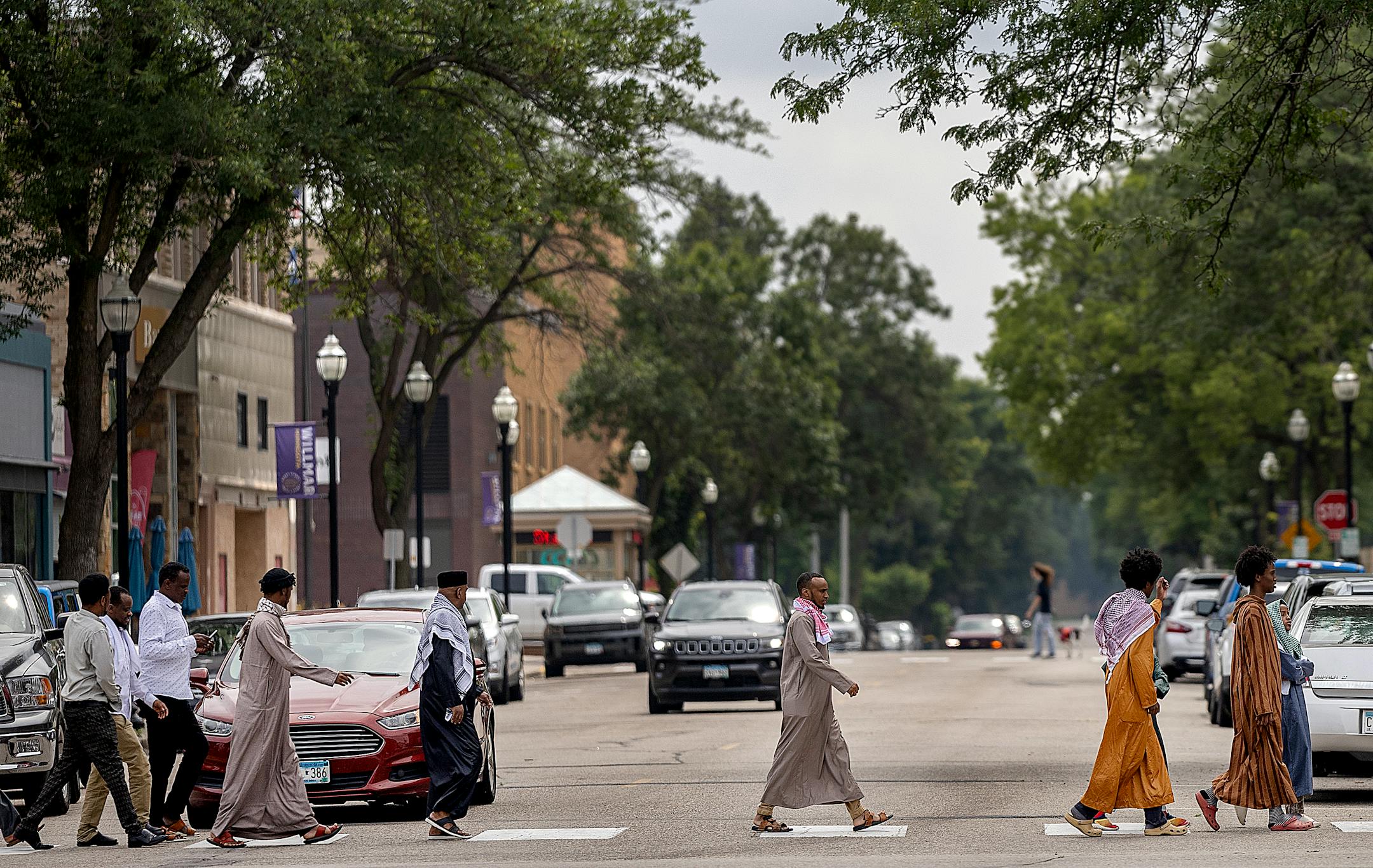
Somali immigrants make their way across the street after prayer in downtown Willmar, Minn., on Aug. 8. (Elizabeth Flores/The Minnesota Star Tribune)

Opinion editor’s note: Strib Voices publishes a mix of material from 8 contributing columnists, along with other commentary online and in print each day. To contribute, click here.

•••

With words such as “garbage” and “contribute nothing,” Donald Trump wrapped around the Somali community like an orange anaconda, each coil a calculated squeeze, leaving little room to breathe, to move or to live free.

In Minnesota, that constriction has been literal: raids, disappearances and intimidation. Our Somali neighbors are being taken from their lives while fear tightens around the rest.

Let’s clearly acknowledge the $8 billion impact of Somali Americans on Minnesota’s economy, and just as clearly remember why they are here. Most Somalis did not arrive in Minnesota randomly or unlawfully. They were admitted as refugees after the collapse of the Somali state in 1991 and the start of a civil war deeply shaped by Cold War geopolitics. The U.S. played a direct role, backing regimes and later withdrawing as the region destabilized. Somalia descended into prolonged conflict, famine and violence, so the U.S. government formally allowed Somali families to resettle under its refugee and asylum commitments.

Somalis arrived carrying war trauma — and then built lives marked by extraordinary resilience. They started businesses, earned degrees, raised families, and have become civically active Minnesotans.

Much has already been written about the cruelty and racism behind Trump’s words. But cruelty is rarely the end goal. Erasure is. And erasure requires a story — one that frames entire communities as disposable, criminal or economically useless. That story collapses the moment facts enter the room.

Economist Bruce Corrie of Concordia University has spent decades studying the economic contributions of people of color and immigrant communities. His recent estimates on Somali Minnesotans’ $8 billion economic impact went viral after a KSTP story cited it, drawing many negative comments from people dismissing the entire Somali community as worthless and Corrie’s research as fake.

Corrie’s response was not emotional. It was empirical.

“This research isn’t about praise or defense,” Corrie told me. “It documents one dimension of contribution — economic participation — and it shows the claim that an entire community has ‘no value’ is factually wrong.”

Using census data and a widely used economic modeling tool (used by state agencies, chambers of commerce and legislators), Corrie calculated that Somali Minnesotans collectively generate over $500 million in household income, pay an estimated $67 million annually in state and local taxes, and contribute roughly $8 billion to the Minnesota economy.

That $8 billion figure is larger than the economies of many Minnesota counties, Corrie noted. It does not mean every dollar is profit, of course. But it does show that Somali labor, consumption and entrepreneurship are woven into the state’s economic fabric.

That reality exists alongside poverty. Nearly 30% of Somali Minnesotans live below the poverty line. But scarcity does not equal absence. Tens of thousands of Somalis work in Minnesota. In fact, at upwards of 70%, they have a higher labor-force participation rate than the general population and most other immigrant groups in Minnesota.

Somalis work as truck drivers, nurses, manufacturing workers and retail staff. They are entrepreneurs, reflected in the small businesses at Karmel Mall in Minneapolis and in countless other small businesses across the state from St. Cloud to Rochester.

These numbers directly contradict Trump’s claim that “These aren’t people that work … These are people that do nothing but complain.”

Corrie added that human value and dignity go far beyond what any spreadsheet can measure and noted that Somalis also contribute through “culture, family, faith, service, creativity and community.”

Fraud is real in the Somali community. It must be prosecuted. But fraud in America cuts across every race, industry and income level. Treating it as an issue only in the Somali community is misleading and adds to the harmful narrative that Somalis should not be in Minnesota or in this country.

I can name a half-dozen white men from Minnesota — Tom Petters, for instance, who ran a $3.65 billion Ponzi scheme that cheated investors, workers and everyday people like us — who have bilked the system or other Minnesotans. Yet somehow, no one ever said that all white men are fraudsters. White people enjoy the privilege of individuality — free to commit crimes without implicating their race — while immigrants and communities of color are condemned for the actions of a few.

Yusra Mohamud, a Somali-Eritrean Minnesotan, entrepreneur and civic leader, noted that Trump’s vitriol toward Somalis and other immigrants isn’t new, recalling his attacks during his first administration, too.

“I’m reminded how often we are expected to show our humanity to people who don’t care,” she told me. “We can be garbage. We can be rotten tomatoes. But at the end of the day, we are here — and that is not going to change.”

Yet even under attack, she sees resilience. “Somali people have so much humanity,” she said. “We love our neighbors.”

Mohamud knows people who have been picked up by ICE and disappeared. She has begun carrying her U.S. passport with her just in case.

Despite Trump’s claims that immigration enforcement targets only dangerous criminals, new data suggests otherwise. Records show that nearly 75,000 people arrested by ICE during his first nine months in office had no criminal record. Data obtained by the University of California, Berkeley’s Deportation Data Project from an internal ICE office through a lawsuit, shows that roughly one-third of the nearly 220,000 ICE arrests between January and October 2025 involved people with no prior convictions.

If ICE removed every brown, Black and yellow person from this country, the economy would collapse. That is not ideology. It is grade school arithmetic.

“I do urge for you to reach out to a business and person in the community to learn more about their story, to connect with them on a human level,” Mohamud said when I asked her how people can be allies to Somalis right now. “It is a moment of crisis for us.”

about the writer

about the writer

Ka Vang

Contributing Columnist

Ka Vang is a contributing columnist for the Minnesota Star Tribune. She focuses on historically marginalized communities.

See Moreicon

More from Contributing Columnists

See More
card image
Elizabeth Flores/The Minnesota Star Tribune

Somali Minnesotans have a higher labor participation rate than the general population. They work as truck drivers, nurses, manufacturing workers and entrepreneurs.

card image
card image