

Leading through unrest: How to talk to distressed employees

Advice from mental health and management experts. Plus: Remembering Doug Ramsey, a giant in the investment industry.

The Minnesota Star Tribune
February 2, 2026 at 12:00PM
A woman holds a candle during a candlelight vigil for Alex Pretti on Nicollet Avenue in Minneapolis on Jan. 28. (Carlos Gonzalez/The Minnesota Star Tribune)

In today’s newsletter: Gunjan Kedia, Andy Cecere, Roland Hernandez, Erica Diehn, Monica Liu, JC Lippold, Marcus Schmit, Craig Johnson, Jess Henrichs, David DeMuth, Andrew Dayton and Stephanie March. With reporting from Patrick Kennedy.

As the University of St. Thomas opens its spring semester this week, a group of undergrads will start a cross-disciplinary honors seminar called Crossing Borders for Work and Love. Associate professors Erica Diehn, who teaches leadership and business management, and Monica Liu, a sociologist whose research includes immigration and globalization, submitted their proposal for the course two years ago. They wanted to explore the career tradeoffs people make when they move to another country. Instead, they’ll start the class asking students how they are feeling during the local immigration crackdown that has resulted in two deaths by federal agents. “We’re writing the script as it’s happening,” Diehn said.

She’s reminding business leaders of that as well. “Be compassionate, be human. We have to acknowledge it’s hard right now and make sure employees know you care, even if you don’t agree.”

I talked to several management and mental health experts last week about how to lead from Minnesota in this tumultuous time when employees may be dealing with all kinds of hardships, fears and disruptions. Of course, the first thing I did when I got leadership coach JC Lippold on the phone was acknowledge my own privilege, away from the front lines. He called me on it. “We tend to minimize our own reactions, saying ‘I’m not on the front line, therefore what I’m experiencing is less than.’ It stops us from moving through what we are feeling.”

Coincidentally, Lippold is currently working with a corporate client on getting comfortable with ambiguity as the company goes through an acquisition. “Humans react to ambiguity much like pain — we want to make it go away. Ambiguity is holding many truths and walking into the future without having all the answers.”

For managers in positions that typically require them to have answers, Lippold suggests speaking to the team in short sentences. “Things feel unsettled.” Or even incomplete phrases. “Today is.”

“Allow that to be the full thought,” Lippold said. “It’s OK not to have all the answers. You need to allow the space for people to say what they’re experiencing and let them know that what they’re experiencing is valid.”

We’re going to be dealing with repercussions for a long time, said Marcus Schmit, executive director of the National Alliance on Mental Illness - Minnesota, who recently penned the Strib commentary, “In Minnesota, grief is a collective task.”
“Flexibility is huge. We need to give employees permission to take breaks,” Schmit told me. “We need to give supervisors grace. This is an opportunity to invite more people and businesses to participate in a conversation about mental health and envisioning what stronger mental health looks like.”

Join me online Tuesday, Feb. 3 at 12:15 p.m. to hear from Strib journalists who are covering the news on the ground. Photographer Richard Tsong-Taatarii and reporters Jeff Day and Sofia Barnett will discuss the stories and images defining this moment in Minnesota, and beyond.

Exec Moves

Gunjan Kedia (Richard Tsong-Taatarii/The Minnesota Star Tribune)

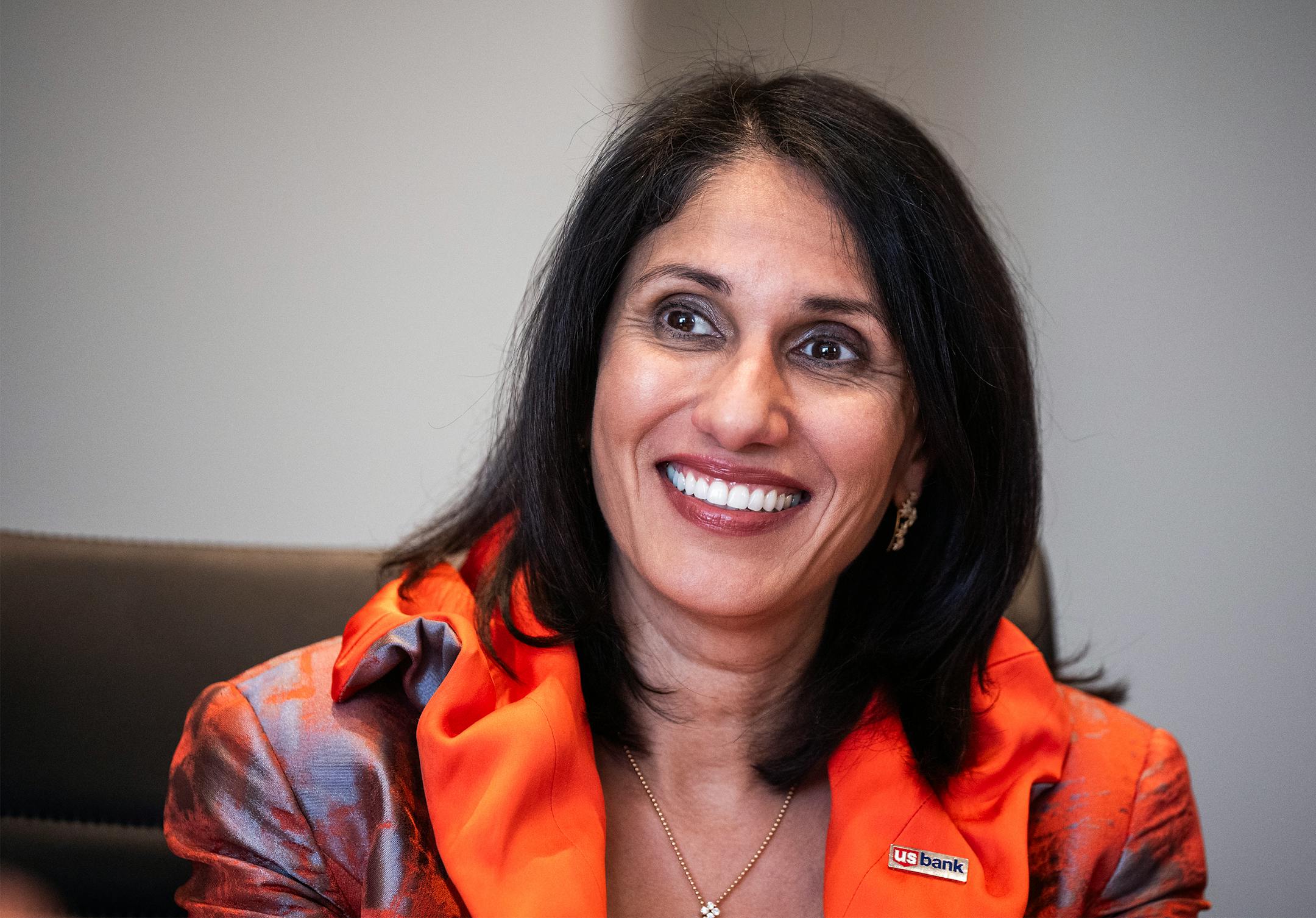
U.S. Bancorp’s Gunjan Kedia will become chair of the board of directors in April, exactly a year after becoming CEO of the bank. She succeeds Andy Cecere, former CEO, who is retiring after more than 40 years in financial services, the bank announced last week. “Gunjan is a remarkable leader who is well-respected by the board, her team and our stakeholders for her strategic acumen, client focus and ability to drive business performance,” Roland Hernandez, the board’s lead independent director, said in a statement. “Most importantly, she understands the company’s culture and leads with a long-term perspective.”

At the Star Tribune’s North Star Summit in October, Kedia spoke about leadership, AI and growth plans. Watch a recording of the CEO panel.

In Memoriam

Doug Ramsey, director of research, The Leuthold Group
Doug Ramsey (Dml - Star Tribune/The Minnesota Star Tribune)

Doug Ramsey, chief investment officer of the Minneapolis-based market research and investment firm the Leuthold Group, died a week ago from a brain aneurysm at age 59.

Ramsey was a literal and figurative giant in his field. Six-foot eight-inch Ramsey was also a co-portfolio manager and, among other things, oversaw the monthly research publication “Perception for the Professional” and the Major Trend Index report for the Leuthold Group, must-reads for investors.

Craig Johnson, the chief market technician for Piper Sandler, knew Ramsey for more than 20 years. Both are CMTs (chartered market technicians) and were members of the CMT Association. “Doug was one of the most respected market technicians in the world,” Johnson said. “Beyond that, everybody knew the very deep and thoughtful work he had done for decades.”

Ramsey was also the public face of the Leuthold Group making numerous media appearances. A frequent participant in the Star Tribune’s annual Investors Roundtable, Ramsey was a market technician and historian who had a gift of making complex investment observations understandable for investors of all levels. Ramsey was also self-deprecating, joking one year that he had predicted zero of the last three bear markets.

Ramsey earned undergraduate degrees in economics and business administration at Coe College in Cedar Rapids, Iowa while playing four years of varsity basketball. He earned a masters degree in Economics from Ohio State and later earned his CFA (chartered financial analyst) and CMT designations. Ramsey joined the Leuthold Group in 2005 and became the company’s chief investment officer when the company’s namesake founder Steve Leuthold retired in 2011. – Patrick Kennedy

In the news

Ameriprise riding high: Ameriprise’s fourth quarter and year-end results exceeded analysts expectations for earnings and revenue. New investments from clients and asset growth drove results to all-time highs with adjusted earnings up 16% in the quarter and 14% for the year to $10.83 and $39.29 a share respectively. The company also announced it was included among the Wall Street Journal’s 250 best-managed companies of 2025 (at 215) and among Time magazine’s top 50 Most Iconic Companies list (no. 48 on the Jan. 8 list which also included local companies Dairy Queen at 17 and Target at 22).

Don’t call it a merger: Minneapolis ad agency Colle McVoy is joining forces with another Stagwell-owned agency, Detroit-based Doner, to form DonerColle Partners. Colle McVoy CEO Jess Henrichs will lead the combined firm as CEO and Doner’s David DeMuth will serve as chairman. No layoffs will result from the partnership. AdWeek reported that DonerColle Partners is positioning itself as a Midwest alternative to coastal agencies. Henrichs said she sees potential to help marketers that are struggling to connect with consumers in a polarized country.

Emergency fundraising: Constellation Fund raised more than $500,000 last week to launch an Immediate Response Fund that will support the organization’s vetted nonprofit partners affected by the ICE surge. Founder and CEO Andrew Dayton said $400,000 has already been distributed for food delivery, child care, emergency rent and small businesses that have lost income.

Restaurant relief: Local food journalist Stephanie March and a collective of restaurant industry advocates just launched the Salt Cure Restaurant Recovery Fund to provide grants to Minnesota restaurants facing economic hardship due to the surge of immigration enforcement operations. The fund is being held at the Minneapolis Foundation and an advisory committee of people in the hospitality industry will review grant applications. “Make no mistake, we are on the verge of losing the soul of our dining scene,” March said. “Restaurants don’t exist without immigrants, and our community doesn’t thrive without these shared tables. We are here to ensure they stay set.”

Get North Star Insider delivered to your inbox twice a week for the inside scoop on Minnesota’s business community. Sign up here.

about the writer

about the writer

Allison Kaplan

Allison Kaplan is Director of Innovation and Engagement for the Minnesota Star Tribune.

See Moreicon

More from North Star Insider

See More
card image
Carlos Gonzalez/The Minnesota Star Tribune

Advice from mental health and management experts. Plus: Remembering Doug Ramsey, a giant in the investment industry.

card image
David Wichmann, CEO of UnitedHealth Group, made a cool $52 million last year as opposed to the previous year's $21.5 million.