Opinion | Our children are traumatized by ICE. Here’s how the Legislature could help.

Building a bright future for Minnesota’s kids requires a commitment to repairing the damage wrought today.

January 28, 2026 at 10:59AM
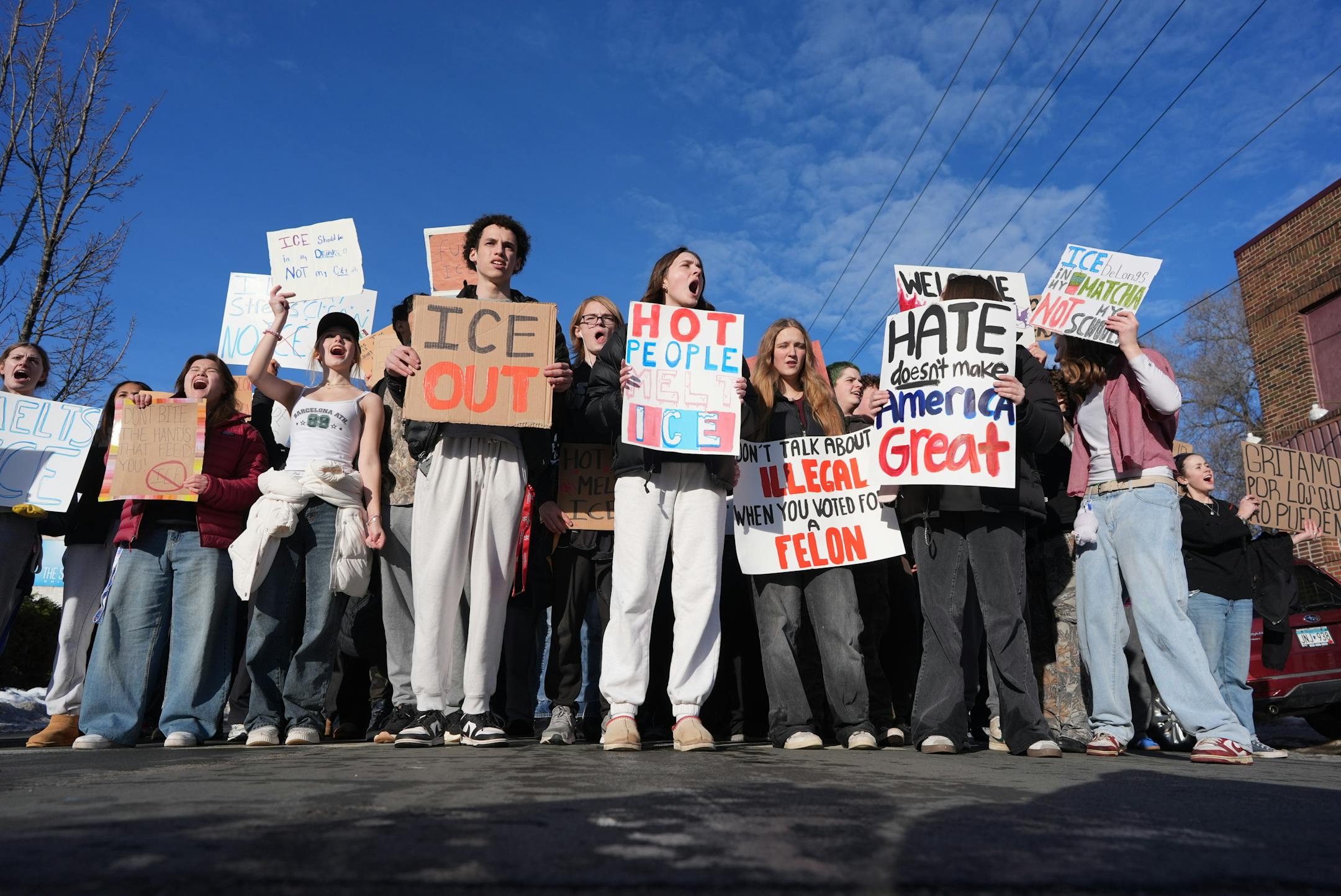
Students from Roosevelt High School walk out of school in a protest against ICE presence in the Twin Cities on Jan.12 in Minneapolis. (Jerry Holt/The Minnesota Star Tribune)

Opinion editor’s note: Strib Voices publishes a mix of guest commentaries online and in print each day. To contribute, click here.

•••

My eyes didn’t deceive me. I knew exactly what was happening when I saw the armed men in black balaclavas and tactical gear emerging from their rented vehicles along Lake Street. I saw them spread out to keep onlookers away. One masked man pepper sprayed a photojournalist who got too close.

What is seared into my memory, though, is a young man’s face as he was grabbed and pushed into a black SUV. His eyes were squeezed tightly shut, and his mouth twisted in fear. He seemed to be crying out, but I don’t know if he was making any noise. The crowd’s whistles and car horns were too loud.

I don’t know where that young man is now. I don’t even know his name and it’s likely I never will. What I know is that he is a young person who — like every young person — deserves to feel safe and have his basic needs met. Instead, he was terrorized publicly on a sunny weekday morning on a busy Minneapolis street while observers could only record his abduction with their mobile phones. No matter where that young man is or where he goes, he will carry that harrowing moment with him; it will be etched on his heart forever.

“Children are like wet cement,” observed child psychologist Haim Ginott. “Whatever falls on them makes an impression.” Every adult who knows a child can attest to this, and children and young people across Minnesota are now witnessing a militarized siege that will make a lifelong impression.

They saw video footage of Renee Good and Alex Pretti being gunned down, and many see federal agents harassing or kidnapping family, friends or neighbors in their communities daily. Some, like 5-year-old Liam Ramos, are taken themselves. This is not to mention the political assassination, school shootings, insurrection, uprisings and global pandemic they also experienced in recent years.

How can any young Minnesotan — whether a victim, a bystander, or simply one aware of what is happening in their community — not be profoundly changed in some way by these calamities? How can they flourish amid overlapping crises? How might these turbulent years impact their entire lives?

Thankfully, these questions already have clear answers.

Though this immigration crackdown is widespread and certainly has few modern precedents, childhood trauma isn’t new. We have robust frameworks and research to help us understand its consequences. Adverse childhood experiences (ACEs), a public health concept that describes harms including community violence, family or caregiver separation and financial uncertainty, can lead to long-term problems like adulthood depression, job insecurity and even heart disease.

Research from Harvard University’s Kennedy School confirm that fatal law enforcement shootings (like Good’s and Pretti’s) have a proven negative academic impact on children. Exposure to this violence leads to decreased GPAs and daily attendance, lower high school graduation and college enrollment rates, and an increased likelihood of emotional disturbance. More recent analyses show similar negative outcomes resulting from immigration crackdowns in Florida and California, and mounting evidence suggests the same is already true here in Minnesota.

These are complex challenges that don’t just resolve themselves, and parents, caregivers and teachers are doing what they can to comfort the children in their lives (while simultaneously processing their own stress and anxiety). They can’t be the only ones responsible for helping young people develop the skills, mindsets and relationships necessary to emerge from this age of trauma unscathed. We all need to start thinking about their future. Time won’t heal all wounds; we need sustained public investment, too.

Admittedly, it’s a steep hill to climb. One obvious strategy would be to increase school-based mental health services, but Minnesota persistently has among the worst school counselor-to-student ratios in the U.S., and federal funding appropriated by Congress to support these activities in Rochester and other cities across Minnesota was terminated by the Trump administration with little warning last year. Major philanthropic funders and corporations once committed to children’s academic and life success, such as the McKnight Foundation and Target, have retreated in recent years.

And yet, as we’ve proven over and over and over again in recent years, Minnesotans can do hard things.

Let’s start by asking young people what they need to move forward. With Minnesota’s Legislature reconvening in February, legislators should invite youth harassed or arrested by federal agents to share their experiences in a safe and non-extractive way. Elected officials across the political spectrum listening with curiosity and responding to what they hear is key to rebuilding the trust that has eroded dramatically in recent years. Despite anticipated shortfalls, a small state surplus is available this year to respond with a feasible but ambitious investment to heal and repair the social, academic and economic harms young Minnesotans are experiencing.

There is precedent here. In 2021, the Legislature recognized that our state’s thriving small business ecosystem would be irrevocably damaged without immediate and flexible resources to help them rebuild after the pandemic and uprisings for racial justice. The Main Street Economic Revitalization Program was administered not by the state but by trusted local intermediaries (including community foundations) to repair physical damage, renovate buildings and provide technical support to entrepreneurs seeking to build back better.

Similarly, a fund based on this model could provide rapid response grants to meet children’s basic needs, increase school-based supports and help catalyze broader community healing work. For example, a school district could make permanent and scale the mutual aid work that has emerged during this federal occupation. A music school could provide ongoing training and coaching to educators about trauma-informed teaching. A local church or mosque could hire facilitators to help the children in their congregation process what is happening together and use their faith as a guide through the fear and uncertainty.

We can’t wait until Operation Metro Surge ends to begin this work. We have to decide today to be good ancestors and to refuse to let these traumas define our children’s lives. Pain or anger can’t be the only driving force here; healing and repair as policy should come from a hopeful place and a deep, unwavering belief that every child — without exception — can and must thrive.

Anil B. Hurkadli is an independent education consultant. He lives in Minneapolis.

about the writer

about the writer

Anil B. Hurkadli

More from Commentaries

See More
card image
card image