Yuen: Teacher helped thousands of Minnesotans who are blind learn how to navigate life

Students who are blind or low-vision found an advocate in Twin Cities orientation and mobility specialist Kelly McCrary.

Columnist Icon
The Minnesota Star Tribune
July 28, 2025 at 11:00AM
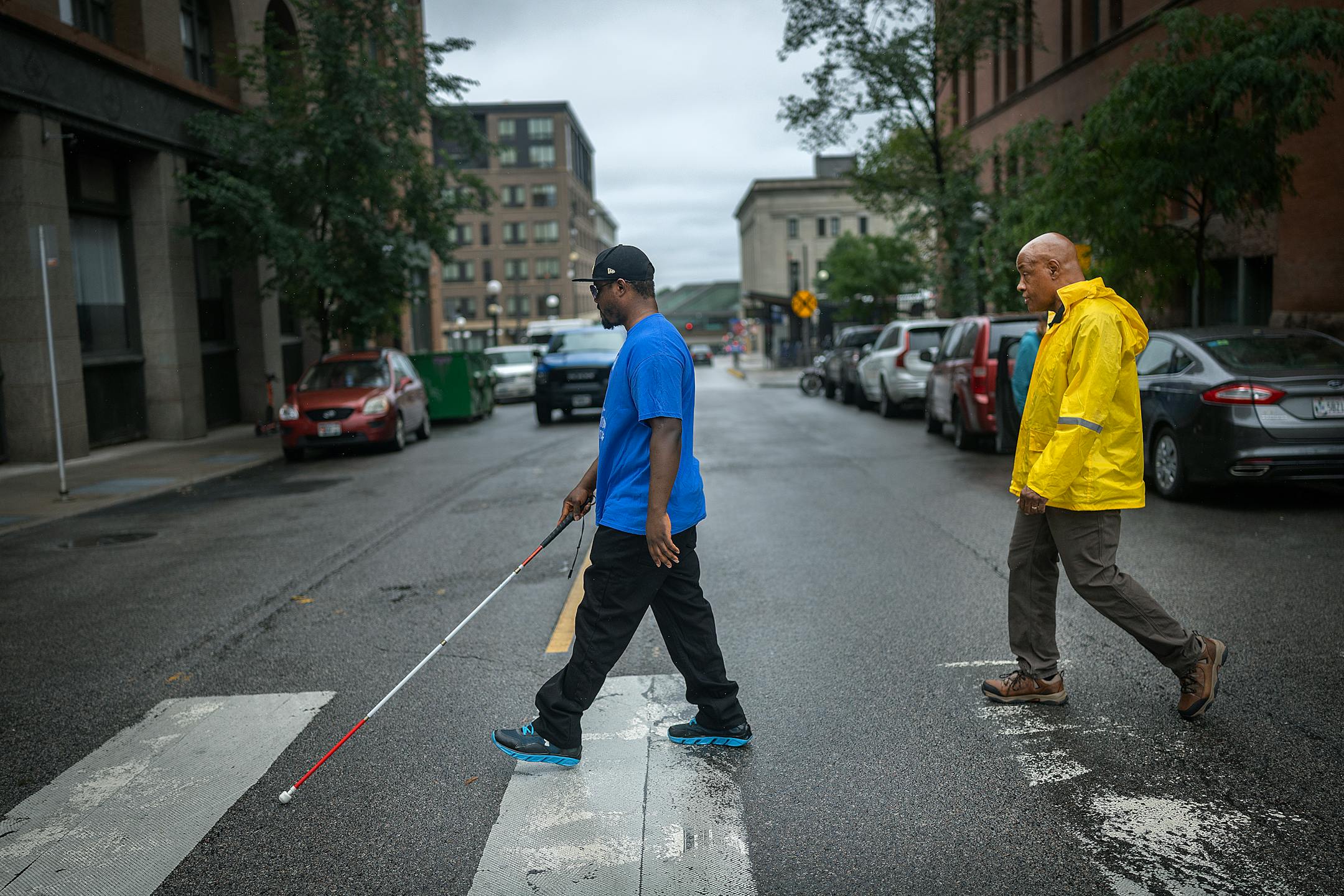
Kelly McCrary, right, follows Julius Momo as he crosses the street in St. Paul. McCrary has taught orientation and mobility skills to Minnesotans who are blind for nearly four decades. (Elizabeth Flores/The Minnesota Star Tribune)

If you were a student of Kelly McCrary, you learned how to climb stairs and board buses, open doors and cross streets, each step a bit closer to a more independent life.

Countless Minnesotans have learned from McCrary how to use the “white cane,” an essential tool that helps people who are blind navigate the day-to-day. They’ve never seen him, but they’ve heard his words. You can do it. You have nothing to be afraid of. I’ll keep you safe.

McCrary has been teaching adults in the Twin Cities who are blind or low-vision how to use the white cane for an astonishing 38 years. In many cases, his students were born sighted but lost their vision, by way of injury or disease. He’s trained them in shopping malls, airports, home-improvement stores, parks and even canoes — any place a student who is blind might want to access.

“Whenever you’re ready,” McCrary tells his student of four months, Julius Momo, on a sidewalk in downtown St. Paul. The lesson begins.

McCrary is a few paces behind Momo. Vehicles whir by. Sweeping his cane in an arc back and forth, Momo cautiously advances along the sidewalk and crosses an intersection and a light-rail platform. He ascends the vast steps of Union Depot and makes his way through the train terminal, bustling with travelers and baby strollers. McCrary is just behind him, offering occasional instructions but mostly allowing Momo to learn from his mistakes.
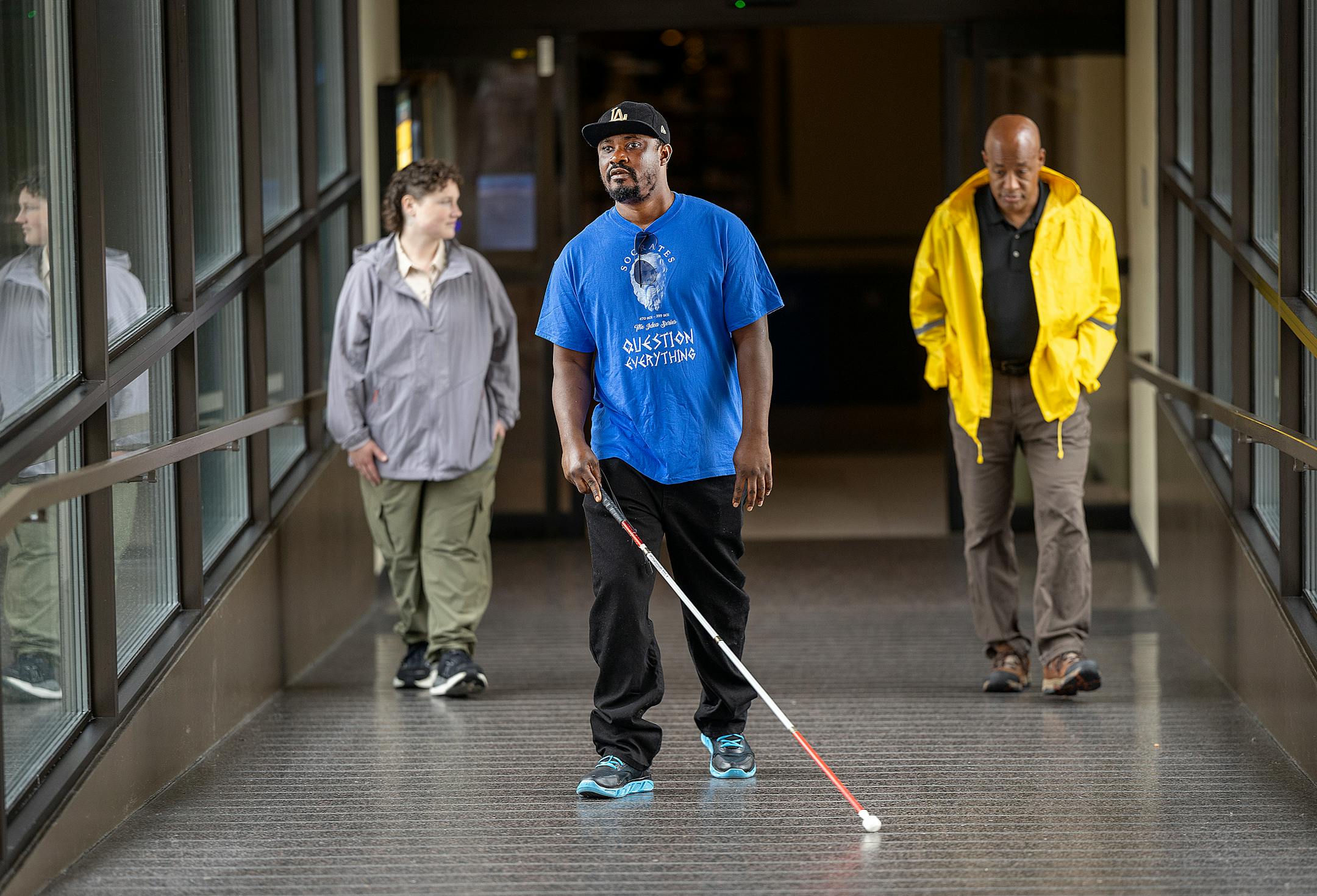
Kelly McCrary, right, and Hailey Bird, left, observe Julius Momo as he navigates the downtown skyway in St. Paul. Bird will replace McCrary as an orientation and mobility specialist at Vision Loss Resources after he retires. (Elizabeth Flores/The Minnesota Star Tribune)

That means McCrary doesn’t say anything just as Momo’s cane taps the foot of a gray-haired woman sitting on a bench. She smiles, unbothered. Nothing terrible happens.

“When I first started, I was really nervous, but he told me, ‘You can do it. You don’t have to be afraid,’” Momo said of his instructor. “He makes me feel safe.”

Years ago, Momo enjoyed freedom and speed; he loved to run and ride motorbikes in his native Liberia. But one morning, he woke up feeling like something was stuck in his eye. He went to wash it out, to no avail. Doctors told him he was developing glaucoma.

Treatment options were scarce. By the time Momo immigrated to the United States and underwent surgery, it was too late to save his vision. He remembers feeling the weight of his despair, and he even considered ending his life. He can only see light and shadows out of his left eye.

“After my surgery, I cried a lot. I felt so lonely, so depressed,” said Momo, now 41 and living in Mounds View. “I felt like the world turned upside down on me.”

McCrary, who estimates he’s worked with roughly 2,000 Minnesotans over his career, said it’s common for his students to struggle with depression after experiencing the trauma of losing their eyesight. He recalls one student reeling from a car crash that affected his vision and motor skills. Frustrated with his new reality, the student threw the cane, shattering it.

“I just stood there and looked at him and said, ‘Now what are you going to do?’” McCrary recalled. “He said, ‘I have to get back.’ I said, ‘Yes. How are you going to do that with your cane broken?’”

Without his cane, the student realized he was lost. He learned to accept his situation and see his cane as a vital tool to identify obstacles, landmarks and other clues along his path.

Julius Momo, who is blind, feels a flower display as he finds his way through the Union Depot in St. Paul. (Elizabeth Flores/The Minnesota Star Tribune)

Most insurance plans do not cover the costs of orientation and mobility, even though learning to use a cane can prevent falls or accidents and may address the root cause of one’s depression. Many of the students McCrary sees are referred to his employer, Little Canada-based Vision Loss Resources, by the government agency State Services for the Blind.

“Orientation and mobility is such a fundamental skill. It’s about your independence. Mobility unlocks so many things,” said Matt Kramer, president of Vision Loss Resources. “Kelly is literally an institution in the blind community with thousands of students over the years.”

But that era is closing, with McCrary retiring at the end of the month. The 62-year-old Bloomington man said he has observed once-timid students grow confidence and pursue pastimes like tandem biking and mountain climbing.

Momo, who is married and the father of a 3-year-old son, says he’s learned that he doesn’t need to give up on life.

The lesson complete, Momo finds his way back to McCrary’s truck parked on the street. While stepping into the vehicle, he accidentally bonks his head on the doorway. McCrary asks if he’s all right.

“I got it,” his student says.

about the writer

about the writer

Laura Yuen

Columnist

Laura Yuen writes opinion and reported pieces exploring culture, communities, who we are, and how we live.

See Moreicon

More from Culture

See More
Lissie
The Minnesota Star Tribune

Highlights from Dec. 25-Jan. 7 include Soul Asylum, the Bad Plus, the New Standards, Cats Under the Stars, Nur-D, Lissie, Karl Denson and a Replacements tribute.