Woman charged with defrauding Minnesota autism program out of $14 million

The U.S. Attorney’s Office said the charges are just the first stemming from a large scheme to bill the state for autism treatment services that were never provided.

The Minnesota Star Tribune
September 25, 2025 at 7:52PM
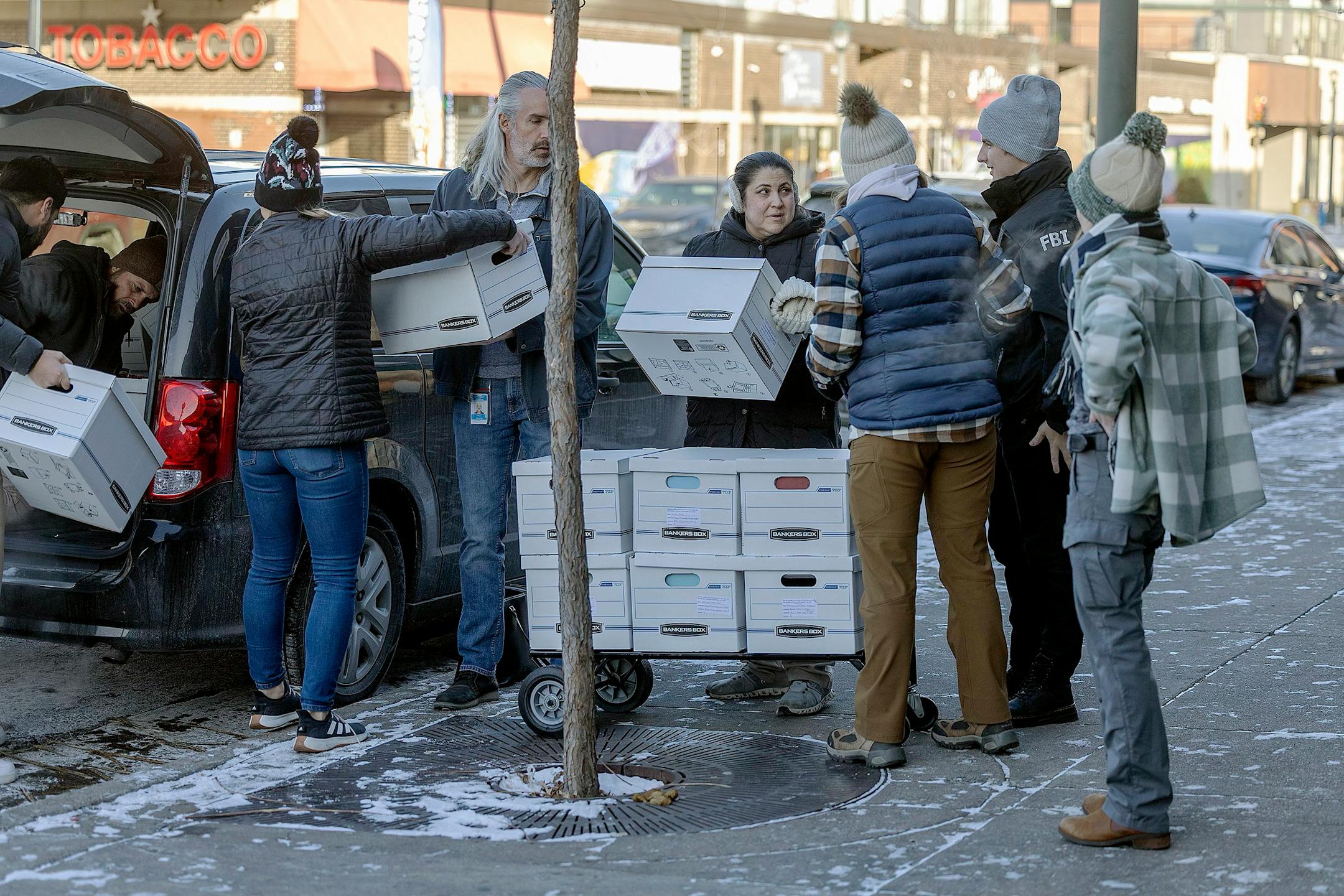
Members of the FBI and investigators with the Minnesota Attorney General's office supervise the removal of boxes and electronic equipment from Smart Therapy Center's business office in Minneapolis on Dec. 12, 2024. (Elizabeth Flores/The Minnesota Star Tribune)

Federal prosecutors allege a woman defrauded a Minnesota program for autism treatment services out of $14 million as part of a sprawling scheme, while simultaneously raking in money as part of the Feeding Our Future food-aid fraud conspiracy.

U.S. District Court filings charging one count of wire fraud against Asha Farhan Hassan, 28, detail what prosecutors contend was a plot to collect millions in fraudulent proceeds through her company, Smart Therapy Center LLC in Minneapolis. Hassan enrolled the company in Minnesota’s Early Intensive Developmental and Behavioral Intervention (EIDBI) program, which is funded by state and federal money to serve people under 21 with autism spectrum disorder.

The U.S. Attorney’s Office referred to Hassan as the first person to face charges in the ongoing investigation into autism providers, the latest health care fraud to prompt federal criminal charges in Minnesota. Last week, the U.S. Attorney’s Office announced charges in connection with another plot to steal hundreds of thousands of taxpayer dollars from a Minnesota housing stability program that prosecutors say was “riddled with fraud.”

Eight people are accused of billing the Housing Stabilization Services program for services that went unprovided. More charges are expected.

“To be clear, this is not an isolated scheme. From Feeding Our Future to Housing Stabilization Services and now Autism Services, these massive fraud schemes form a web that has stolen billions of dollars in taxpayer money,” acting U.S. Attorney Joe Thompson said in a statement. “Each case we bring exposes another strand of this network. The challenge is immense, but our work continues.”

In the autism case, the charge alleges Hassan enrolled Smart Therapy Center in the EIDBI program as well as the federal child nutrition program meant to feed hungry children during the COVID-19 pandemic, under the sponsorship of Feeding Our Future. That nonprofit, according to prosecutors, is at the center of the $250 million food fraud case.

Court filings say from 2019 to late 2024, Hassan and her partners received more than $14 million in reimbursements from the Minnesota Department of Human Services’ EIDBI program and UCare insurance carrier by submitting claims for autism services that often were not provided. Prosecutors said she split the proceeds with her partners and sent hundreds of thousands of dollars abroad, including for real estate in Kenya.

Hassan’s attorney, Ryan Pacyga, said she intends to plead guilty “in the near future. It is her best path forward.”


“Ms. Hassan started businesses with a genuine desire to serve her community. She did real work. But after some time, fraud began to happen,” Pacyga said. “We determined it was best to take responsibility early and work an agreement out with the US attorney’s office. Ms. Hassan is doing what she can to make it right.”

In a statement, DHS said the department opened its investigation into Smart Therapy in August 2024. and stopped payments when law enforcement searched Smart Therapy in December. The DHS Office of Inspector General currently has 84 open cases on autism providers and 24 active payment withholds.

“Increased investigatory oversight from the DHS Office of Inspector General has been and continues to be an essential factor in the discovery of complex fraud schemes,” Commissioner Shireen Gandhi said in a statement. “DHS is taking multiple actions to stop fraud, including stopping payments, designating services as high-risk, bolstering data analytics and establishing licensure.”

In its own statement, UCare said the insurance carrier has multiple ways to detect and be alerted to fraud and suspends payments to providers when it is notified that DHS has stopped payments. The carrier declined to provide discuss specifics about the alleged fraudulent claims by Smart Therapy.

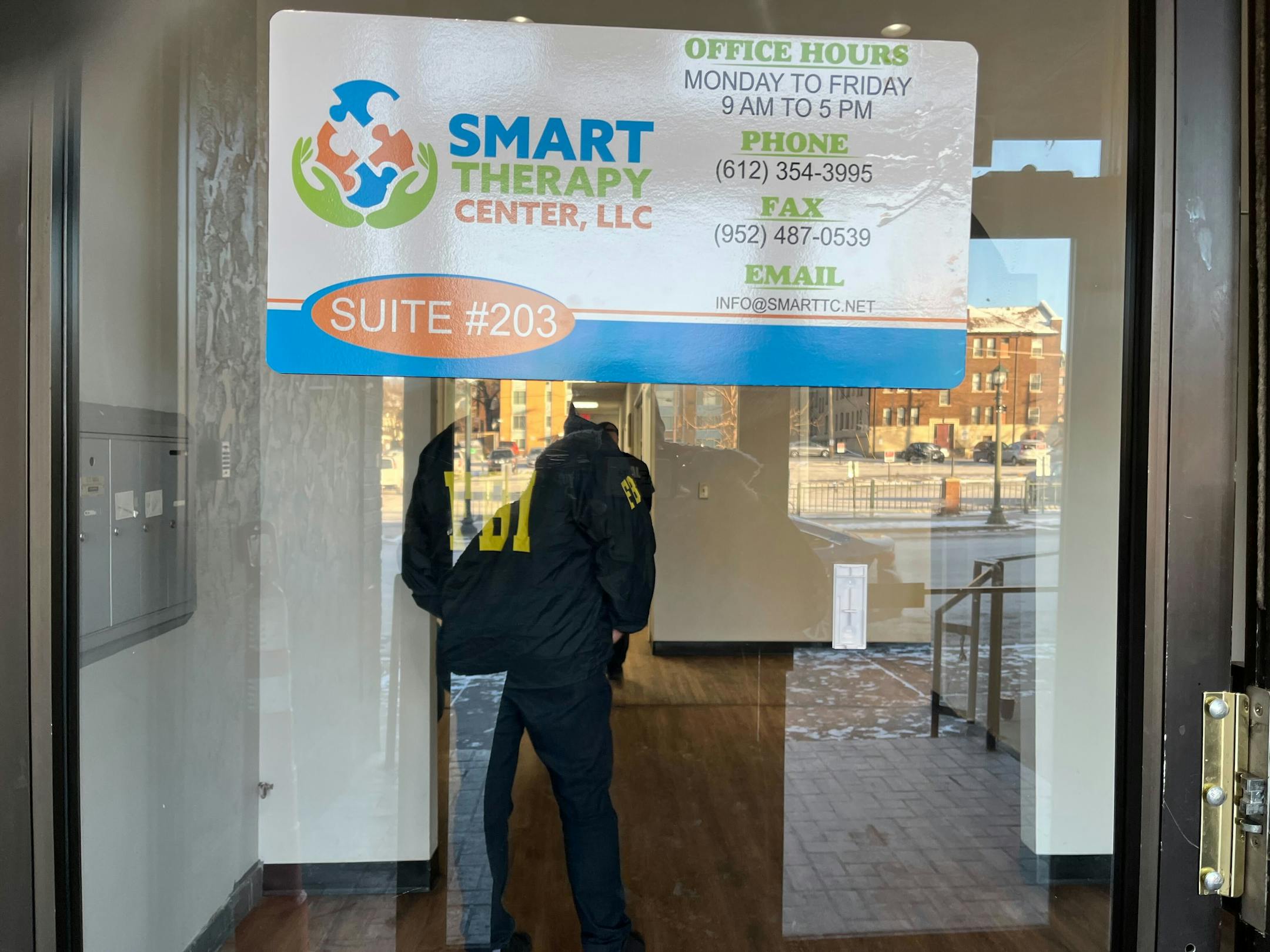
An FBI agent in the lobby of Smart Therapy Center during a search of the facility at 1817 Nicollet Av. in Minneapolis. (Deena Winter/The Minnesota Star Tribune)

The charging document said Hassan and others recruited families in the Somali community to enroll in Smart Therapy, even when their child did not have autism. To ramp up enrollment, Hassan and her partners gave monthly kickback payments to parents ranging from $300 to $1,500 to enroll their children, according to court records.

“There was no child that Smart Therapy was not able to get qualified for autism services,” the indictment said.

Parents often threatened to take their children to other autism centers if they did not receive higher kickbacks from Smart Therapy, the court filing said. Several families ultimately left after being offered larger payments by other centers.

Federal prosecutors said Smart Therapy often employed Hassan’s 18- and 19-year-old relatives as “behavioral technicians” with no formal education beyond high school or training related to autism treatment. The center also billed the state for services rendered by providers who were outside the country at the time or sometimes not on the clinic’s payroll. Transportation services were also billed for drivers who dropped off children in the morning and picked them up in the evening hours. As part of the fraud scheme, the drivers were also on the Smart Therapy payroll, the charges said.

Prosecutors said that within the same time period, Hassan submitted fraudulent reimbursement requests through the federal child nutrition program by claiming the agency served nearly 200,000 meals to children in one year. She requested $465,000 in reimbursements under the sponsorship of Feeding Our Future. The CEO of the nonprofit, Aimee Bock, was convicted in March.

The Feeding Our Future case unearthed connections that led investigators to the autism provider fraud, search warrant affidavits said, which culminated in the federal raid of Smart Therapy Center and another provider last December.

Similar to the state’s housing program, the number of autism providers quickly grew over the years — from 41 in 2018 to 328 in 2023. Spending by Feeding Our Future also dramatically increased, from disbursing $3.4 million in 2019 to nearly $200 million in 2021.

Thompson previously called the fraud cases a “wholesale attack” on Minnesota’s programs that show the state’s system of trust for its social services no longer works.

“These programs have been abused over and over to the point where the fraud has overtaken the legitimate services,” he said.

about the writer

about the writer

Sarah Nelson

Reporter

Sarah Nelson is a reporter for the Minnesota Star Tribune.

See Moreicon