
Law enforcement hopes to obtain devices to catch people driving high

Devices that could determine if someone was impaired by a substance other than alcohol were “highly accurate,” during a pilot, a Public Safety Department spokesman said.

The Minnesota Star Tribune
January 11, 2026 at 10:00PM
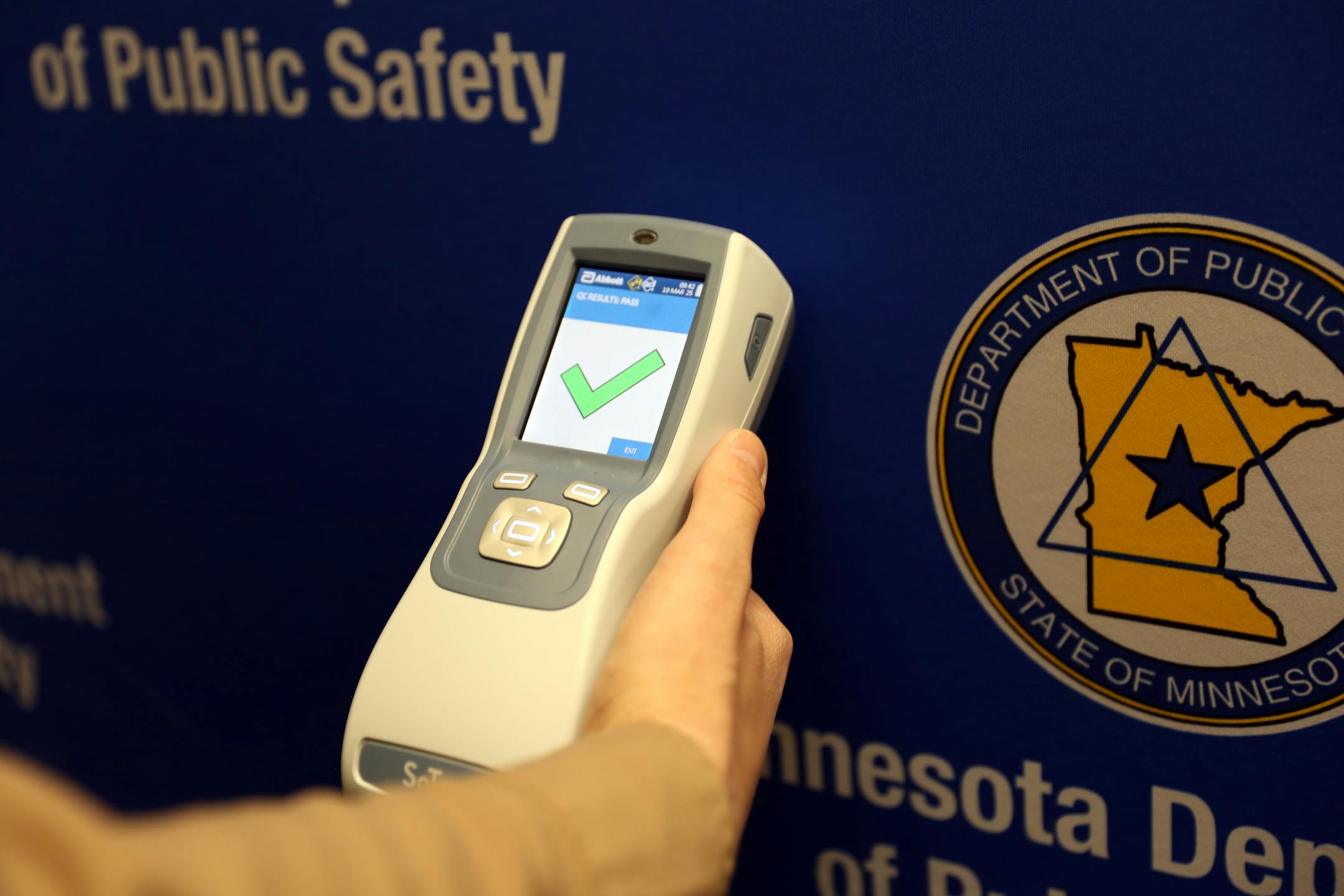
Devices such as this can detect if a motorist is impairied by a substance. (Department of Public Safety)

Public safety officials are hoping this is the year the Minnesota Legislature will give law enforcement permission to employ technology to detect drivers under the influence of cannabis.

They had permission to run a pilot last year and results were promising.

Drivers who were stopped by police for suspected marijuana use were asked to participate in a voluntary oral fluid roadside test. Like with alcohol, motorists who agreed gave a saliva sample that was tested to determine the substance leading to impairment.

“The devices proved highly accurate,” said Mike Hanson, director of the Department of Public Safety’s Office of Traffic Safety. “The instruments worked as expected. We are hopeful policy makers will approve them” in 2026.

With recreational cannabis now legal in Minnesota, impaired driving is a growing problem on state roads. About a third of crashes resulting in a fatality can be attributed to impairment, including alcohol, Hanson said.

Delta 9 is the primary psychoactive compound in cannabis responsible for the “high,” said Sgt. Tyler Milleis, Drug Recognition Expert Program coordinator with the State Patrol. Cannabis can slow or alter perception, coordination and reaction time, according to the Centers for Disease Control and Prevention and the Insurance Information Institute.

But may users don’t think marijuana-impaired driving is as risky as other behaviors such as drunken or distracted driving. Only 1 in 5 cannabis users thought their driving skills deteriorated after using while about under 47% thought they drove the same as when they were sober, findings from the AAA Foundation for Traffic Safey published in March 2025 found.

More than a third of users felt their driving was a little or much better, the study said.

“They don’t see a problem,” Hanson said. “There is this thought that cannabis is legal and you can drive. We need the public to do their research and learn what substances do to the body before [engaging in] risky behavior ”

About half of U.S. adults (51%) say they have tried marijuana, according to the 2023 National Survey on Drug Use and Health.

Currently, there is no foolproof method to determine whether someone is under the influence of marijuana, because the drug can remain detectable in the body for weeks after use. During the pilot, the hand-sized machines were able to distinguish if a driver had recently used pot or had done so weeks ago. And they found 62% of drivers who tested positive were using more than one substance, Milleis said

Minnesota has more than 400 Drug Recognition Experts who can tell when drivers are impaired or high, and even without the devices can build a case based on what they see or smell and by conducting sobriety tests similar to those given to drunken drivers. Law enforcement can also get a warrant for a blood or urine draw, Millis said.

That can take hours. The devices, which can return sample results in minutes, could be a boon for police looking to keep high drivers off the roads.

“Cannabis is legal,” Milleis said. “Just don’t use it and get behind the wheel.”

Take the Baker Street survey

Last summer, St. Paul installed a traffic circle on Baker Street at Waseca Street and bump-outs at Baker Street at Stryker and Hall Avenues. The city also painted bike symbols and arrows to designate shared bicycle and vehicle space.

It was done to demonstrate low-cost traffic calming measures as part of plans to possibly put in a bike boulevard on Baker.

St. Paul wants to know how things have worked. A survey is open until Friday Jan. 16. Responses will be incorporated into the West Side Bicycle Boulevards plan.

about the writer

about the writer

Tim Harlow

Reporter

Tim Harlow covers traffic and transportation issues in the Minneapolis-St. Paul area, and likes to get out of the office, even during rush hour. He also covers the suburbs in northern Hennepin and all of Anoka counties, plus breaking news and weather.

See Moreicon

More from News & Politics

See More
card image
Department of Public Safety

Devices that could determine if someone was impaired by a substance other than alcohol were “highly accurate,” during a pilot, a Public Safety Department spokesman said.

card image
card image