
Immigration attorneys call out dirty conditions, ‘disarray and chaos’ at Whipple detention facility

Attorneys for the Advocates for Human Rights visited the Whipple Federal Building on Monday following a judge’s ruling.

The Minnesota Star Tribune
February 11, 2026 at 3:58AM
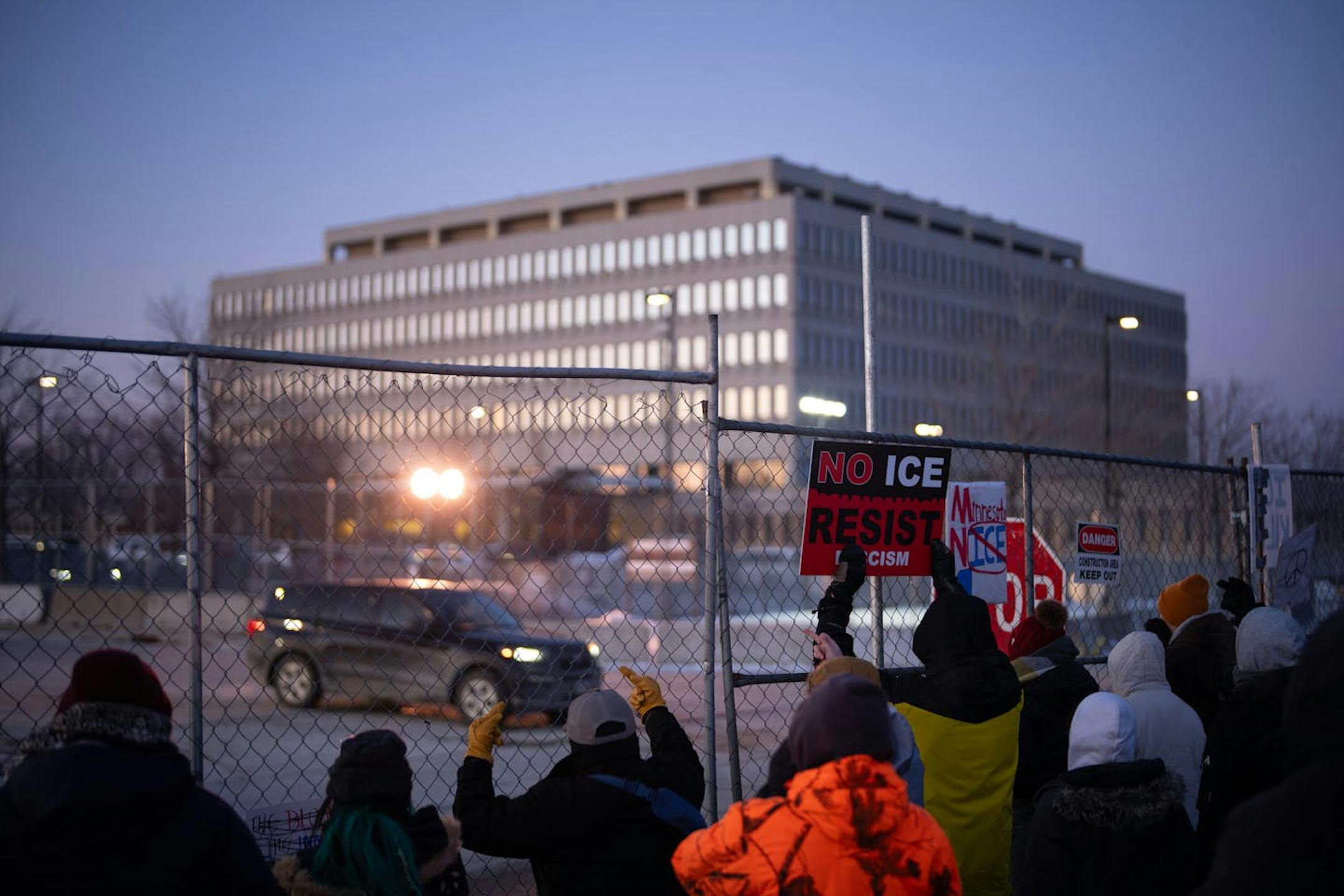
Protesters are blockaded across the street from the Whipple Federal Building on Jan. 25. (Jeff Wheeler/The Minnesota Star Tribune)

Immigration-rights attorneys said they saw “significant disarray and chaos” this week when they inspected the Whipple Federal Building, where hundreds of immigrants have been detained by federal authorities in recent months, according to court documents filed Tuesday, Feb. 10.

Attorneys for Minneapolis nonprofit Advocates for Human Rights visited the Whipple building on Monday and reported that conditions included piles of trash, no bedding with people sleeping on the floor, detainees shackled by the ankle and holding rooms with as many as a dozen or more people.

The Whipple Building near Fort Snelling has been at the center of the Department of Homeland Security’s massive “Operation Metro Surge,” the government’s aggressive immigration crackdown in Minnesota.

There has been a battle over who can access the building. Over the weekend, U.S. District Court Judge Nancy Brasel ordered that attorneys be given full access to the detention facility.

In her court filing, Hanne Sandison, the immigration and legal services director for the Advocates for Human Rights, wrote of phones that could not be used to contact legal service providers, dirty conditions and detainees who had been in custody for almost 24 hours.

In a declaration provided to the court, Sandison wrote she observed as many as a dozen or more detainees in each holding room.

“All detainees I observed were shackled at the ankles, even while sleeping and in the holding cells,” she wrote. “From my observations of several holding cells, I did not see any detainee who had a blanket, pillow, sleeping pad, or cot. I saw men sleeping on the floor with no bedding.”

In an area with semiprivate showers, changing rooms were blocked by junk and appeared to not be available for use, she said.
Sandison also wrote of “significant disarray and chaos, with many [DHS] staff giving us information that clearly contradicted their own prior statements, the conditions we were seeing, and the conversations we had with detainees.”

Sandison said she tested a phone to contact legal services, but the number codes were all out of service. The phones that did work were not private, with federal agents stationed only feet away. While an official said detainees were given a handbook, Sandison said it had limited information and was only in English. She said she never saw the handbook in a holding room or in the possession of any detainees.

Sandison wrote she did not see a garbage can in a holding cell, and there was food waste on the floor, including brown apple cores.

Officials told Sandison that detainees were only held at Whipple for 12 hours, but three detainees she spoke to said they had been there longer – one of them for almost 24 hours.

In her filing to the court, Kimberly Boche, a supervising attorney for the Advocates for Human Rights, said that several detainees she spoke with did not have lawyers and did not know how to contact one.

“Based on what they told me, and my own observations, it did not appear that detainees received clear, timely guidance about contacting counsel immediately after apprehension,” Boche wrote.

She also said a female detainee had slept overnight in her “freezing” holding cell without a blanket because she didn’t know she could ask for one. Boche said she didn’t see any detainee handbooks in the cells but noted piles of trash on the floors with no readily available trash receptacles that she could see.

Both Sandison and Boche said the tour was cut short as the lawyers were told they were “interfering with operations.”

DHS officials didn’t respond to a request for comment about the reports Tuesday night. In an earlier response to questions about the conditions at the Whipple Building, DHS said detainees are provided proper meals, water and medical treatment. DHS said detainees also have access to lawyers.

A federal judge last week temporarily restored Congress members’ ability to inspect ICE detention facilities without appointments after several members were initially blocked during a visit.

In recent weeks, detainees have described overcrowded rooms and being denied basic needs such as food and medical care.

Tim Harlow of the Minnesota Star Tribune contributed to this story.

about the writers

about the writers

Elliot Hughes

Reporter

Elliot Hughes is a general assignment reporter for the Star Tribune.

See Moreicon

Neal Justin

Critic / Reporter

Neal Justin is the pop-culture critic, covering how Minnesotans spend their entertainment time. He also reviews stand-up comedy. Justin previously served as TV and music critic for the paper. He is the co-founder of JCamp, a non-profit program for high-school journalists, and works on many fronts to further diversity in newsrooms.

See Moreicon

More from News & Politics

See More
card image
Alex Kormann

Federal deportation efforts are also unpopular nationally, turning immigration from a political strength to a problem for the president ahead of the midterm elections.

card image
card image