
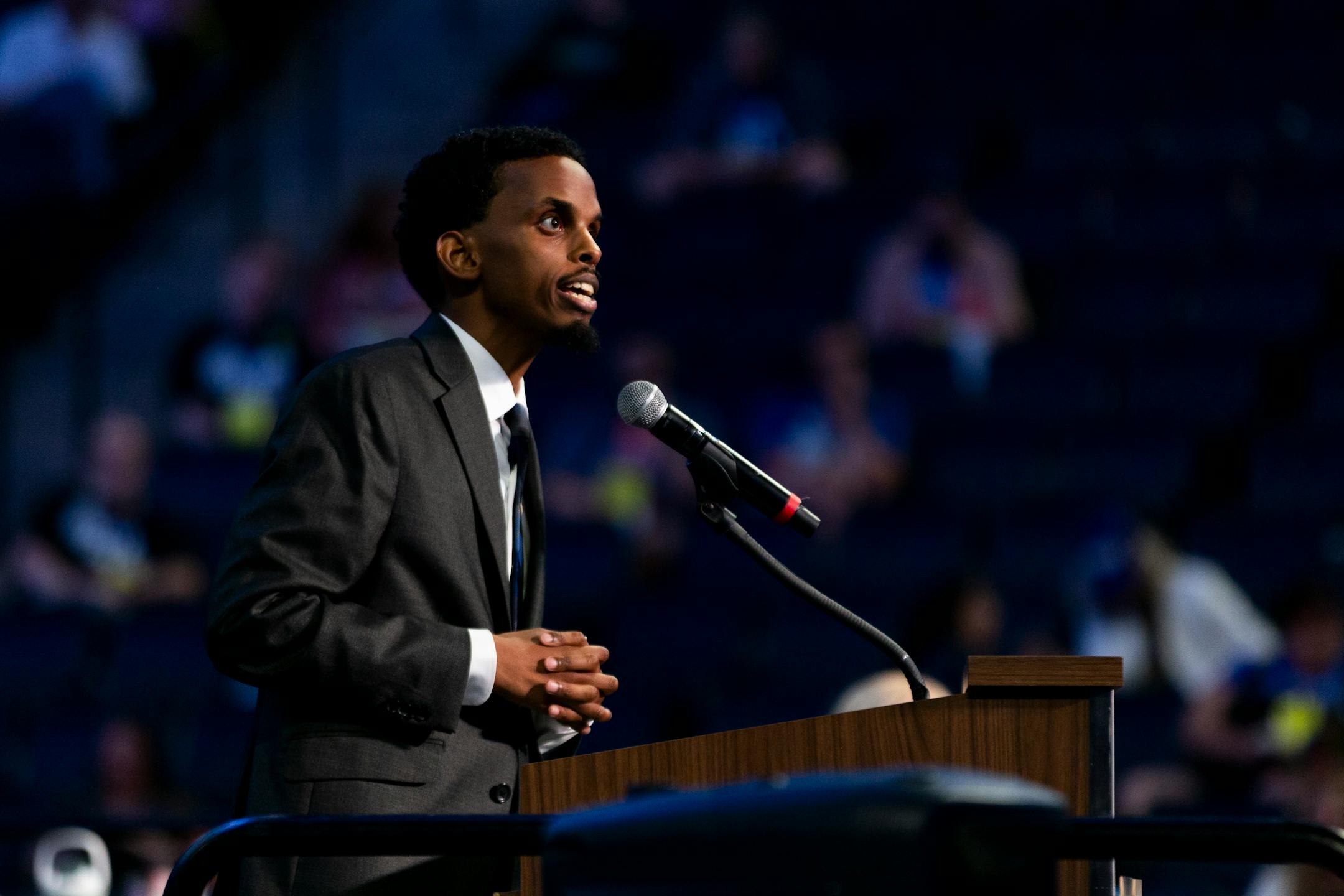
Omar Fateh is aiming to defeat Mpls. Mayor Frey. DFLers outside the city worry they’ll be the losers.

Some moderate DFLers fear the recent endorsement of democratic socialist-backed Fateh will hurt their chances to win races in the suburbs and greater Minnesota.

The Minnesota Star Tribune
July 30, 2025 at 7:21PM
Mayoral candidate Omar Fateh speaks during the Minneapolis DFL convention at Target Center on July 19.
Mayoral candidate Omar Fateh speaks during the Minneapolis DFL convention at Target Center in Minneapolis on Saturday, July 19, 2025. (Rebecca Villagracia/The Minnesota Star Tribune)

If the DFL’s endorsement of Omar Fateh for Minneapolis mayor was an earthquake, Democrats across the state are bracing for the aftershocks.

More moderate party members are concerned that the Minneapolis DFL’s endorsement of the democratic socialist-backed Fateh over incumbent Jacob Frey in July could be a drag on the party’s ability to win races outside the Twin Cities.

“They will be a barrier to winning back those districts,” Ryan Winkler, a Golden Valley DFLer and former House majority leader, said of the Democratic Socialists of America (DSA). “Because their positions on a number of issues are so outside the mainstream that they tarnish a candidate or party who runs with their support.”

Frey’s campaign is challenging the endorsement, but it represents a milestone for the party’s far-left flank after nearly a decade of making electoral and policy gains at the Legislature and in local politics.

“People are hungry for authentic, progressive candidates who proudly stand with working people,” Fateh said in a statement.

While local DSA chapters operate separately from the DFL, there’s some overlap in membership and policy positions. Nationally, DSA priorities include defunding police, supporting Palestine, demilitarizing the U.S. border, establishing universal government-provided health insurance and pushing for aggressive climate action. The Twin Cities chapter is advocating for the replacement of Interstate 94 with a transit-oriented boulevard and the closure of Minneapolis’ garbage incinerator.

In his race against Frey, Fateh is also pushing for rent control, limiting evictions and raising the minimum wage. He once called for the dismantling of the Minneapolis Police Department but has since moderated his position. More than a dozen of his Democratic peers in the Legislature have endorsed his campaign, including several from the suburbs and greater Minnesota.

Fateh has also touted his bipartisan work at the Capitol since being elected in 2020, but state Republicans have already criticized the DFL for embracing “left-wing extremism” by endorsing Fateh’s mayoral bid.

A Fateh win this November could turn off potential DFL voters outside the Twin Cities core in next year’s gubernatorial race and beyond, said David Sturrock, a professor of political science at Southwest Minnesota State University in Marshall.

“I think it helps shape those perceptions of the DFL as being too far left and too far disconnected from everyday things,” Sturrock said. “Clearly in greater Minnesota, that would just be catnip for the voters who’ve already become unhappy with the DFL. And I think it may hurt them in the suburbs.”

Democrats already have an uphill climb to regain power outside of the Twin Cities. On the Iron Range, a former DFL stronghold with a strong labor history, Republicans now hold nearly every legislative seat.

Democrat Lorrie Janatopoulos, a longtime Range resident and retired Minnesota Department of Employment and Economic Development official, framed herself as a moderate when running for a House seat last year. She bucked many in her party, for instance, by supporting controversial copper-nickel mining proposals, saying the metals are necessary for the clean energy economy.

Yet she still lost by more than 12 percentage points. She was attacked as “radical” over gender issues and her supposed opposition to the Second Amendment, which, as a gun owner, she called untrue.

While she doesn’t begrudge the success of DSA-backed candidates in the Twin Cities, she worries that their new prominence could reinforce a growing divide between urban and rural residents.

“It just isn’t greater Minnesota,” she said of the DSA.

The Twin Cities DSA, which did not respond to an interview request, has emerged as a power since Vermont Sen. Bernie Sanders’ run for president in 2016. About a dozen officeholders in the Twin Cities — between the Legislature, the Minneapolis and St. Paul city councils, and a few other local bodies — have been endorsed by the group.

The DSA has had some success outside of the metro in Duluth. Two members of the Duluth City Council, one St. Louis County commissioner and state Sen. Jen McEwen are all backed by the Twin Ports DSA.

Joel Sipress, a founding member of the Twin Ports DSA, credits the organization for generating new energy for liberal politics in the city. About 50 people now attend the organization’s monthly meetings, he said.

“The reason that the Democratic Party is struggling nationwide is that the party and its leaders over time, I think, lost touch with the grassroots,” said Sipress, a former city of Duluth councilor. “For the party to revitalize, the party has to sort of re-energize at the grassroots level.”

Sipress, who also serves as chair of the Duluth-area DFL, said the DSA was able to move into the political mainstream in Duluth by emphasizing “what we want to create as opposed to what we are against.”

So rather than pushing a “defund the police” message, Sipress said the local DSA backed an effort to create crisis response services that operate outside of the Police Department. The group also is pushing for “social housing” to combat affordability issues and is a strong labor advocate.

“There’s always been a strong left progressive politics in Duluth going back many, many decades,” Sipress said. “Since the group’s been founded in 2017, Twin Ports DSA has become like one of the major vehicles for that kind of politics.”

Yet Winkler, the former House majority leader, said the DSA’s more controversial positions are always going to limit its reach, even if he thinks establishment Democrats are too “milquetoast” on economic issues.

The way forward for Democrats, Winkler said, is to elevate populist economic policies and moderate elsewhere.

“We need to be able to sell that to people in small towns and rural areas,” he said.

about the writer

about the writer

Nathaniel Minor

Reporter

Nathaniel Minor is a reporter for the Minnesota Star Tribune.

See Moreicon

More from Politics

See More
card image
Mark Schiefelbein/The Associated Press

A Navy admiral commanding the U.S. military strikes on an alleged drug boat in the Caribbean told lawmakers Thursday that there was no ''kill them all'' order from Defense Secretary Pete Hegseth, but a stark video of the attack left grave questions as Congress scrutinizes the campaign that killed two survivors.

card image