Dabney: Why rescheduling cannabis isn’t enough

It’s a historic shift in tone, but it doesn’t end prohibition.

Columnist Icon
The Minnesota Star Tribune
December 20, 2025 at 10:59AM
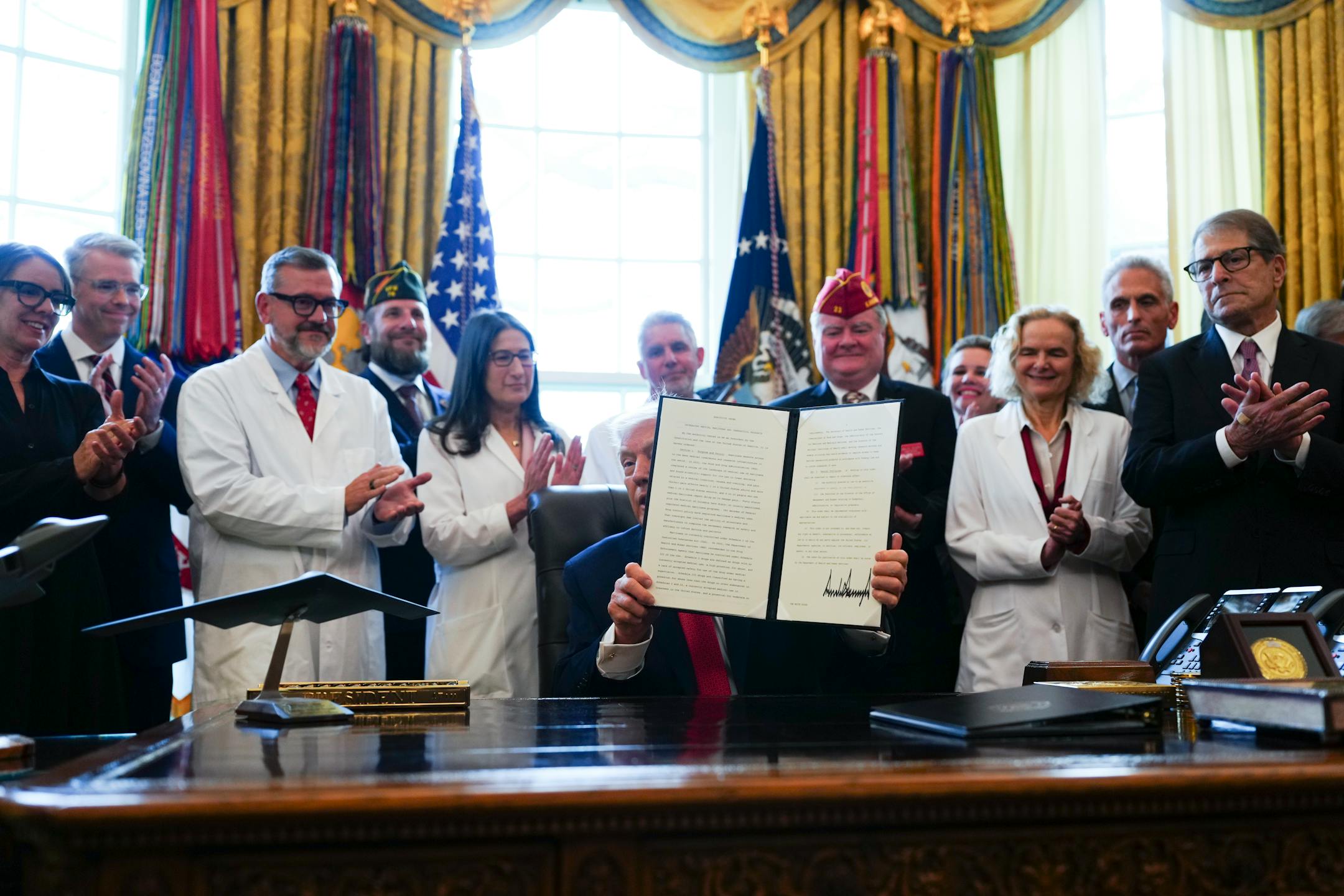
In an Oval Office event, President Donald Trump holds up a signed executive order regarding cannabis on Dec. 18. (TIERNEY L. CROSS/The New York Times)

Opinion editor’s note: Strib Voices publishes a mix of material from 8 contributing columnists, along with other commentary online and in print each day. To contribute, click here.

•••

When they hear that President Donald Trump signed an executive order “rescheduling marijuana,” a lot of Minnesotans might assume the war on weed is basically over. It’s not.

On Thursday, the White House issued an executive order titled “Increasing Medical Marijuana and Cannabidiol Research.” It directs Attorney General Pam Bondi to complete the rulemaking to move marijuana from Schedule I to Schedule III “in the most expeditious manner,” under the Controlled Substances Act’s legal process.

That’s not nothing. In fact, it’s a historic shift in tone from a federal government that has spent decades insisting marijuana has “no accepted medical use.” The order itself cites federal medical findings and acknowledges what millions of patients and clinicians have been saying out loud for years: Cannabis is being used as medicine, and the federal research framework has been lagging reality.

It moves cannabis from Schedule I — the same legal tier as heroin — to Schedule III, alongside drugs like ketamine and Tylenol with codeine. For a plant that 38 states recognize for medical use and that nearly half the country has legalized for adult recreational use, including Minnesota, it’s long overdue.

But if Schedule I was a legal fiction — pretending cannabis had “no accepted medical use” — Schedule III risks becoming a political fiction: the appearance of bold reform without actually ending prohibition.

To see why, you have to understand what this executive action really changes — and what it very intentionally does not.

First, it tries to finish the rescheduling process already underway. The order notes that the Department of Justice issued a proposed rule in May 2024, that it drew tens of thousands of public comments, and that the matter was awaiting an administrative hearing — then tells the attorney general to move it to completion.

Second, the order frames rescheduling as a research and medical-policy problem, not a freedom or civil-rights problem. It leans heavily on chronic pain and the widespread use of medical marijuana across state programs, arguing the federal government has failed to build adequate research infrastructure and clinical guidance.

Third, it reaches beyond marijuana into the chaos of hemp-derived cannabinoids. The order directs White House legislative staff to work with Congress on updating definitions and building a framework for hemp-derived cannabinoid products, including guidance around THC-per-serving concepts, container limits and ratios — aiming to allow access to “appropriate full-spectrum CBD” while restricting products deemed risky.

In other words, the order is trying to thread a needle — medical legitimacy for marijuana, and a tighter federal posture on the hemp-derived THC marketplace that many states (including Minnesota) have relied on as a stepping-stone industry.

If marijuana ultimately lands in Schedule III, it would be a symbolic earthquake. Schedule I has always been the most dishonest classification in American drug policy — a government claim that cannabis has no accepted medical use, despite state medical programs, physician recommendations and decades of patient experience.

It also matters for science and research. Researchers would no longer have to jump through the same extreme hoops that come with Schedule I status, which has slowed serious clinical work for decades. I felt that weight up close while working on my Ph.D. at the University of Minnesota. It was like doing science inside a minimum-security prison. We kept plant material and seeds in a literal bank safe. The grow room had a security keypad; if we punched in the wrong code or were too slow, police were automatically dispatched. DEA auditors showed up to inspect the facility. We were allowed only 40 living plants at a time, and every leaf, gram and seed had to be logged twice — digitally and on paper. Any excess material had to be boxed up and shipped to a DEA-approved facility for incineration.

A shift to Schedule III wouldn’t erase oversight, but it would open the door to more human trials, more FDA-approved cannabis medicines and more real data to guide doctors instead of Reddit threads.

And yes — this is the one cannabis business owners in Minnesota care about most — Schedule III could bring real tax relief. Internal Revenue Code Section 280E blocks ordinary business deductions for businesses “trafficking” in Schedule I or II substances. Right now, because cannabis is in Schedule I, state-licensed businesses can’t take ordinary deductions for rent, payroll, insurance or marketing. Some pay effective tax rates north of 60-70%. If marijuana moves to Schedule III, it means less tax distortion, more stable margins and a better shot at competing with the illicit market.

So that’s all good news. But now for the part that does not make the headlines:

Even as cannabis becomes Schedule III, federal prohibition remains. The Controlled Substances Act still treats marijuana as illegal to manufacture, distribute or possess outside narrow federally authorized channels. Rescheduling changes the category; it does not automatically create a legal adult-use system or erase the federal-state contradiction.

And the executive order itself is explicit that it must be implemented consistent with law, doesn’t create enforceable rights, and depends on appropriations — meaning it’s not a magic wand.

That’s why Schedule III can be both a milestone and a mirage.

It may help licensed businesses and researchers. It may reduce stigma. It may speed the pipeline for FDA-style evidence. But it does far less — sometimes nothing — for the people who were promised legalization meant an end to the petty, life-warping consequences of cannabis enforcement.

Rescheduling doesn’t automatically expunge records. It doesn’t automatically free people serving prison sentences. It doesn’t automatically stop collateral penalties that are tied to federal control, federal benefits and federal discretion.

For non-citizens, cannabis has long been an immigration tripwire where even legal activity under state law can collide with federal rules. For public housing residents, federal policy can still treat cannabis as grounds to deny or terminate assistance. For gun owners, federal law’s “unlawful user” framework can still create risk as long as cannabis remains federally controlled.

Schedule III doesn’t solve those by itself. Congress would have to do that.

So if you make your living in this industry, or if you have a loved one whose health or freedom is tangled up with cannabis, you’re allowed to feel two things at once about Trump’s executive order: relief and frustration. Relief, because moving toward Schedule III could bring better research, better clinical guidance and fairer taxation. Frustration, because after 50 years of failed prohibition, a simple rescheduling decision still refuses to answer the basic question: Why are we criminalizing adults over this plant at all?

Rescheduling is a big headline. It is a historic admission that the old “Reefer Madness” classification was wrong. But if we stop there, the people who benefit most will be those of us with licenses and business plans — not the people who carry old convictions, live in public housing or don’t yet have citizenship.

Schedule III will change some numbers on a chart in Washington and some lines on a tax return in Minnesota. It won’t, by itself, end the war on cannabis.

That’s still our job.

Clemon Dabney is a contributing columnist for the Minnesota Star Tribune focusing on all things cannabis. He is a cannabis expert, scientist and entrepreneur.

about the writer

about the writer

Clemon Dabney

Contributing Columnist

Clemon Dabney is a contributing columnist for the Minnesota Star Tribune focusing on all things cannabis. He is a cannabis expert, scientist and entrepreneur.

See Moreicon

More from Contributing Columnists

See More
card image
card image