
Washington: Will whistles, car alarms or a pickle costume stop ICE?

From Target-ed pressure campaigns to comic relief, Minnesota’s protests reflect distinct strategies that echo lessons from history.

Columnist Icon
The Minnesota Star Tribune
January 24, 2026 at 7:07PM
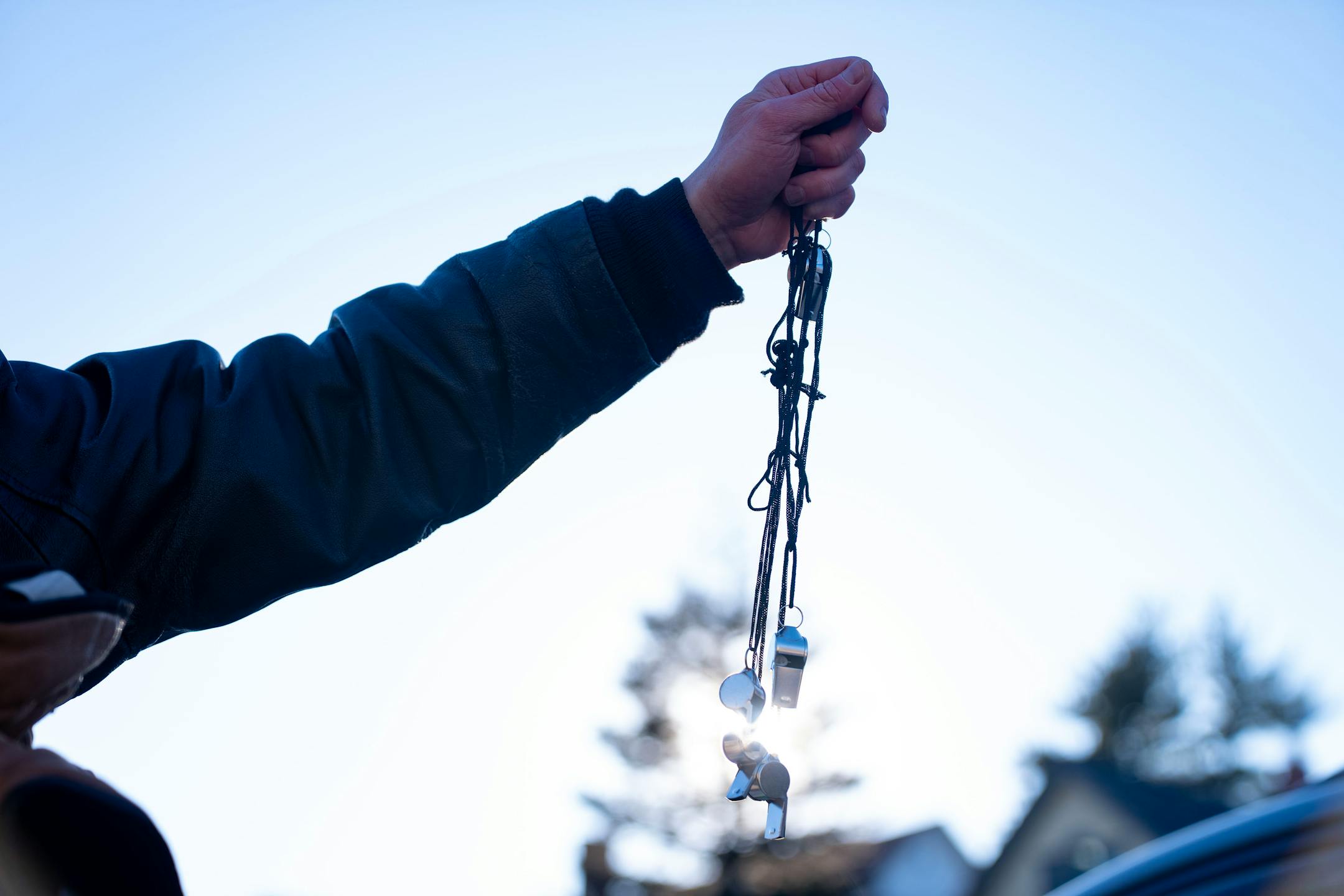
A local resident, who asked not to be named, offers free ICE whistles to cars driving past the memorial site for Renee Good near the intersection of 34th St. and Portland Ave. in Minneapolis on Jan. 14. (Alex Kormann/The Minnesota Star Tribune)

Opinion editor’s note: Strib Voices publishes a mix of material from eight contributing columnists, along with other commentary online and in print each day. To contribute, click here.

•••

Minnesota Star Tribune opinion editor’s note: This article was written and prepared for publication before Saturday’s events in Minneapolis.

•••

Whistles pierce the frigid air as an ICE SUV pulls up at an apartment building. A chorus of car alarms erupts down the block. A man in a pickle costume engages federal officers outside a detention center. And 100 would-be shoppers pushing full-size carts jam a Target return counter, bringing back their single purchase of salt.

Will any of these antics get ICE to leave Minnesota?

“What we see on the streets of Minneapolis right now is thousands of people observing and reporting on the activities of ICE,” said Joel Sipress, a professor of history at the University of Wisconsin-Superior and a former Duluth city councilor. “It’s very clear that nonviolent resistance in Minneapolis is currently very well organized.”

But, he adds, not all those forms of protest have the same goals or level of risk.
“I would make a distinction between what I would call nonviolent resistance activities and nonviolent direct action,” he said.

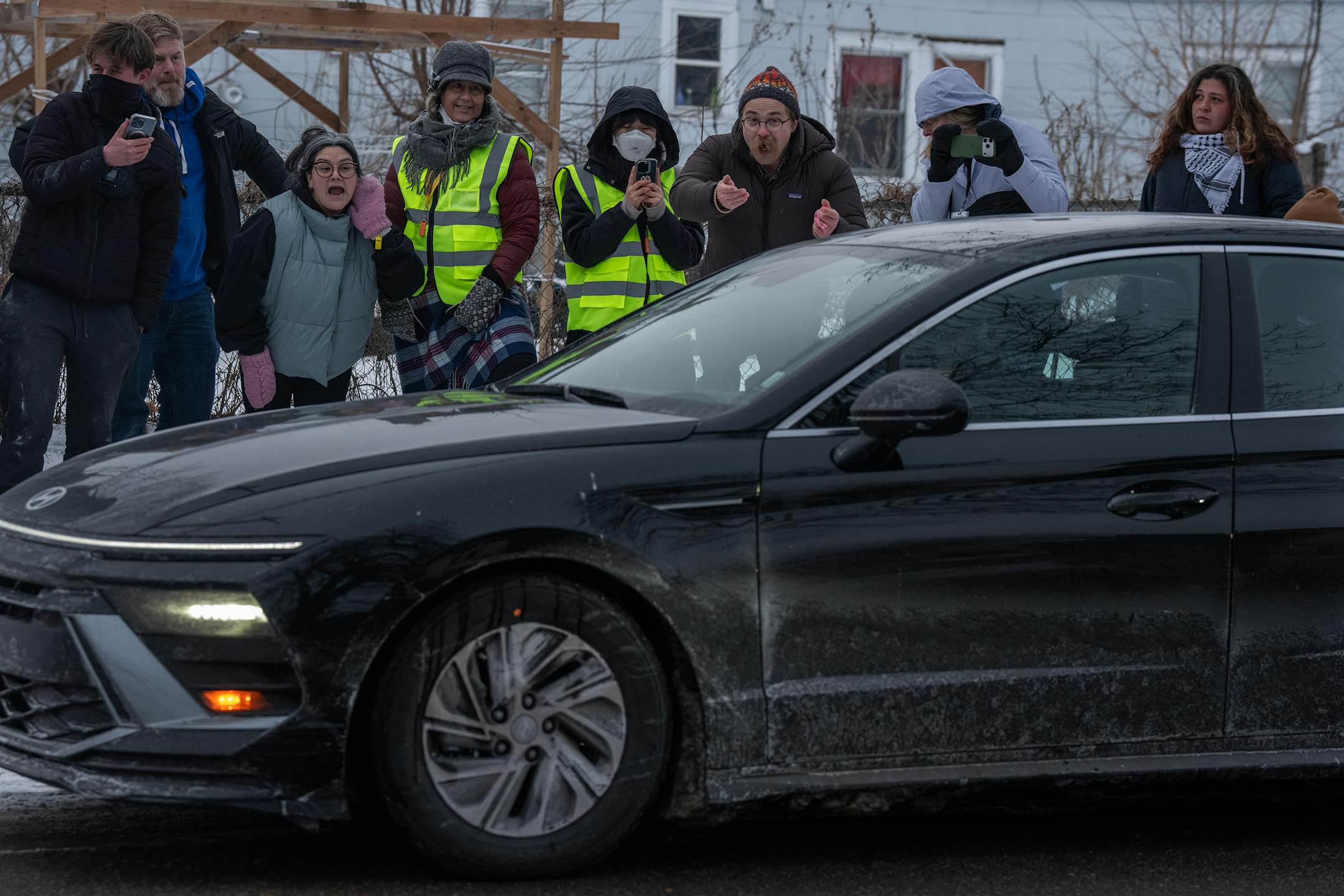
An example of resistance is the whistles, which have been used in Chicago and other cities as a way of warning residents that ICE is in the neighborhood. “The purpose of the whistle is not primarily to distract or prevent ICE from doing what they’re doing,” Sipress said, but as “a neighborhood signal.”

Neighbors blow whistles and confront ICE agents in St. Paul on Jan. 20. (Richard Tsong-Taatarii/The Minnesota Star Tribune)

Setting off car alarms, he said, “is more a form of protest, designed to be a safe and low-risk way of showing your displeasure with ICE activities in your neighborhood.” A video posted to Reddit shows officers appearing confused about how to respond to them.

Although federal agents and their superiors, beginning with President Donald Trump, have shown little appreciation for nuance, the two forms of activism could result in very different outcomes for those engaged in them. Resistance activities can — and have — been interpreted as impeding ICE from doing its work, a claim made about slain anti-ICE protester Renée Good for positioning her car to block a roadway. That action was cited by Vice President JD Vance and others as Good being in part responsible for her own death.

Other protest actions may have a particular aim short of thwarting ICE directly. The Target salt-return campaign — which reminded me of a column in this space last year about highly specific tactics versus unmeasurable boycotts — was undertaken by protesters seeking to pressure the Minnesota-based chain. With Target employees among those detained by federal agents and store parking lots used as staging areas, the goal was to push Target CEO Brian Cornell to take a stand on behalf of those affected within his company.

And then there are protests you can file under comic relief.

“I have been out protesting since August. I started out as an upside-down inflatable frog,” said Rick Johnson of Red Wing — or Pickle Rick, as he is better known today for wearing a bright green, full-body pickle costume inspired by the animated television character.

“My name really is Rick and I already had a Pickle Rick outfit. Also, it supplies some heat and some resistance from the wind. So that’s helpful.”

He is usually stationed outside the Whipple Federal Building, which is the home base for ICE operations in the region and has become a focal point for protests.

Though he made his pickle debut amid heightened tensions not long after Good’s death, Johnson said the costume has had a calming effect — even on some ICE agents.

“Some of them will be flicking us off, some will be waving. I have noticed a few of them chuckling when they see me — those who expose their faces. I’m hoping it has an effect that has them questioning what they’re doing and their impact on the community,” he said, adding that while in costume, he offers to buy a burrito for any agent who agrees to quit the force.

That is unlikely to happen, said Scott Lyons, a retired Duluth police chief who also spent years training law enforcement officers.

“They’re only doing what they’re told to do, and they’re doing it either to keep that job or because there’s an incentive to make more money,” Lyons said.

As with the different forms of protest Sipress describes, authorities also have a variety of ways to practice law enforcement, which Lyons is well acquainted with.

For years, police were trained under a use-of-force model that encouraged officers to respond to resistance with the next highest level of force — a model that would defend ICE agent Jonathan Ross’s decision to shoot at Good for what he perceived was her operating a vehicle as a deadly weapon.

That thinking has largely been replaced by modern training that emphasizes responding with a level of force appropriate to the situation at hand, with a focus on de-escalation whenever possible. This includes talking people down, slowing encounters, and using time and distance to disarm people and reduce the likelihood of violence.

ICE, however, doesn’t appear to have received that memo, Lyons said, or is ignoring it.

“The old ICE that I knew was a good group of agents. They knew what they were doing. They were professional,” he said. “But in the last year or two, in order to bump that agency up, they’ve just destroyed any type of decorum that a federal agency should have.”

Following the rules is not just a matter of good etiquette. It can result in more effective policing, even when large segments of the public oppose the underlying mission. A classic example during the Civil Rights Movement occurred in Albany, Ga., where Police Chief Laurie Pritchett thwarted a campaign led by the Rev. Martin Luther King, Jr. by instructing officers not to beat demonstrators and by securing jail space across a hundred-mile radius. That meant authorities could jail every protester King could mobilize and keep them locked up, without producing the images of brutality elsewhere in the South that outraged the nation.

Similarly, ICE could detain large numbers of undocumented immigrants without resorting to Draconian tactics. But pressure from the top appears to be pushing the agency in the opposite direction, including street detentions based largely on appearance — a practice many people of color say they have experienced firsthand.

Lyons traces that escalation to directives coming from Washington.

“They’ve been given quotas,” he said, pointing to intense pressure from White House adviser Stephen Miller to meet daily detention numbers. “When you do that, people start pushing the edges or going over the rules to meet those numbers, and that’s when constitutional rights get trampled.”

Given that ICE is unlikely to open its toolbox of kinder, gentler policing techniques, will civil disobedience protesters and their nonviolent resistance cousins prevail with their tactics?

Sipress again invokes Civil Rights Movement history, pointing to Birmingham, Ala., where King rebounded from his defeat in Albany. In Birmingham, the response was radically different. Bull Connor’s police unleashed fire hoses and attack dogs on marchers in scenes of shocking brutality.

“When things in Birmingham reached a point where they were truly about to explode, the business leaders of the city intervened and said, ‘We’re going to settle this and we’re going to reach an agreement about how we’re going to move forward on dismantling Jim Crow,’” Sipress said. He noted that the clergy pressing the Target CEO to appeal to the Trump administration from a business perspective are hoping for a similar outcome.

The Civil Rights era also had a willing partner in the White House. The administrations of Presidents John F. Kennedy and Lyndon Johnson intervened to de-escalate tensions and push the country toward racial justice — sympathies Sipress said are nowhere in evidence today.

“I don’t see any indication of that among anyone in the chain of command,” he said.

Which, he said, leaves the present moment as “uncharted territory.”

about the writer

about the writer

Robin Washington

Contributing columnist

Robin Washington is a contributing columnist for the Minnesota Star Tribune. He is passionate about transportation, civil rights, history and northeastern Minnesota. He is a producer-host for Wisconsin Public Radio and splits his time between Duluth and St. Paul. He can be reached at robin@robinwashington.com.

See Moreicon

More from Contributing Columnists

See More
card image
Alex Kormann/The Minnesota Star Tribune

From Target-ed pressure campaigns to comic relief, Minnesota’s protests reflect distinct strategies that echo lessons from history.

card image
card image