Washington: One last Hail Mary idea to save (part of) the Northstar Line

I rode its last train Jan. 4 after the Vikings game and mulled over my idea with passengers and a Metro Transit executive.

Columnist Icon
The Minnesota Star Tribune
January 5, 2026 at 6:43PM
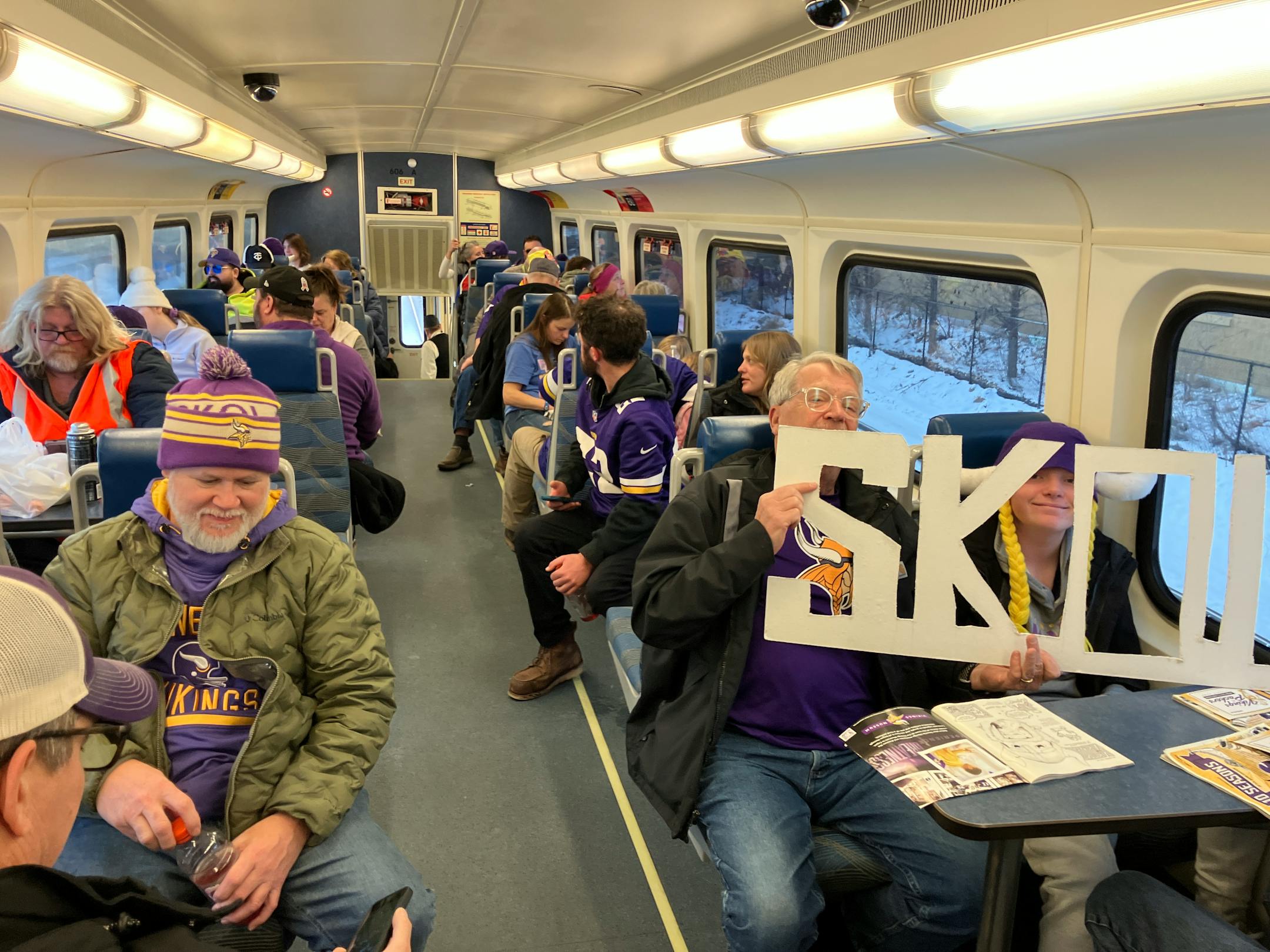
Passengers from the Jan. 4 Vikings game crowd the last car of the Northstar commuter rail train on its final run from Target Field Station to Big Lake. (Robin Washington/The Minnesota Star Tribune)

Opinion editor’s note: Strib Voices publishes a mix of material from eight contributing columnists, along with other commentary online and in print each day. To contribute, click here.

•••

ABOARD THE NORTHSTAR, Target Field to Big Lake — This train is packed.

Or at least our car was. It was the end car, closest to the station entrance, inviting riders to quickly hop aboard rather than walk the length of the platform in 20-degree weather. Metro Transit officials estimated the passenger count on the inbound train headed to the Vikings game earlier in the day Jan. 4 at 375. Logic would dictate a similar number would be returning; how else would they get home?

As of Monday, Jan. 5, not on the Northstar.

“This is the last one? Oh my gosh!” said Alexandra Lotts of Elk River, who knew the line would be shutting down but hadn’t realized she boarded the last train — her first and last time taking it to see her Vikings dispatch the Packers in their season finale.

Lotts said she understood the reasons for the line’s closure. With its weekday ridership at about 60% of gameday levels, it never recovered from a downturn during the pandemic and ran an unsustainable $116 subsidy per rider.

“I get that it’s not used all the time,” Lotts said, but wondered if it couldn’t still operate for major sporting events. “There’s a lot of traffic that comes down here, for sure.”

Shahn Dilks, a season-ticket holder from Elk River, said his family has taken the Northstar to Vikings games ever since the service began in 2009.

“They were always pretty packed,” Dilks said.

Although the trains have stopped running, Metro Transit has promised replacement service via three new bus routes: Route 827 between Fridley and downtown Minneapolis, Route 888 serving Northstar stops in Ramsey, Anoka, Coon Rapids and downtown Minneapolis, and Route 882, running weekdays-only between Big Lake, Elk River and downtown Minneapolis.

The agency’s website is less forthcoming about running buses to future Vikings and Twins games, which Dilks said wouldn’t matter to him anyway.

“Probably won’t take the bus,” he said. “We’ll go back to driving down.”

That means putting more cars on the road, which is what public transit is supposed to alleviate. And if buses can offer “more frequent and flexible” service, as the agency’s website states, it’s reasonable to ask if Metro Transit ever fully utilized buses to serve as feeders to the Northstar to boost ridership.

An opportunity to do exactly that existed at the Northstar’s Fridley Station, just 3½ miles from a major bus hub at the Brooklyn Center Transit Center. An express bus between those stops could have connected riders to downtown Minneapolis in about the same amount of time as the current C Line bus from Brooklyn Center, without the headache of what feels like endless intermediate stops.

And if I’m allowed a postseason Hail Mary to keep a portion of the Northstar alive, couldn’t a shortened version of the line be revived to run from Target Field to Coon Rapids, with Fridley as an intermediate stop? Those stations and parking lots wouldn’t have to be abandoned, and with feeder buses, they would serve much of the same area tapped for the Blue Line light rail extension.

I bring that up because if money is still a worry, it certainly hasn’t stopped the light rail project. With construction still at least two years out, its budget has ballooned from $997 million in 2014 to $2.9 billion today.

I asked Brian Funk, Metro Transit’s chief operating officer, who was on hand to see the final train off, about a Brooklyn Center-to-Fridley bus run.

“I don’t know, honestly, if this particular trip pattern has been evaluated before,” he said, “but it’s one of the things [on which we] can get with the planners and try to see if that’s something that’s viable or worth a test case.”

Melinda and Randy Yule may be a real-life example of that test. They were getting off at Fridley, where they’d parked their car to head home to Brooklyn Park, the next burb over from Brooklyn Center.

Melinda called the shutdown “sad.” They both supported continuing a Vikings/Twins train — though Randy qualified: “There’s still the maintenance of the trains and the tracks. You’ve got to take all these things into consideration for individual events to pay for everything.”

True, but you can make the same argument about stadiums.

As for me, with no return train or bus headed back to the city, I also got off at Fridley. I hailed a Lyft for Brooklyn Center. It was $11 — not feasible for a daily commute — but it only took eight minutes.

Boarding the C Line bus with me for downtown Minneapolis was Trey Riser, who wholeheartedly endorsed a Brooklyn Center-Fridley express bus.

“I actually had a job at Big Lots [in Blaine, bordering Fridley]. And because I would have to travel all the way downtown [from Brooklyn Center], I was late every day and lost my job because of it.”

Let’s hope flexible and frequent works better.

about the writer

about the writer

Robin Washington

Contributing columnist

Robin Washington is a contributing columnist for the Minnesota Star Tribune. He is passionate about transportation, civil rights, history and northeastern Minnesota. He is a producer-host for Wisconsin Public Radio and splits his time between Duluth and St. Paul. He can be reached at robin@robinwashington.com.

See Moreicon

More from Contributing Columnists

See More
card image
Robin Washington/The Minnesota Star Tribune

I rode its last train Jan. 4 after the Vikings game and mulled over my idea with passengers and a Metro Transit executive.

card image
card image