A season of uncertainty: Having weathered 2025 turbulence, a Minnesota farm family braces for 2026

December 28, 2025
The Johnson family in their living room in Kenyon, Minn., on Dec. 10. While Talia, 14, and her mom Meredith unpacked Meredith’s Snow Baby collection, Ellie, 9, steadied herself on her father Ben’s head while she searched for an chocolate ornament to eat from the family Christmas tree. On the right is Frederick, 12.
The Johnson family in their living room in Kenyon, Minn., on Dec. 10. While Talia, 14, and her mom, Meredith, unpacked Meredith’s Snow Baby collection, Ellie, 9, steadied herself on her father, Ben’s, head while she searched for a chocolate ornament to eat from the family Christmas tree. On the right is Frederick, 12. (Glen Stubbe/For the Minnesota Star Tribune)

There’s no end in sight to the instability created by President Donald Trump’s trade policies, and one analysis projects more challenges in the new year.

Columnist Icon
The Minnesota Star Tribune

Opinion editor’s note: This is the final installment of a four-part series of columns about the impact of federal decisions on agriculture, with a focus on one particular Minnesota farm family, the Johnsons. Visit these links to read the first, second and third columns of this series.

•••

KENYON, Minn. — Snow days hit differently for Minnesota farm kids. When drifted-over roads closed Kenyon-Wanamingo schools in mid-December, 14-year-old Talia Johnson didn’t spend the day relaxing. She helped her dad with a vital chore: vaccinating the family’s 7,000 weaner pigs against PRRS, or Porcine Reproductive and Respiratory Syndrome.

The task involves corralling squealing swine, giving injections and marking each immunized animal with blue paint. Talia called a friend for help. The teenagers finished the day with extra cash, and Talia with a colorful paint smudge on her cheek.

“No matter what, the pigs have to be taken care of,” said Talia’s father Ben Johnson, who proudly shared that the hardworking pair vaccinated around 3,000 pigs.

Ben Johnson along with daughters Talia, 14, and Ellie, 9, returned from the pig barns where an unexpected snow day off from school gave them time to vaccinate a few thousand pigs in the morning. Talia greeted the family dog Parker, who was waiting for them.
Ellie Johnson, 9, played with the family dog Parker, in the snow outside their home.
Left, Ben and his daughters, Talia and Ellie, return from the pig barns. The family dog, Parker, was waiting for them. Right, Ellie plays with Parker in the snow in their yard. (Glen Stubbe/For the Minnesota Star Tribune)

That the work must go on despite conditions outside the family’s control sums up the Johnsons’ stoic approach to 2025 — a year they’ll long remember for its uncertainty even in an industry accustomed to sudden changes in fortune due to weather, disease and market prices.

Soon after the January inauguration, President Donald Trump moved aggressively to wield tariffs to reshape U.S. trade policy. The Johnsons reacted with apprehension, knowing that the soybeans, corn and pork they produce are among the nation’s top exports, making them a prime target for retaliatory tariffs.

Now the crops are in, snow blankets their 2,500 acres and the combine harvester is tucked into the machine shed. Winter’s essential work is calculating yields, expenses and revenue, planning for 2026 and, of course, taking care of the pigs.

At their kitchen table this month, Ben and his wife, Meredith Johnson, reflected on the year. They lost money on corn and soybeans but still finished in the black overall, thanks to a diversified income stream and agricultural assistance programs.

From the couple’s perspective, the ongoing trade upheaval didn’t prove catastrophic but it intensified existing agricultural headwinds: increasingly expensive supplies and market prices failing to keep pace with production costs.

Asked whether anything positive has come so far from the trade overhaul, the couple paused. Ben said it’s worthwhile to seek better deals and kick-start domestic manufacturing, but both worry that the trade negotiations were rushed and lacked balancing measures, such as stronger biofuel policies to boost domestic demand for corn and soybeans.

“I don’t know what tariffs have improved for us,” said Ben, who is deeply concerned about the further erosions to the U.S. share of China’s vast soybean market.

“We just put the nail in the coffin. We made it very clear that South America is a more stable market for China to get their soybeans from.”

More trade changes to come

I began interviewing the Johnson family in April as spring planting loomed. As someone who lives in rural Minnesota, I watched with concern as Trump’s tariffs became a reality soon after his inauguration.

During Trump’s first term, a more limited trade war with China resulted in the Asian nation slapping tariffs on most American agricultural products. Soybean exports declined and while they would eventually resume, Brazil accelerated its lead as the world’s leading soybean supplier to China, by far the world’s largest market.

It was easy to see that agriculture would again land in the crosshairs in 2025. My friends, neighbors and much of Minnesota would feel it first. I wanted to bear witness. I am deeply thankful to the Johnson family for opening their lives to that scrutiny and reflection. Their willingness to share the pressures tariffs place on one farm, and by extension a whole state, was an act of courage and public service.

Ben Johnson pulled boxes of Christmas decorations from the crawl space that is part of the basement in their family home in Kenyon.
Kenyon, Minn., Wednesday December 10, 2025 


Glen Stubbe for The Minnesota Star Tribune
Handmade ornaments, including a photo of Ellie from a few years ago, decorate the Johnson Family Christmas tree.
Kenyon, Minn., Wednesday December 10, 2025 


Glen Stubbe for The Minnesota Star Tribune
Left, Ben pulls Christmas decorations from their basement crawl space. Right, handmade ornaments, including a photo of Ellie from a few years ago, decorate the Johnson family's Christmas tree. (Glen Stubbe/For the Minnesota Star Tribune)

Witnessing their year on the farm has felt a lot like being batted around in a pinball machine. Tariffs were raised, lowered or repeatedly delayed. The inconsistent approach resulted in the weighted average U.S. applied tariff rate being 10.8%, according to the Tax Foundation. That’s less than half what Trump initially threatened in April.

Details remain elusive about the deals the administration has touted as settled. Countries have disputed the terms agreed to. China has been slow to resume soybean sales after a trade truce announced in October.

Now the Johnsons are watching as the U.S. Supreme Court weighs Trump’s authority to levy tariffs and can only guess at the fallout if it rules against him. “I don’t think China will all of a sudden be like, ‘Oh well, now we’re going to buy all this stuff,’ ” Meredith said. “The damage has been done.”

Another wild card looms: The U.S.-Mexico-Canada Agreement (USMCA) that went into effect in 2020 is up for review in 2026. Instead of a routine review, Trump is likely to push for additional concessions, warned a recent brief from the bipartisan Center for Strategic and International Studies. Mexico is a large market for American corn and pork, and Canada the leading ethanol export destination.

The Johnsons can’t wait for the situation to stabilize. This is the time of year when they make key decisions about the next growing season: what to plant, how much seed and fertilizer to buy and whether to expand their acreage.

“Do we rent another piece of ground? Do we take a chance?” Ben said.

Outlook dim for soybeans

The wintry calm at the farm belies that this is a busy time of year. The big desk in the living room is where Ben runs the numbers. His preliminary analysis indicated the decision to plant more corn last spring (vs. soybeans targeted in China’s trade move) was a good one.

But it’s complicated.

“Despite strong exports and record total use, the price of corn has dropped $0.48 per bushel from the average price in February, a 10.3% decline,” the National Corn Growers Association reported this fall. “Corn remains competitive in the global market, but the value isn’t making its way back to the farm.”

Other farmers also apparently believe corn will be a better bet than beans for 2026. As he drives through the area, Ben said he’s seeing early applications of the fertilizer corn requires, a decision reflecting worries about the ongoing trade dispute with China.

“I would estimate 25% more corn acres will be planted for ’26 in this area,” Ben said. “Today the return on corn acres looks better than soybean acres for ’26, but it also shows the lack of confidence that we will be shipping record numbers of soybeans.”

Tough 2026 projections

The Johnsons’ official financial reckoning for 2025 took place in mid-December, in the basement office of Farm Bureau Management (FBM) instructor Jeff Schultz. FBM helps farmers track performance, manage risk and make better business decisions. Schultz works out of South Central College in Faribault.

From my perspective, the appointment looked a lot like having your taxes done. Schultz fired up his computer and Ben pulled up a chair to look over his shoulder.

They’ve known each other for years, so family chitchat popped up in between questions about deductions, a traded-in chisel plow and pig barn leases.

Ben Johnson entered South Central College in Faribault, where he met with farm business management expert Jeff Schultz, to go over Ben’s end of the year farm operating numbers.
Farm business management expert Jeff Schultz cracked a joke with Ben Johnson before the two  met to go over Ben’s end of the year farm operating numbers.
Ben took a sip from his morning coffee as farm business management expert Jeff Schultz went over Ben’s end of the year farm operating numbers.
Ben visited South Central College in Faribault, Minn., on Dec. 11 to meet with farm business management expert Jeff Schultz and review the family's end-of-year operating numbers. (Glen Stubbe/For the Minnesota Star Tribune)

As Schultz looked at the Johnson corn yields, which came in around 210 bushels per acre, he sympathized about a crop that looked spectacular in late August, generating hopes of 230 bushels per acre yield, then shriveled in a dry September. “It went from green to brown in 17 days,” Schultz said. “You didn’t do anything wrong.”

At the session’s end, the Johnson farm’s bottom line is calculated with precision and Ben gets an analysis showing whether his costs are out of line with other farmers thanks to the regional data FBM collects. In his review, Schultz praised a longstanding Johnson family trait to control expenses: their willingness to fix combines and other major machinery instead of buying new.

Like any private business, the Johnsons’ financial performance details are proprietary. But Ben shared high-level results. While their operation had a positive net income, it did so despite significant negative margins on the corn and soybeans raised this year.

Many other farmers are facing row crop red ink. Economists at North Dakota State University’s respected Agricultural Risk Policy Center have projected $44 billion in losses for American farmers for 2025-26 crops. Corn and soybean growers account for $30 billion of that $44 billion total.

The Johnsons did get assistance through two federal commodity assistance programs, offsetting crop losses but not negating them.

More aid is likely on the way. Trump administration officials recently announced a $12 billion one-time “bridge” program for “unfair market disruptions,” which is a curious way to refer to its own trade policy. It’s unclear how much the Johnsons will get.

The FBM session underscored the value of the Johnsons’ diversified income. Without the pigs and Meredith’s income and health benefits from teaching and another part-time job, the outlook would be much more daunting.

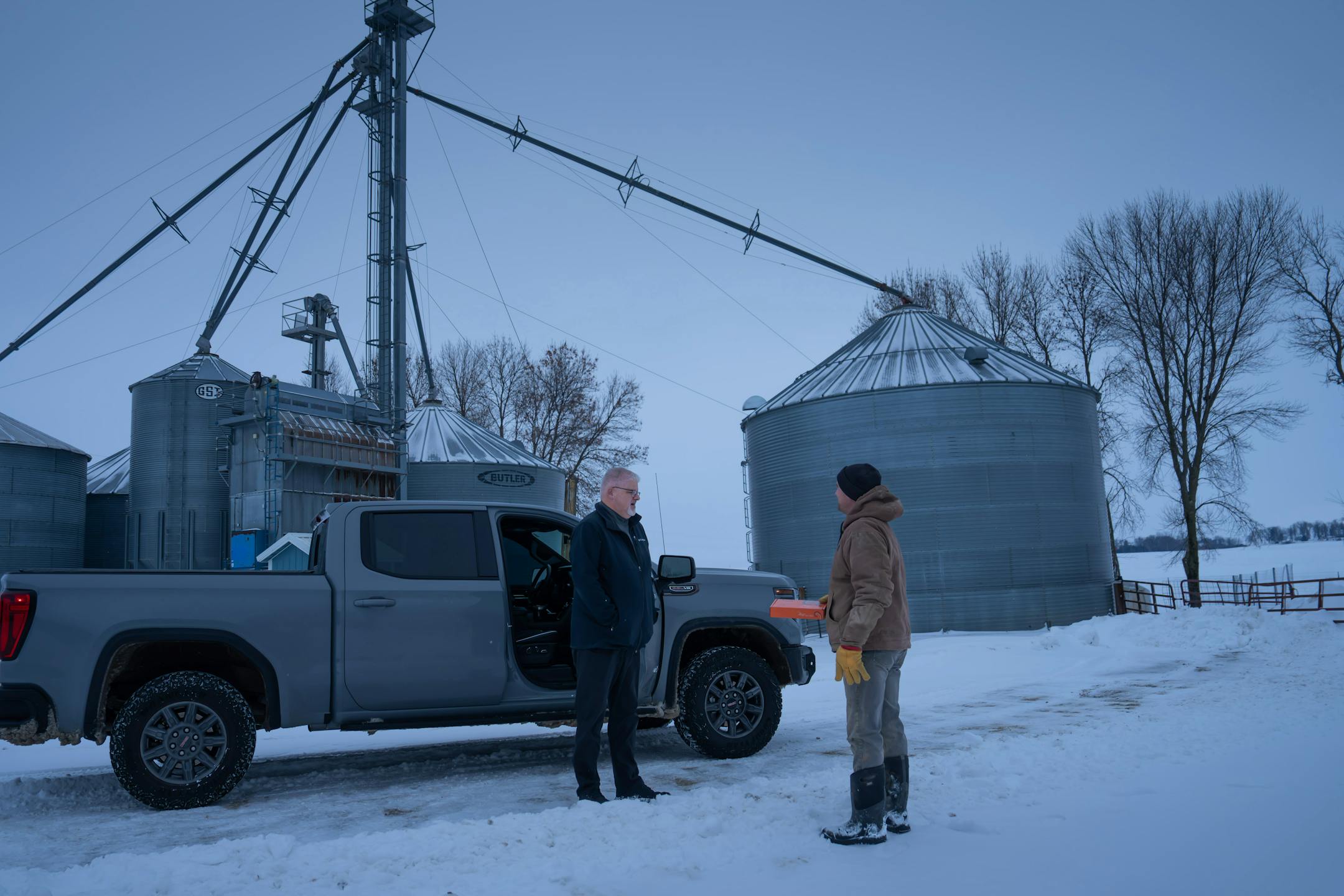
Ben's community banker, Kevin Kruger of Security State Bank, dropped off a Christmas present for the family to thank them for their business. (Glen Stubbe/For the Minnesota Star Tribune)

Ben also left Schultz’s office with projections for 2026. The FBM analysis shows things will only get more challenging. It projects steady price increases for key supplies such as seed, fertilizer and crop chemicals.

“Tariffs have increased the costs of many agricultural inputs ... including steel, equipment and parts, as well as insecticides, herbicides, and inputs used for fertilizer production,” according to EconoFact, a nonpartisan publication.

In turn, that pushes already-out-of-reach break-even market prices even higher for the crops the Johnsons will raise in 2026.

Frustration over farm aid

The FBM analysis didn’t surface any surprises. Still, the crop losses are hard. For peace of mind, Meredith focuses on the long term and sometimes takes a break from reviewing their financials, trusting Ben to handle it.

“He knows this business. And he worries enough for both of us,” she said.

While 2025 proved to be manageable for the Johnsons, trouble looms when losses happen repeatedly. They had a run of good crop years in 2021, 2022 and 2023. But returns have steadily eroded since then, adding to the urgency to stabilize export markets.

“By ’28, we better hope for some turnaround here,” Ben said.

At the kitchen table, a question about the new federal “bridge” relief program touches a nerve. The couple is aware of longstanding criticism about federal aid for farmers.

They don’t like taking aid. But as Meredith has emphasized in our conversations, farmers lack the ability of other businesses to pass on tariff costs by raising prices.

Ben is frustrated by presidential rhetoric about how easy it would be to win a trade war. If that were the case, then the aid wouldn’t be necessary.

“It’s being offered because we got into this situation,” Ben said, noting that the assistance isn’t a permanent fix and shouldn’t be. “It’s a bridge to what, and because of what? A bridge is supposed to lead somewhere.”

The couple is appreciative of congressional representatives like Sen. Amy Klobuchar, who championed legislation to undo Canadian tariffs and has called out the dubious authority Trump has relied on to levy tariffs. The Johnsons want others in Congress to act as a check on the executive, particularly on trade.

“The president has so much power here. Why are you letting that happen?” Ben said.

The Johnsons knew 2025 would be turbulent. They head into 2026 even more uncertain whether their labors will be rewarded or if the president’s ambitious but disruptive trade policy will again exacerbate farming’s already substantial risks.

Like Talia on a snow day, they’ll adapt and work through circumstances beyond their control. They love what they do and stopping isn’t an option, even when this season of uncertainty shows no sign of ending.

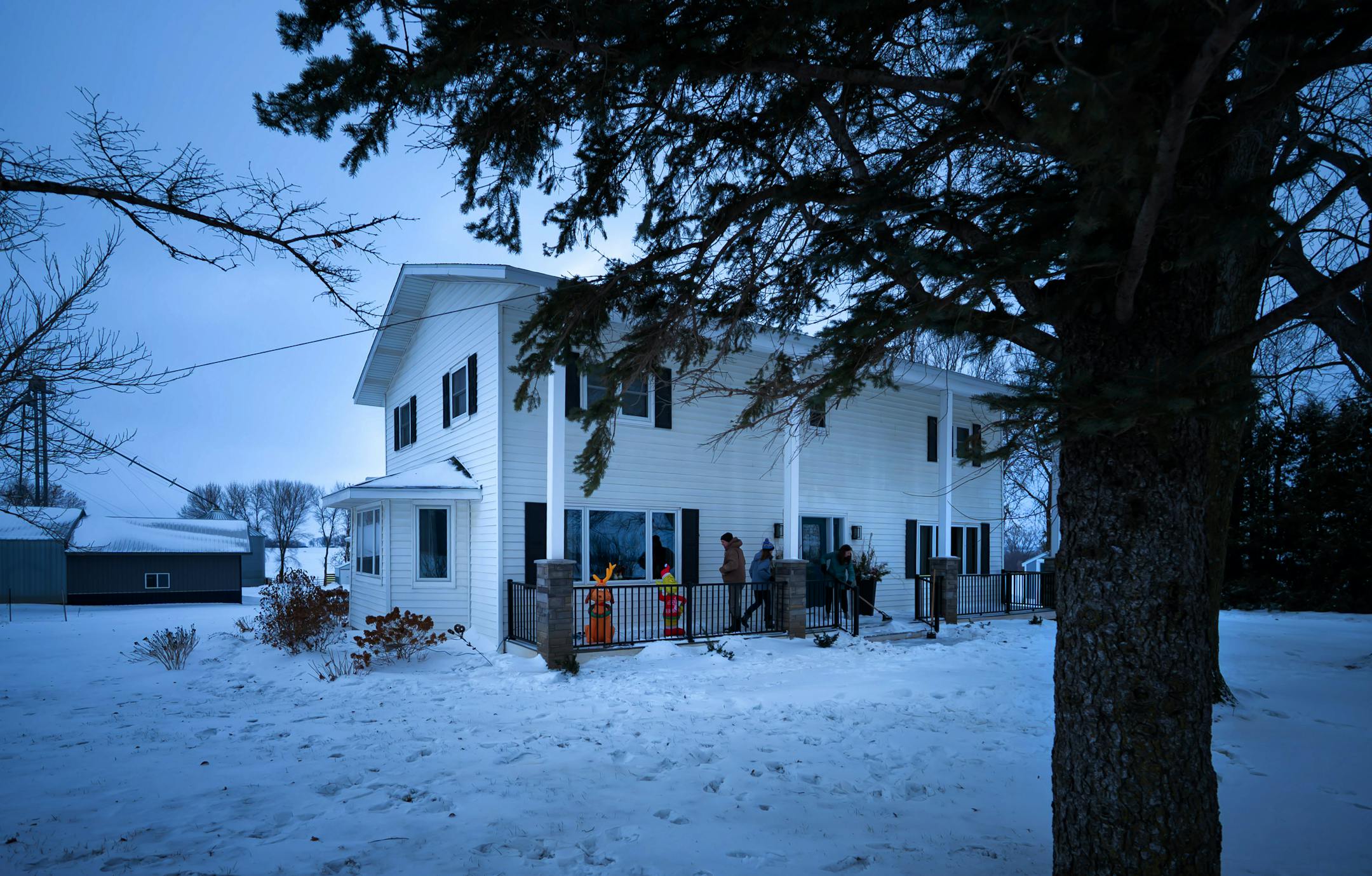
Ben Johnson and his daughter Talia, 14 installed the family’s new Christmas decorations, an inflatible Grinch and his dog Max, that Talia won in a family gift exchange last year, while Ben’s wife Merideth scraped ice from the front of their house.
Kenyon, Minn., Wednesday December 10, 2025 


Glen Stubbe for The Minnesota Star Tribune
The Johnson family's home. (Glen Stubbe/For the Minnesota Star Tribune)
about the writer

about the writer

Jill Burcum

Editorial Columnist

See Moreicon

More from Columnists

See More
The Johnson family in their living room in Kenyon, Minn., on Dec. 10. While Talia, 14, and her mom Meredith unpacked Meredith’s Snow Baby collection, Ellie, 9, steadied herself on her father Ben’s head while she searched for an chocolate ornament to eat from the family Christmas tree. On the right is Frederick, 12.
Glen Stubbe/For the Minnesota Star Tribune

There’s no end in sight to the instability created by President Donald Trump’s trade policies, and one analysis projects more challenges in the new year.

card image
card image