A season of uncertainty: Minnesota pork caught in Trump’s trade war crosshairs

September 7, 2025
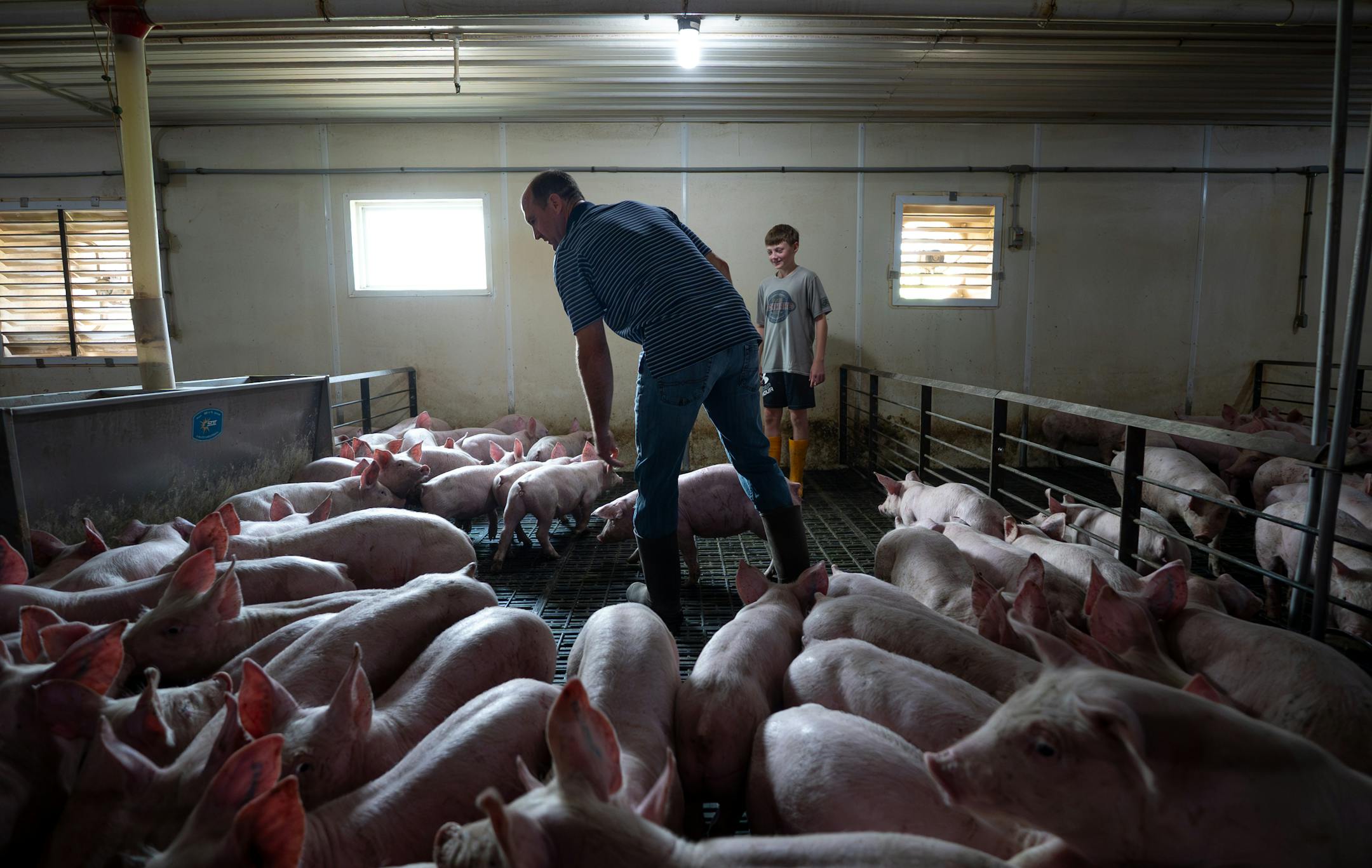
Ben Johnson and his son, Frederick, check on the pigs in one of his barns. The Johnsons, who raise 7,000 pigs at a time, are closely watching the pork market as tariffs ripple through the agricultural sector. (Glen Stubbe/For the Minnesota Star Tribune)

Could pork, one of the state’s top exports, see key overseas markets shift to foreign competitors? That’s what happened to soybeans after the U.S. and China clashed during Trump’s first term.

Columnist Icon
The Minnesota Star Tribune

Opinion editor’s note: This is the second in a four-part series of columns about the impact of federal decisions on agriculture, with a focus on one particular Minnesota farm family, the Johnsons. Future installments are anticipated during the harvest and at the year’s end. Read the first installment here.

•••

KENYON, Minn. — Ben Johnson knows the moment he sets foot inside his family’s pig “nursery” in the morning whether chores will go easy or hard.

Ben’s workday revolves around his caretaking responsibilities at two barns housing 7,000 young pigs. The animals arrive by truck when they’re around 21 days old, weighing between 12 and 14 pounds. When they leave in a matter of weeks and head to a finishing facility, they’ll weigh an average of 55 pounds, before reaching a market weight of 285 pounds.

Their stay at the Johnson farm is a critical stop in that journey. Here, they’re kept warm and safe at this vulnerable stage, with temperature, feed and water controlled by a phone app. The sounds they make on Ben’s arrival speak volumes. Healthy pigs are noisy and on the move. Sick ones are quiet. “A good day is when you slam the door closed and hear them running around, bumping into the walls and gates. They’re active, feeling good, they’re curious, they’re paying attention,” he said.

Today, all is well as Ben and his son, Frederick, 12, climb into the dozens of pens that run the length of the main 102-by-142-foot barn, checking equipment and each resident’s health. Even the situation in the “hospital pen” is promising, with a porcine patient admitted for lameness recovering nicely.
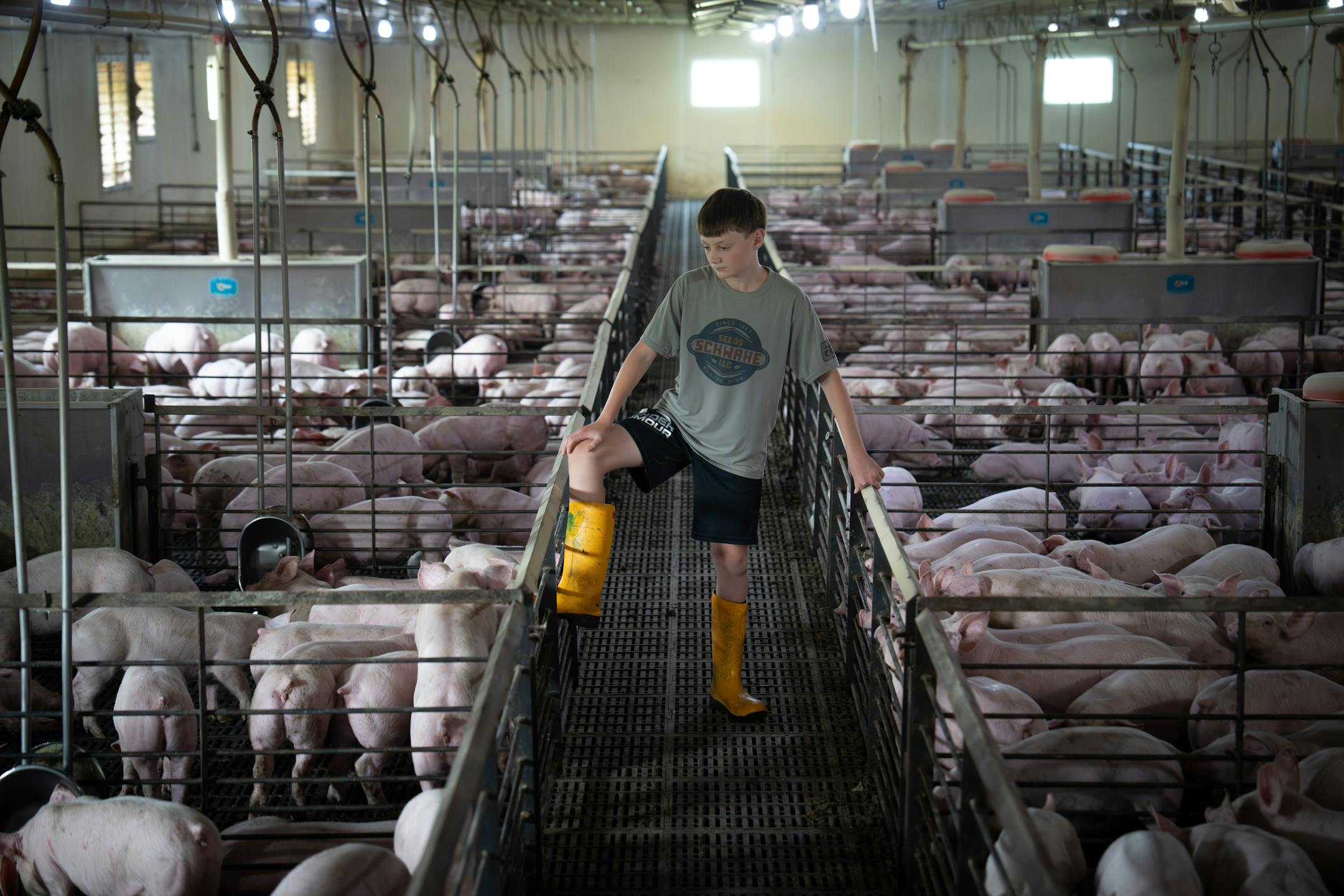
Frederick checks on the pigs in one of his dad’s barns. These pigs each weigh around 45 pounds and eat two pounds of feed each day. (Glen Stubbe/For the Minnesota Star Tribune)

Clean, modern and large facilities like this make Minnesota an agricultural powerhouse and pork a vital component in the state’s economic engine. Minnesota is the fourth-largest agricultural exporting state. It ranks second nationally in hog production and second in pork exports. That success is why the state has so much riding on the outcome of President Donald Trump’s breathtakingly ambitious effort to use a big controversial stick — tariffs — to renegotiate trade deals with most of the world.

While a federal appeals court ruling declared many of the president’s tariffs illegal on Aug. 29, Trump isn’t likely to back away from his signature policy and has other options to pursue it. These include appealing to a U.S. Supreme Court with an expansive view of presidential authority. Or asking the Republican-controlled Congress to authorize the import taxes Trump seeks.


A trade spat with China was Trump’s marquee trade move during his first term in office. In his second term, he’s levied or threatened additional tariffs on not just one of the Midwest agriculture’s biggest customers but virtually all of them. Leading U.S. pork export markets by value in 2024: Mexico, China, Japan, South Korea, Canada and Colombia.

The trade maneuvers could pay off in stronger markets for American products. But it’s important to be clear about potential downsides and what products could be tempting targets.

Other countries can raise tariffs, too. They can also find other suppliers, as China did with soybeans after the 2018-2019 trade conflict. China has already signaled that pork is in its crosshairs in the latest trade conflict with the United States. It canceled a 12,000 metric ton pork order earlier this year and at one point, hiked total effective tariffs on the meat to triple digits, though another 90-day truce is now in place.

While the Trump administration appears to have made some progress — such as deals announced with Japan and the EU — the agreements remain frameworks, with insufficient details publicly available. The federal court ruling, which leaves current tariffs in place through October, has made things even more unpredictable. That’s the last thing the Johnsons need.

Ben and Meredith Johnson sit down for a lunch of ham sandwiches with their children, Talia, 14, Frederick, 12, and Ellie, 9. (Glen Stubbe/For the Minnesota Star Tribune)

The corn sown this spring on their farm is a lush green and least 12 feet high after a summer of well-timed rainfall and warmth. Meredith Johnson, a teacher, and the couples’ three kids are back at Kenyon-Wanamingo schools after summer break. Yet Ben and Meredith still have far more questions than answers about the markets for what they produce, the cost of inputs and how they should adjust their business plan for 2026 and beyond.

“We do not have any clarity as to how this is gonna work,” Ben said when I interviewed the family in late August at the Minnesota Star Tribune’s State Fair stage. Answers are urgent “because we’re gonna be making plans for next year in a couple of weeks.”

The Johnsons are featured in my ongoing series “A season of uncertainty” about the sweeping trade changes. The mission: to better understand this historic overhaul’s stakes and impact here. The first installment focused on spring planting on the 2,500 acres the family farms in Kenyon, located in Goodhue County, where they mainly raise corn and soybeans. Their pig nursery is a vital part of their livelihood, too.

Pork economics hopeful, for now

Livestock has been a bright spot for farmers in a grim period marked by stubbornly low crop prices. The 2024 Minnesota Farm Finances Annual Report notes “the lowest net farm income for farms this century.” In late August, Beth Ford, CEO of Twin Cities-based Land O’Lakes, warned of a “gathering storm” for American agriculture and noted that “farm bankruptcies have roughly doubled” year over year.

But 2024 was generally a good one for livestock producers and a “welcome recovery year for Minnesota hog farms,” the state report notes, adding that this year “looks like another profitable one for Minnesota hog producers.”

Left, Ben Johnson walks past the vents on one of the pig barns. Right, one of the pigs.

That prediction comes with caution and a list of potential disruptions, such as diseases that conscientious farmers like the Johnsons can guard against with biosecurity. When I visited their barn, I had to shower in the entry and change into coveralls and boots provided by their contractor, Wakefield Pork.

But another significant risk the report lists is one that the Johnsons understand all too well that they have little control over: “international trade issues.”

Lessons from trade wars past

Soybeans offer a sobering example of how trade conflicts can have lasting unintentional consequences even after initial tensions resolve. On Aug. 20, the American Soybean Association (ASA) sounded a dire alarm about the market shift that followed the 2018-2019 trade conflict with just one country: China, by far the world’s leading soybean importer.

While Brazil overtook the U.S. as the world’s leading soybean exporter in 2013, the South American country’s advantage widened after the end of the last decade. Before the 2018-2019 conflict, there was near parity between Brazil and the U.S., according to ASA data.

But in response to that trade conflict, China imposed retaliatory tariffs of 25% on American soybeans and its buyers pivoted sharply toward Brazil. The South American country responded by expanding acreage and export infrastructure. By 2024, Brazil dominated Chinese soybean imports — with 71% coming from Brazil vs. 21% from the United States.

Soybeans represent a worst-case scenario for long-term trade conflict damage. But other agricultural sectors are vulnerable to market restructuring and other impacts, such as higher input costs or disrupted supply chains.

Chad Hart, an agricultural economics professor at Iowa State University, considers pork one of the “more sensitive” sectors to trade war fallout, with cotton and soybeans topping his list of “most sensitive.”

A key reason for Hart’s concern about these products: the substantial gap between what the U.S. produces and what is consumed domestically. In 2024, the nation consumed 21.7 billion pounds of pork, exporting 7.1 billion pounds.

“That tells you that pork for us is definitely a global commodity. That we depend on selling pork to the rest of the globe to help balance our market out,” Hart said.

In 2024, U.S. pork exports topped $8.63 billion in value. The nation is neck-and-neck with the European Union as one of world’s top pork exporters.

One of the Johnsons' pig barns. (Glen Stubbe/For the Minnesota Star Tribune)

A shift by China or other buyers to non-U.S. suppliers could pose significant challenges for the industry. Mexico was by far the United States’ leading customer for pork by value in 2024, but China is second, according to a pork industry analysis. China is also the leading market for “pork variety meats,” the polite name for feet, organs and other parts that have more limited consumer appeal. In 2024, variety meats accounted for 20% of total U.S. pork exports.

Fortunately, the U.S. pork export market appears to have rebounded from the triple-digit tariffs exchanged by the Trump administration and China earlier this spring, a situation that temporarily cratered American pork exports to the Asian nation.

For now, China continues to tariff most American pork at 57%, a high number but one that nevertheless represents a welcome de-escalation. U.S. pork exports have rebounded since then, according to the U.S. Meat Export Federation (USMEF), but are still “down 4% from last year’s record pace.”

Randy Spronk is a well-known pork producer and entrepreneur based in Edgerton, Minn., and a previous USMEF chair. The Minnesota Pork Producers Association referred me to him for comment. Spronk is confident that efforts to renegotiate trade agreements will benefit pork producers and pointed to pork exports’ rebound this summer. He also said the industry is working to boost domestic consumption and that demand for American pork remains strong, especially in Mexico, the top export market that enjoys protections under the United States-Mexico-Canada Agreement (USMCA), though that agreement is up for review in 2026.

Spronk is adamant that the nation’s pork producers can outcompete the rest of the world. I hope he’s right, because another fierce global competitor is on the rise: Brazil.

Brazilian pork export volume is expected to reach nearly 1.45 million metric tons in 2025.

That export volume is an astounding 161% increase over the past decade, reports the Farm Journal’s Pork publication. “If the next 10 years unfold like some think they may, Brazil could become an undisputed leader of global pork production, rivaling the U.S. on the global trade front.”

Anxiety going into 2026

At the Johnsons’, the additional uncertainty from the tariff court ruling adds to what’s already a complicated year. Down the hill from his pig barns, Ben walks along the edge of his cornfield, picks an ear and pulls back its husk to reveal a large, magnificently healthy ear of corn.

Left, Ben and Frederick Johnson walk toward one of the cornfields behind the family's pig barns. Right, Ben examines an ear of field corn.

“It looks like the best crop we’ll ever have in this area,” Ben said, adding that it might be the best even in his lifetime. Yields could be 10%, even 20%, higher than normal. The problem of low crop prices remains and the bumper crop won’t help. But farmers having more corn to sell could provide a cushion against low prices.

There’s a long way to go between now and harvest, though. Storms or an early freeze are hazards. Ben’s worries also include his inability to get pricing information at this late point from local suppliers for fertilizer, much of which is imported. That complicates the family’s efforts to plan for 2026.

At the State Fair, Meredith pleaded for “more certainty in what’s happening so we do know what our options are, where we can sell our products to, whether it be grain or pork.”

One unlikely potential ally for the Johnsons and other Minnesota farmers has a lofty perch: the U.S. Supreme Court. The Trump administration has appealed the adverse decision against the presidential tariffs.

The high court usually takes months to weigh in. This is a moment for an exception to that. The justices should expedite the ruling to provide answers to waiting farm families and a waiting world.

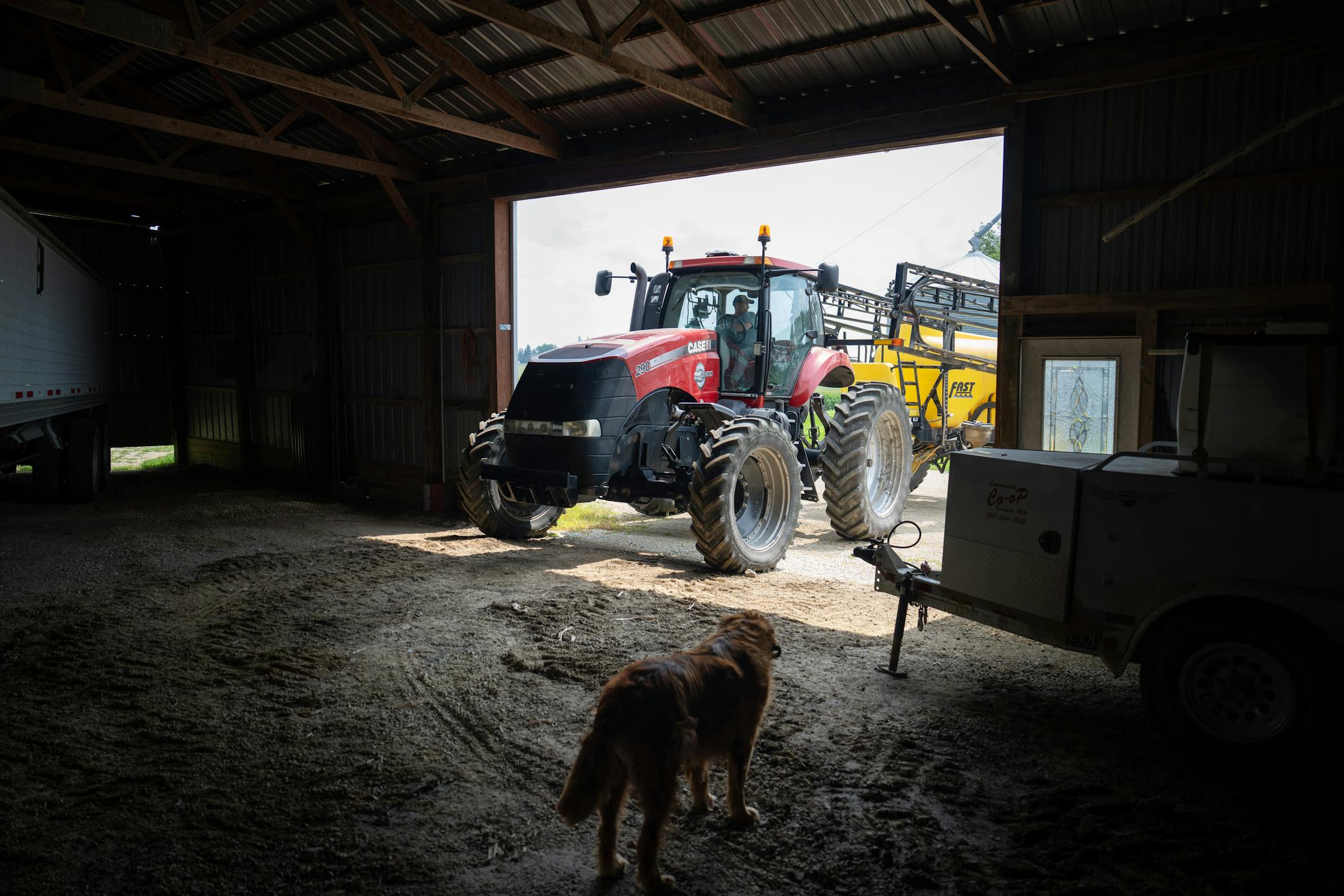
Ben Johnson backs a sprayer out of his shed to winterize and store it for next year. (Glen Stubbe/For the Minnesota Star Tribune)
about the writer

about the writer

Jill Burcum

Editorial Columnist

See Moreicon