
School districts brace for Trump administration’s next move on transgender athletes in high school

Minnesota has been ordered to change its policies governing girls high school sports or face an “imminent enforcement action” from Washington. The initial deadline set by the federal government appears to be Friday.

The Minnesota Star Tribune
October 10, 2025 at 11:00AM
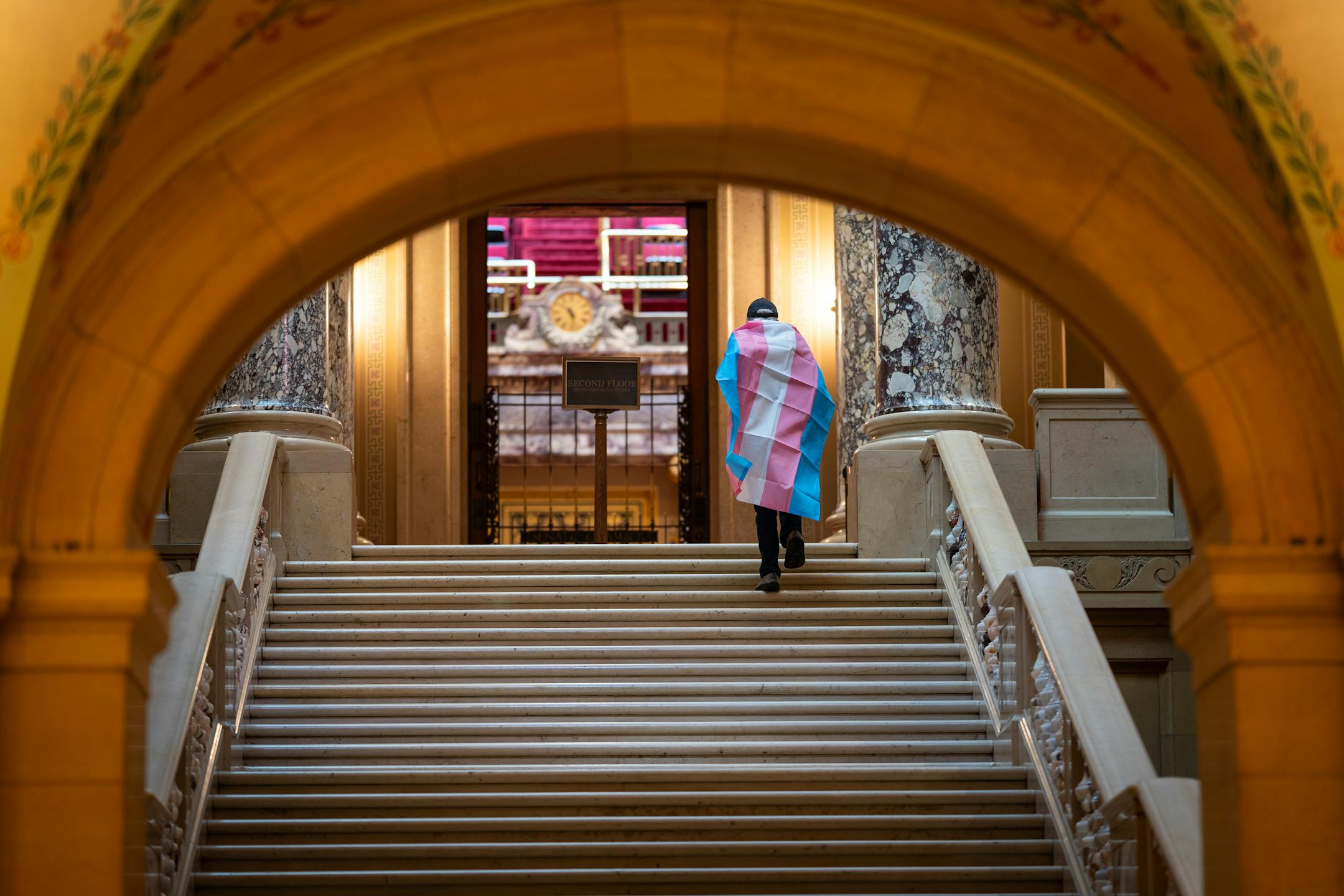
A person draped in the transgender pride flag walks up the steps of the Minnesota Capitol on Transgender Day of Visibility on March 31. (Leila Navidi/The Minnesota Star Tribune)

The Trump administration put Minnesota schools and high school teams on notice: change the rule that allows transgender girls to participate in high school girls sports within 10 days or risk consequences.

That 10-day window appears to expire Friday, but what exactly might happen — and when — is unclear. The ongoing federal government shutdown, which has silenced the U.S. Department of Education, makes the situation even murkier.

But the looming threat of what an Education Department news release called an “imminent enforcement action” has school officials bracing for what could be a hit to the federal funding that flows to the state’s districts.

The federal assertion that Minnesota is in violation of Title IX comes after the Trump administration issued an executive order in February banning transgender athletes from participating in girls and women’s sports — and launched an investigation into the state high school league.

The debate about what to do cuts across the Minnesota State High School League (MSHSL), the state Department of Education, and more than 300 school districts, each with its own political dynamics among school board members and a slew of girls and boys high school teams.

There’s not consensus on what should or even legally could immediately change in Minnesota: The high school league says that its policy complies with state law.

Here’s what to know about the dispute and what could be at stake:

What’s the Minnesota State High School League’s policy on transgender athletes?

The Minnesota State High School League, a 110-year-old nonprofit association, creates and operates state tournaments for more than 600 member high schools across the state for athletics and fine arts.

The MSHSL board of directors in 2015 voted to open girls sports to transgender student-athletes. State law had already permitted girls to compete in boys sports.

Specifically, the bylaw states “in accordance with applicable state and federal laws, rules and regulations, the Minnesota State High School League allows participation for all students consistent with their gender identity or expression in an environment free from discrimination with an equal opportunity for participation in athletics and fine arts.”

Under the MSHSL bylaw, the process for establishing a transgender student-athlete’s eligibility includes written statements from a student’s parents or guardians and health care professionals regarding the student’s “consistent or sincerely held gender-related identity.”

How many transgender athletes are there in Minnesota?

It’s unclear. The MSHSL does not require, nor does it keep, records of transgender athletes in Minnesota.

What does the Trump administration want Minnesota to do?

The Sept. 30 notice makes several demands, including:

  • Requiring the MSHSL to change its policy to ban transgender athletes from girls sports and use biological definitions of male and female.
    • Issue statewide guidance that interscholastic sports must comply with Title IX and update related training, which would be federally reviewed.
      • Apologize to female athletes who competed against transgender athletes and rescind titles or records held by transgender athletes in girls sports.

        What has the MSHSL said in response to the Trump Administration’s demand?

        The league administration and its advisers have said the executive order signed by President Donald Trump in February is in direct violation of the equal protection clause of the Minnesota Constitution and Minnesota’s Human Rights Act.

        “Students have been allowed to participate consistent with their gender identity in Minnesota for a number of years, based on the [Minnesota] Human Rights Act and the state constitution,” MSHSL Executive Director Erich Martens told the Minnesota Star Tribune in February.

        Legal counsel Kevin Beck said the league received the most recent letter on Sept. 30 and declined further comment.

        “I would say, really directly, we’re in receipt of their information, and, right now, our legal counsel is reviewing all aspects of it,” Martens said.

        What does the Minnesota human rights law say?

        The Minnesota Human Rights Act bans discrimination against protected classes, including discrimination based on gender identity.

        The Minnesota Legislature added “gender identity” as a protected class in 2023.

        What have athletic directors, coaches and athletes said?

        The majority of athletic directors, coaches and athletes in Minnesota have not publicly commented on the issue and have deferred comment to school district spokespeople or the MSHSL.

        “We have to follow the guidance of the MSHSL and the laws of the state of Minnesota,” Elk River athletic director Mike Cunningham said last week. “We have no choice in the matter.”

        If Minnesota’s bylaws changed and transgender girls were not allowed to compete in girls sports, two transgender high school athletes in Minnesota told the Star Tribune earlier this year that leaving sports entirely would mean leaving behind benefits including a daily routine, friendships, physical health and community. The Star Tribune did not identify the athletes at the request of their families.

        There’s also a pending lawsuit, filed on behalf of athletes who reportedly competed against a transgender softball player, that alleges Title IX violations.

        What have school boards or districts said about the threat?

        More than 200 school board members from across Minnesota have signed a letter calling on the state to comply with the federal mandate.

        Kirk Schneidawind, executive director of the Minnesota School Boards Association, issued a statement this week noting there are more than 2,000 school board members across 329 school boards in the state who all have their own opinions.

        “Public education governance is designed to reflect the diversity of thought within our communities,” he said. “Differences of opinion are not a sign of division; they’re a sign of democracy at work.”

        In a statement, a spokesman for Anoka-Hennepin, the state’s largest school district, said district administrators were aware that individual Anoka-Hennepin school board members signed the letter, but “this is a matter between the Federal Government, Minnesota Department of Education and the Minnesota State High School League.”

        What are Minnesota politicians saying?

        Republicans have praised the move, arguing the federal government is holding Minnesota accountable for its policy.

        “Minnesota’s so-called leaders’ refusal to protect female athletes must end,” Rep. Tom Emmer, the No. 3 Republican in the U.S. House, said on X.

        Democrats across the state have condemned the Trump administration’s actions, but many stop short of saying where they stand on the policy itself, instead criticizing Republicans for the ongoing federal government shutdown.

        A spokesperson for Gov. Tim Walz said that “the Governor knows this issue is purely a distraction used by Republicans in Washington while they defund Americans’ health care, drive up costs, and shut down the federal government.”

        What has happened in other states?

        The Trump administration attempted to pressure Maine to change its policy by pulling funding for schools, with targeted cuts to federal school nutrition programs.

        Citing Title IX violations, the U.S. Department of Agriculture announced it would “pause and, where appropriate, terminate categories of education programming in Maine.”

        The cuts were aimed at grants to Maine’s Department of Education and the state’s schools, rather than the state’s athletic governing body.

        According to the Maine Policy Institute, more than $3 million in school nutrition funding to the state was blocked. The state sued the USDA, arguing the freeze was put in place without due legal process and “jeopardized essential meal programs for students.”

        A federal judge granted a temporary injunction to unfreeze the funds. The USDA and Maine eventually settled out of court, with no policy changes in place.

        How much federal funding does Minnesota get?

        Minnesota receives about 10%, or $1.4 billion, of its school funding from the federal government. That pays for a variety of programs, from services for students with disabilities to support for English-language learners to school breakfast and lunch.

        School nutrition money, which the Trump administration targeted in Maine, amounts to about $429 million this year in Minnesota.

        Does the MSHSL get federal funding?

        The MSHSL neither solicits nor receives state or federal funding. The league is a membership fee-based association. It generates its revenue by charging its member schools and their students annual activity fees, running state championship tournaments and signing broadcast and partnership deals.

        Membership fee-based organizations, like the MSHSL, are considered publicly supported charities by the Internal Revenue Service.

        Joe Christensen, Cassidy Hettesheimer, Elliot Hughes, Mara Klecker, Jim Paulsen and Nick Williams of the Minnesota Star Tribune contributed to this story.

        about the writer

        about the writer

        Star Tribune staff

        See Moreicon