Advertisement

Rash: Trump should level with Americans about Iran

Trump missed the chance in his State of the Union address to offer clarity to the country about America’s military buildup.

Columnist Icon
The Minnesota Star Tribune
February 25, 2026 at 8:17PM
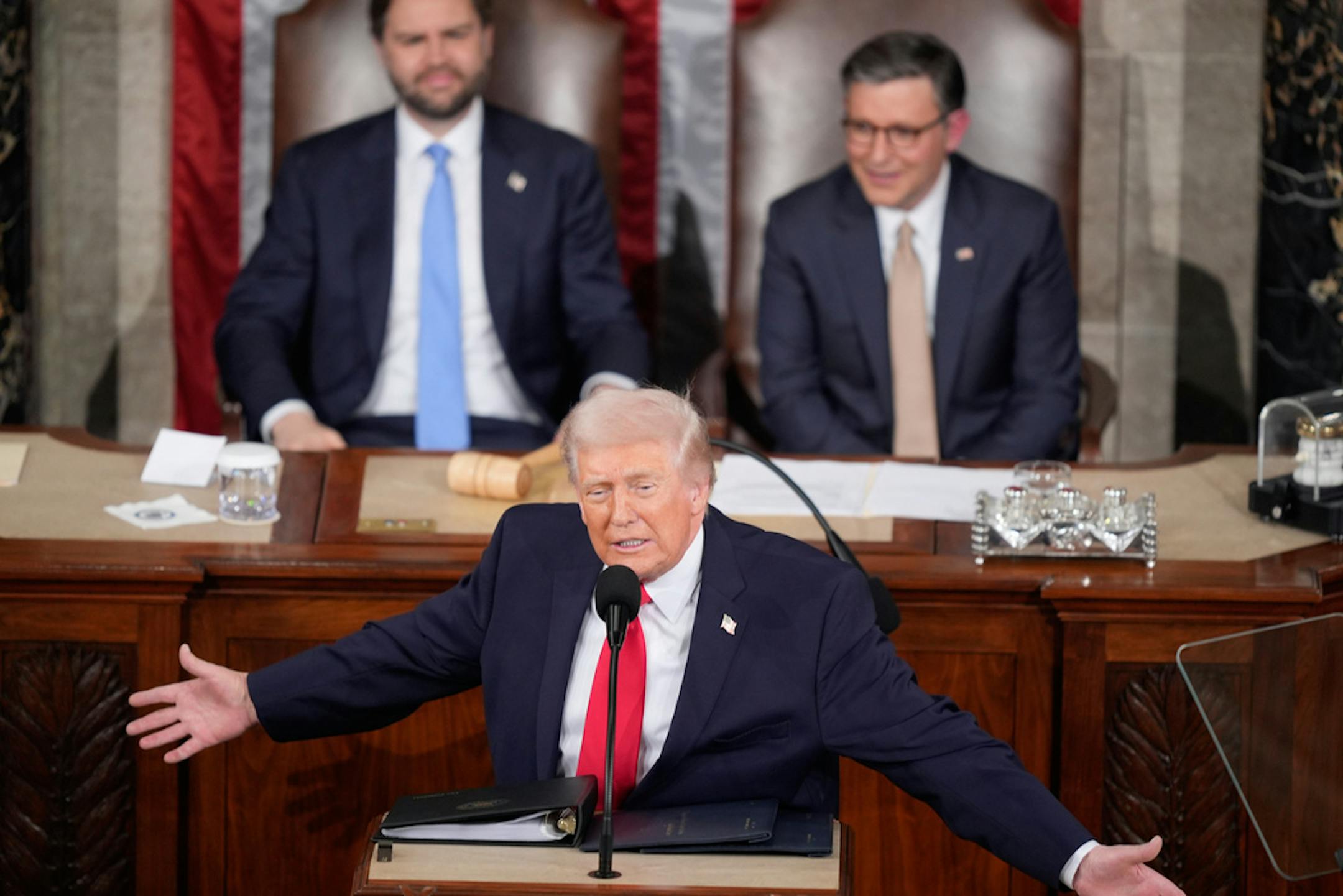
President Donald Trump delivers the State of the Union address to a joint session of Congress in the House chamber at the U.S. Capitol in Washington on Feb. 24 as Vice President JD Vance and House Speaker Mike Johnson listen behind him. (Mark Schiefelbein/The Associated Press)
Advertisement

Opinion editor’s note: Strib Voices publishes a mix of commentary online and in print each day. To contribute, click here.

•••

Like previous presidents, Donald Trump offered the requisite reassurance that “the state of the union is strong.”

But how strong can it be when it’s this divided?

Indeed, in his Feb. 24 State of the Union address, more honest presidential rhetoric (on a night when honesty was scarce, according to fact-checkers) would be that the state of the union is disunited.

Especially in Washington, where the Democrats who didn’t boycott the speech were denigrated in it — just as Minnesota and its Somali diaspora were, prompting protests from Fifth District Rep. Ilhan Omar, among others, during Trump’s speech.

This disunity matters.

On the economic, immigration and social issues stressed by the president, to be sure.

Advertisement

But even more so regarding potentially life-or-death issues of war and peace. Including Iran, which faces what Trump terms a “vast armada” of naval vessels as well as other assets — the most in the Mideast since the 2003 invasion of Iraq — poised to strike, pending the outcome of last-ditch diplomatic dialogue.

National unity is useful, if not essential, if the commander in chief summons the country to war. But instead of explaining the stakes and stating an objective, the president has barely addressed the buildup, and he spent only about three minutes toward the end of his record-long 108-minute address to justify what could become another major Mideast war. This stands in stark contrast to former President George W. Bush’s months of making the case (however false) for the Iraq invasion.

The quiet “is really quite unusual,” said Ronald Krebs, a University of Minnesota professor of political science whose scholarship includes a focus on civilian-military relations.

Commenting before Trump’s speech, Krebs said, “We’ve certainly had plenty of indications from various people in the administration regarding what the purposes are, but we have not heard much from the president himself, and it is the president who is the commander in chief and it is the president who is the nation’s narrator in chief.”

In his address, the commander and narrator noted, again, that last June the U.S. military “obliterated Iran’s nuclear-weapons program.”

If so, why would another strike — or an even more significant attack — be necessary?

Advertisement

“To say that Iran’s nuclear program was obliterated does not seem plausible,” said Krebs’ colleague Mark Bell, an associate professor of political science at the U. Bell, an expert on nuclear proliferation, added that “the United States, the most powerful country the world has ever seen, basically did what it could last year to destroy Iran’s nuclear facilities” but that there’s still “ambiguity” about its potential program, including its highly enriched uranium.

One reason it’s unclear is that after Trump abrogated the Obama-era Joint Comprehensive Plan of Action (the JCPOA or “the Iran deal”) during his first term — despite his administration’s acknowledgment that Iran was in compliance — International Atomic Energy Agency inspectors were kicked out of the country.

Referring to the deal’s widely acknowledged limitations, Bell said that “the JCPOA certainly wasn’t perfect, but you’re also now seeing the serious imperfections of military solutions to this problem.”

Two things seem concurrently true, said Jane Darby Menton, a fellow in the Nuclear Policy Program at the Carnegie Endowment for International Peace. “It can be true that those strikes did a lot of damage, and it can also be true that Iran has the ability to reconstitute a program.” An attack can have limitations: “If you want to get the IAEA back in there in a meaningful way, military strikes just don’t really help you with that.”

Trump signaled that “my preference is to solve this problem with diplomacy. But one thing is certain; I will never allow the world’s No. 1 sponsor of terror, which they are by far, to have a nuclear weapon.”

The president also rightly identified other issues, including Iran’s conventional weapons program, with missiles Trump said will soon be able to reach America, as well as the killing of what he said were up to 32,000 protesters in recent weeks — protesters who may have been steeled by Trump’s previous promise that “help is on its way.”


Advertisement

Indeed, the theocracy has defiled the religion it’s based on with its heinous human-rights record and its malign influence throughout the region by supporting militias that have killed many more. Iranians and the world would benefit from an end to the repressive regime.

But it’s unclear if regime change is the administration’s intent. Or for that matter, what the overriding objective is.

Using poker parlance, Krebs said that Trump’s “tell” is that there is not a large-scale invasion force that would be necessary to try to topple the regime. This, he said, is “perhaps why you see the Iranians looking like they are calling Trump’s bluff.”

Any attack could fall on what Krebs called a “symbolic” and “capacity” continuum: from the more symbolic strike that killed Qassem Soleimani, a key Iranian military leader, during Trump’s first term, to last June’s 12-day campaign that had more of a “capacity” component. Regime change would require a more massive military force or internal dissent so significant that the regime implodes.

But by now, Americans should be prepared by the president for any eventuality, something Trump paid scant attention to in his speech or beforehand. Perhaps the president is thinking that such national knowledge and resolve isn’t a requirement for a 12-day war. But it is for another “forever war” — the kind Trump campaigned against — and it’s dangerous for America’s commander in chief to assume a certain outcome.

“You don’t always know when you start a military action which version of that you are going to get,” said Menton. “And I think that’s one of the concerns here, that the other side gets a vote in terms of how they respond.”

Advertisement

Regarding a previous president and Mideast conflicts, Menton concluded that “I don’t think people in Washington at the time thought that what they were starting was a ‘forever war.’”

The president, prioritizing demonizing Democrats in an address that further divided the Congress and the country, missed an opportunity to try to unite the nation — or at least explain to it the thinking on his most profound presidential prerogative: sending Americans into harm’s way. He should quickly correct that error and level with the American people.

about the writer

about the writer

John Rash

Editorial Columnist

John Rash is a columnist.

See Moreicon

More from Columnists

See More
card image
Glen Stubbe/The Minnesota Star Tribune

From start to finish, the GOP congressman has used his platform to undermine, rather than help, state leaders.

card image
Advertisement