
Advertisement

Opinion | With ‘pirates’ comment, Trump again punches down on Somali Minnesotans

Fraud is a crime, not a culture.

February 25, 2026 at 6:57PM
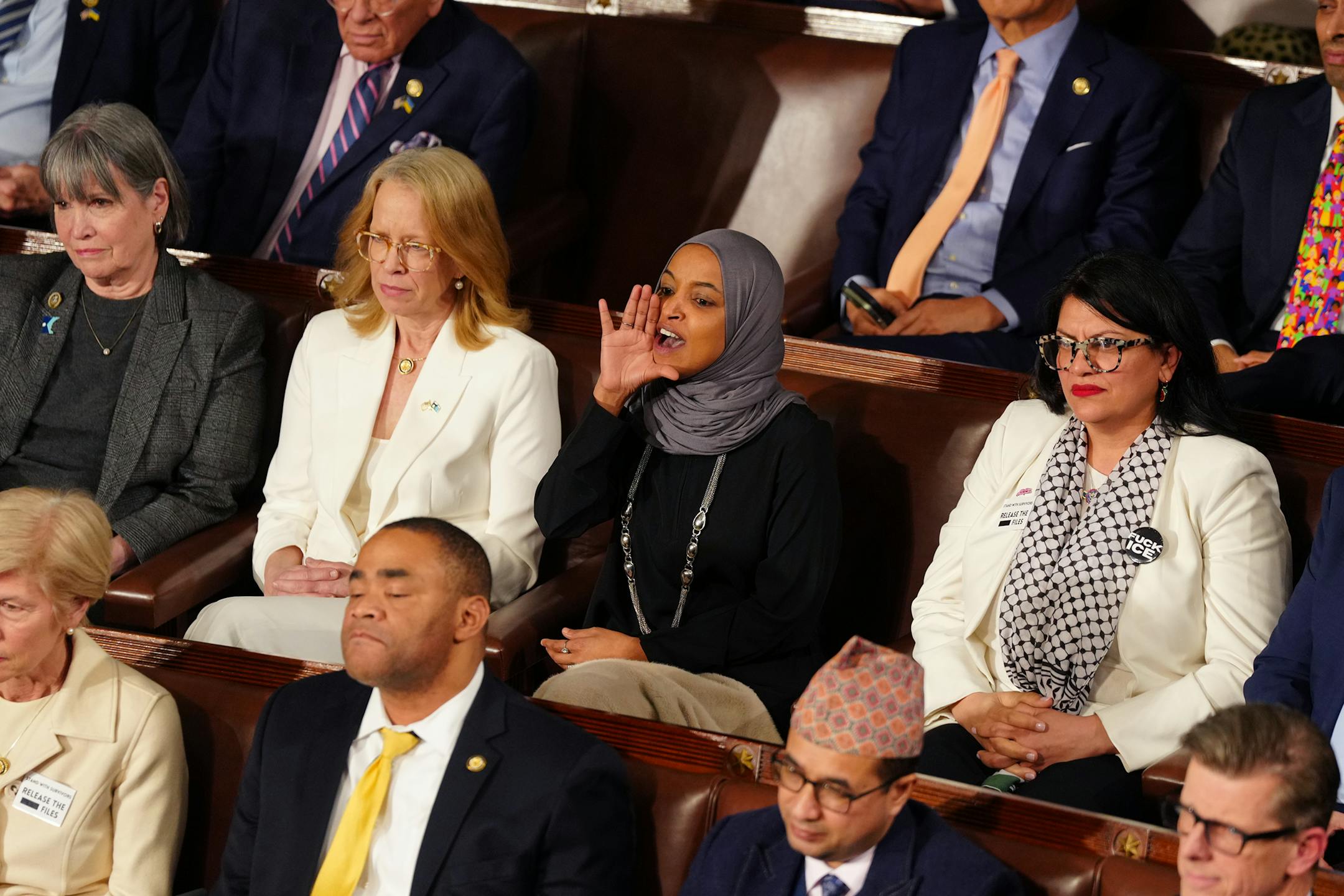
Rep. Ilhan Omar, D-Minn., shouts at President Donald Trump as he delivers his State of the Union address to a joint session of Congress at the Capitol in Washington on Feb. 24. (Tierney L. Cross/The New York Times)
Advertisement

Opinion editor’s note: Strib Voices publishes a mix of guest commentaries online and in print each day. To contribute, click here.

•••

On Tuesday night in his State of the Union address, President Donald Trump referred to the Minnesota Somali community as “pirates” and claimed they had stolen $19 billion from taxpayers. That figure does not match the cases charged in Minnesota. It is not supported by the public record. It was false.

But the damage of repeating it is real. Viral videos of this smear against an entire community are circulating stripped of context, amplifying suspicion rather than facts. Political rhetoric has escalated into a digital pile-on against the Somali American community.

As a Minnesotan, I am incensed that our state was held up before the nation in that way. Minnesota is not a punch line. And the Somali community is not a caricature. It is an integral part of this state, contributing to its economy, its civic life, its small businesses, its schools and its neighborhoods.

Fraud is indefensible. Stealing from programs meant to feed children or provide health care is repugnant. Every dollar stolen in any scam must be recovered. Every individual who broke the law should face the full weight of the justice system.

But there is a profound difference between prosecuting individuals and weaponizing their crimes to brand an entire community as criminal.

When we examine the actual numbers, the smear collapses under its own weight.

Advertisement

Federal and state prosecutors have charged approximately 80-90 individuals in connection with major pandemic-era fraud schemes in Minnesota. Estimates place Minnesota’s Somali population at 100,000 to 110,000. Do the math.

Even if all of the individuals charged were Somali, which they are not, those charged would represent less than 0.1% of the community. Treating the remaining 99.9% as complicit is collective punishment. It violates the most basic American principle of individual responsibility.

If this standard of collective blame were applied consistently, American history would look very different. Parity demands we ask how fraud has been treated when perpetrators came from other communities, faiths and backgrounds.

Over the past century, the U.S. has experienced fraud on a scale that far exceeds anything currently under discussion in Minnesota. Bernie Madoff orchestrated a $65 billion Ponzi scheme. Enron executives destroyed more than $70 billion in shareholder value. More recently, FTX vaporized billions in customer funds, and nationwide COVID-19 relief fraud is estimated at around $280 billion.

In none of these cases was fraud treated as a cultural trait. No one suggested that Madoff’s crimes revealed a flaw in the broader community he came from. No religious institutions were treated as suspect. No neighborhoods were subjected to collective scrutiny. His actions were understood for what they were: the choices of an individual.

The same standard applied when Minnesota businessman Tom Petters ran a $3.65 billion Ponzi scheme. No one demanded investigations into every white or Christian businessman in the state. Entire communities were not put on trial.

Advertisement

Yet when defendants have Muslim names, or are immigrants or Black, the standard shifts. The crime is reframed not simply as criminal conduct, but as proof of a cultural defect. That shift is not accidental. It turns prosecution into propaganda.

The cost of that rhetoric is devastating. Somali-owned businesses face harassment. Families feel exposed. Children hear their community described in the harshest possible terms by the president of the United States. A community that rebuilt its life here after fleeing civil war is forced to defend its very belonging. Their humanity and dignity are not up for debate.

Minnesota must be able to do two things at once. We can support the aggressive prosecution of every person who stole public money. We must also reject collective blame.

Fraud is a crime. It is not a culture. And no community in this state should be reduced to a slur from a national podium.

Zafar Siddiqui is a Twin Cities-based interfaith and civil rights advocate. He is the co-founder of Islamic Resource Group.

about the writer

about the writer

Zafar Siddiqui

Advertisement