
Advertisement

Opinion | The line between civilian and military law enforcement is blurring. Congress must act.

The guardrails of liberty are fraying.

February 24, 2026 at 10:59AM
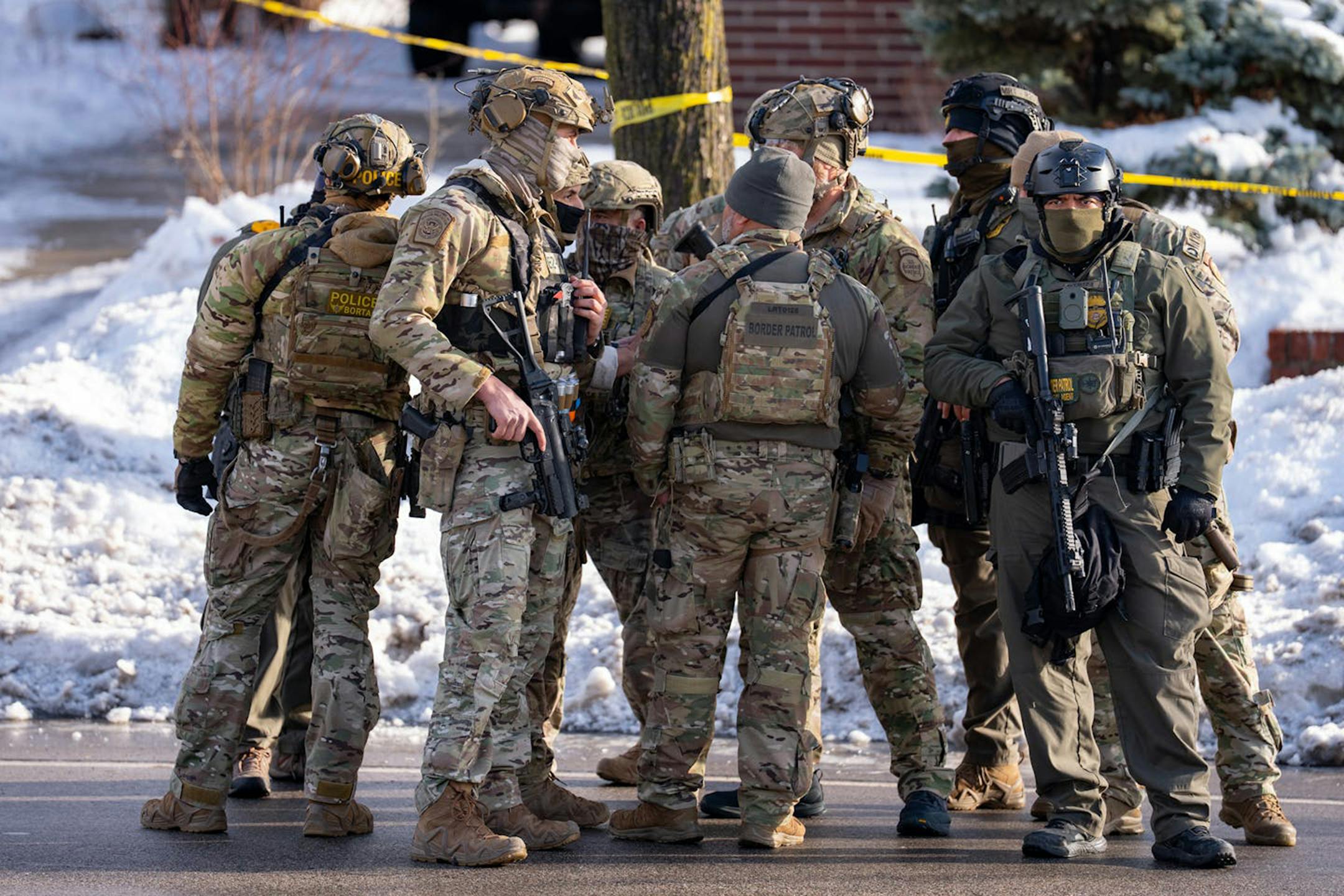
Federal agents from Immigration and Customs Enforcement and the U.S. Border Patrol huddle on Jan. 7 near the spot in Minneapolis where an ICE agent killed Renee Good earlier that day. (Alex Kormann)
Advertisement

Star Tribune opinion editor’s note: This article was signed by several people who have served in the federal and military justice systems. Their names are listed below.

•••

Strib Voices publishes a mix of guest commentaries online and in print each day. To contribute, click here.

•••

The systematic militarization of civilian law enforcement — exemplified by “Operation Metro Surge” in Minnesota — represents a fundamental shift that endangers our democracy and our nation’s commitment to our Constitution and the rule of law.

For more than two centuries, a foundational pillar of American democracy has been the “bright line” separating civilian law enforcement from the military. As former U.S. Attorneys, Department of Justice (DOJ) lawyers and Department of Defense (DOD) counsel who have served under Republican and Democratic administrations, we believe a dangerous confluence of the Trump administration’s policies and actions are threatening to collapse this distinction.

Our founders’ aversion to a domestic military presence was forged in the crucible of the British occupation. In the Declaration of Independence, Thomas Jefferson indicted King George III for “affecting to render the Military independent of and superior to the Civil power.” This principle was later codified through the Third Amendment and the Constitution’s structural separation of powers. James Madison warned that the tools of national defense are fundamentally incompatible with the rights-based requirements of domestic law enforcement. Today, that warning is being ignored.

1) The paramilitary shift: From policing to occupation

Since summer 2025, we have witnessed an unprecedented escalation in the “militarization” of Immigration and Customs Enforcement (ICE) and Customs and Border Protection (CBP). While these remain civilian agencies, the recent deployment of thousands of federal personnel — masked and equipped with battlefield-grade hardware and operating under “strike team” mandates in cities like Minneapolis, Chicago and Los Angeles — has blurred the line beyond recognition.

Advertisement

When federal agents operate with the tactics, gear and disregard for individual rights characteristic of a military occupation by a foreign power rather than community policing, public trust completely breaks down. In the Twin Cities, these operations have already resulted in tragic civilian fatalities and massive community trauma, creating a “war zone” mentality that our founders sought to avoid. Periodic false statements by certain administration officials and their lack of transparency have only exacerbated the situation.

2) Military prosecutors prosecuting civilians in federal courts

As a result of the recent principled resignations of numerous Assistant U.S. Attorneys in the District of Minnesota, the DOJ and DOD reportedly are planning to assign a large number of military prosecutors from the Judge Advocate General Corps to serve as special AUSAs there. Five Judge Advocate lawyers already are in place in Minnesota and at least one of their court appearances is being challenged as a violation of this nation’s longstanding Posse Comitatus Act.

The deployment of military prosecutors to prosecute protesters and other civilians in civilian federal courts marks a radical departure from American tradition. Unlike civilian Assistant U.S. Attorneys, military prosecutors are active-duty personnel subject to the Uniform Code of Military Justice (UCMJ) and a chain of command.

We agree with Mark Hertling, a retired U.S. Army lieutenant general combat veteran with 37 years of service, who spoke to the risk created when civilian courts are turned over to military prosecutors.

“Civilian government attorneys can resign. Many have. That option is part of what preserves prosecutorial discretion and our rule of law. Uniformed military lawyers do not have that option … . The military’s legal corps exists to preserve the rule of law within the force … . Treating it as a reservoir of compelled compliance undermines that role and risks normalizing the idea that when some professionals say ‘no,’ the answer is to find other professionals who cannot.”

This shift carries the profound risk of “normalizing” military intervention in civilian life, effectively signaling that this administration is seeking to control people through convictions, not ensuring equal justice under the law. Furthermore, it siphons military lawyers away from their essential duties within the armed forces.

Advertisement

3) The Insurrection Act: A political cudgel

Perhaps the most direct threat to the republic is the repeated presidential threat to invoke the Insurrection Act of 1807 to quell civilian dissent. This act was designed as a tool of last resort for extreme emergencies — not as a political cudgel to silence protesters or bypass the objections of state governors.

Using the military to police American streets against the objections of state governors — as attempted in Chicago and Portland — violates core constitutional principles. The military is trained to defeat an enemy, not to de-escalate a protest or safeguard First Amendment rights. Deploying active-duty Marines or soldiers into American neighborhoods effectively treats American citizens as enemy combatants in their own cities. These deployments are not a solution to civil unrest; they are a violation of the Posse Comitatus Act and, ultimately, a surrender of our constitutional values.

One of the American military’s great strengths is its standing as a nonpartisan institution. Forcing it into domestic political disputes and civilian law enforcement roles for which it is not trained risks permanent damage to its reputation and its relationship with the people it is sworn to defend.

We collectively have more than 130 years of experience serving as federal prosecutors and proud members of our nation’s military branches. As former stewards of the law and the military’s legal framework, we call on Congress to immediately reassert its oversight role. We must:

• Reform the Insurrection Act with clear definitions and mandatory congressional oversight.

• Restrict the use of DOD funds and personnel from being used in civilian federal criminal proceedings that have no relation to a clear military purpose.

Advertisement

The strength of our nation lies in the rule of law, not the rule of force. The guardrails of liberty are fraying. It is time for Congress to reinforce them and the courts to protect them.

This article was signed by B. Todd Jones, former U.S. Attorney, director of Bureau of Alcohol, Tobacco, Firearms and Explosives, and judge advocate, U.S. Marine Corps; Jill Wine-Banks, former DOJ organized crime attorney and assistant Watergate special prosecutor, and former general counsel, U.S. Army; Anders Folk, former acting U.S. Attorney, senior counsel to the U.S. deputy attorney general, and judge advocate, U.S. Marine Corps; John Marti, former acting U.S. Attorney and judge advocate, U.S. Marine Corps; Hank Shea, former assistant U.S. Attorney, assistant to the Army general counsel and judge advocate, U.S. Army; Charles Kovats, former acting U.S. attorney and judge advocate, U.S. Army; Steve Schleicher, former assistant U.S. Attorney and judge advocate, U.S. Army; Andrew Winter, former assistant U.S. Attorney and judge advocate, U.S. Army; Doug Kelley, former assistant U.S. Attorney, chief of staff for a U.S. senator, and U.S. Army.

about the writer

about the writer

multiple authors

Advertisement