
Rash: Trump’s geopolitical aggression is a rupture in the world order

The president said the U.S. won’t take Greenland by force, but allied tensions persist.

Columnist Icon
The Minnesota Star Tribune
January 22, 2026 at 11:00AM
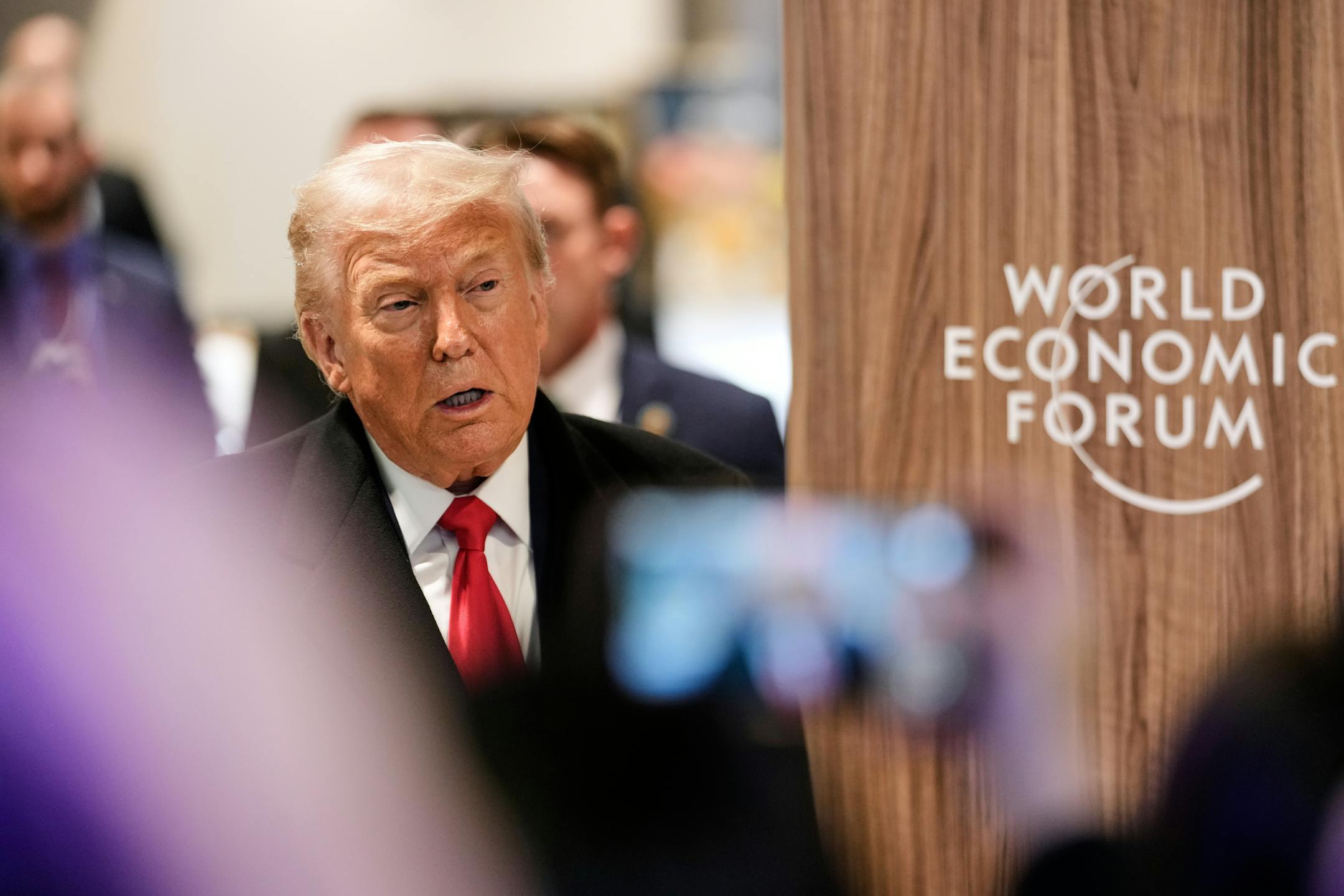
President Donald Trump talks to news outlets after a meeting during the Annual Meeting of the World Economic Forum in Davos, Switzerland, on Jan. 21. (Markus Schreiber/The Associated Press)

Opinion editor’s note: Strib Voices publishes a mix of commentary online and in print each day. To contribute, click here.

•••

Imagine a writer pitching this dystopian premise:

The president of the U.S. — the country that created the postwar rules-based international order and led NATO, the most formidable military alliance in history — does what Moscow and Beijing couldn’t: Create a crack in the alliance so seismic that Mark Carney, the prime minister of Canada, calls it a “rupture, not a transition.” And get this — it’s all over Greenland, a semiautonomous portion of the Kingdom of Denmark, among America’s staunchest allies — even though a 1951 treaty already allows America nearly unfettered military access.

Too far-fetched, might be the publisher’s reply. That’s not political science. It’s political science fiction.

Unfortunately, however, it’s nonfiction. And allies are reeling.

Indeed, it wasn’t until his speech to the World Economic Forum in Davos, Switzerland, on Jan. 21 that President Donald Trump ruled out military means to get Greenland. Before that he left it uncertain if he would use force, fiat or a fee yet to be negotiated, even though Danes have said it is not for sale and Greenlanders overwhelmingly told pollsters they don’t want to be Americans.

The geopolitical crisis heightened this week when Trump responded to a request from Norway’s prime minister to diplomatically discuss the matter by writing: “Considering your Country decided not to give me the Nobel Peace Prize for stopping 8 wars PLUS, I no longer feel an obligation to think purely of Peace, although it will always be predominant, but can now think about what is good and proper for the United States of America.”

As if thinking about peace — which is achieved in part by having an alliance so effective that it avoids war — isn’t what is good and proper for the United States of America. (And never mind that the Norwegian government doesn’t decide on the awarding of the prize, an independent committee does.)

Trump called for “immediate negotiations” to take over Greenland and had already turned to his favorite weapon — tariffs — to threaten European nations. In turn, European leaders paused a previously negotiated E.U.-U.S. trade pact. Hours after his speech, Trump backed off the tariffs, alluding to an unspecified “framework” of a future deal.

Prior to his Davos address, Trump also broke the normal protocol between leaders by leaking some of their text messages suggesting a diplomatic de-escalation of the cross-continental dispute. He also reposted reckless rhetoric from random social-media accounts that claimed Russia and China were “boogeymen” and that “the real threat” were the United Nations and NATO, and for good measure he posted a computer-generated image of him planting an American flag on Greenland with a wooden placard reading “Greenland, U.S. Territory, Est. 2026.”

Russia couldn’t have scripted it better. But it tried, through a Kremlin-aligned newspaper that stated: “If Trump annexes Greenland by July 4, 2026, when America celebrates the 250th anniversary of the Declaration of Independence, he will go down in history as a figure who asserted the greatness of the United States.”

That’s because the Kremlin correctly identifies such an event as undermining, if not unraveling, the alliance — something Russia can’t accomplish.

Danish Prime Minister Mette Frederiksen noted as much when she recently said, “If the United States chooses to attack another country militarily, then everything stops,” including “NATO and the security that has been provided since the end of the Second World War.”

Carney’s remarkable Jan. 20 Davos address, which was met with a standing ovation, defined the dynamics of the emerging era.

And to do it, he referenced Czech playwright and later president Václav Havel.

Said Carney: “Every day we are reminded that we live in an era of great power rivalry. That the rules-based order is fading. That the strong do what they can, and the weak suffer what they must.

“This aphorism of Thucydides is presented as inevitable — the natural logic of international relations reasserting itself. And faced with this logic, there is a strong tendency for countries to go along to get along. To accommodate. To avoid trouble. To hope that compliance will buy safety.

“It won’t.

“So, what are our options?

“In 1978, the Czech dissident Václav Havel wrote an essay called ‘The Power of the Powerless.’ In it, he asked a simple question: How did the communist system sustain itself?

“His answer began with a greengrocer. Every morning, this shopkeeper places a sign in his window: ‘Workers of the world, unite!’ He does not believe it. No one believes it. But he places the sign anyway — to avoid trouble, to signal compliance, to get along. And because every shopkeeper on every street does the same, the system persists.

“Not through violence alone, but through the participation of ordinary people in rituals they privately know to be false.

“Havel called this ‘living within a lie.’ The system’s power comes not from its truth but from everyone’s willingness to perform as if it were true. And its fragility comes from the same source: when even one person stops performing — when the greengrocer removes his sign — the illusion begins to crack.

“It is time for companies and countries to take their signs down.”

Trump’s aggression on Greenland and devaluation of NATO has led Canada to consider de-emphasizing U.S. ties. Other allies may follow.

Accordingly, it’s time for Americans to take their signs down, too, and to stop living within the lie that threatening allies is in the best interest of the country. On the contrary, it’s making Trump’s stated goal of national security less likely.

Carney, in introducing his speech, said it was “about the rupture in the world order, the end of a nice story, and the beginning of a brutal reality where geopolitics among the great powers is not subject to any constraints.”

Public and congressional constraints are needed, now, on Trump’s troubling policies — before what was once a “nice story” becomes even more of an ominous one.

about the writer

about the writer

John Rash

Editorial Columnist

John Rash is a columnist.

See Moreicon

More from Columnists

See More
card image
Markus Schreiber/The Associated Press

The president said the U.S. won’t take Greenland by force, but allied tensions persist.

card image