
Rash: Trump threatens Greenland — and by extension, NATO

Allies are an American advantage over Russia and China. But those bonds are imperiled by the president.

Columnist Icon
The Minnesota Star Tribune
January 13, 2026 at 11:00AM
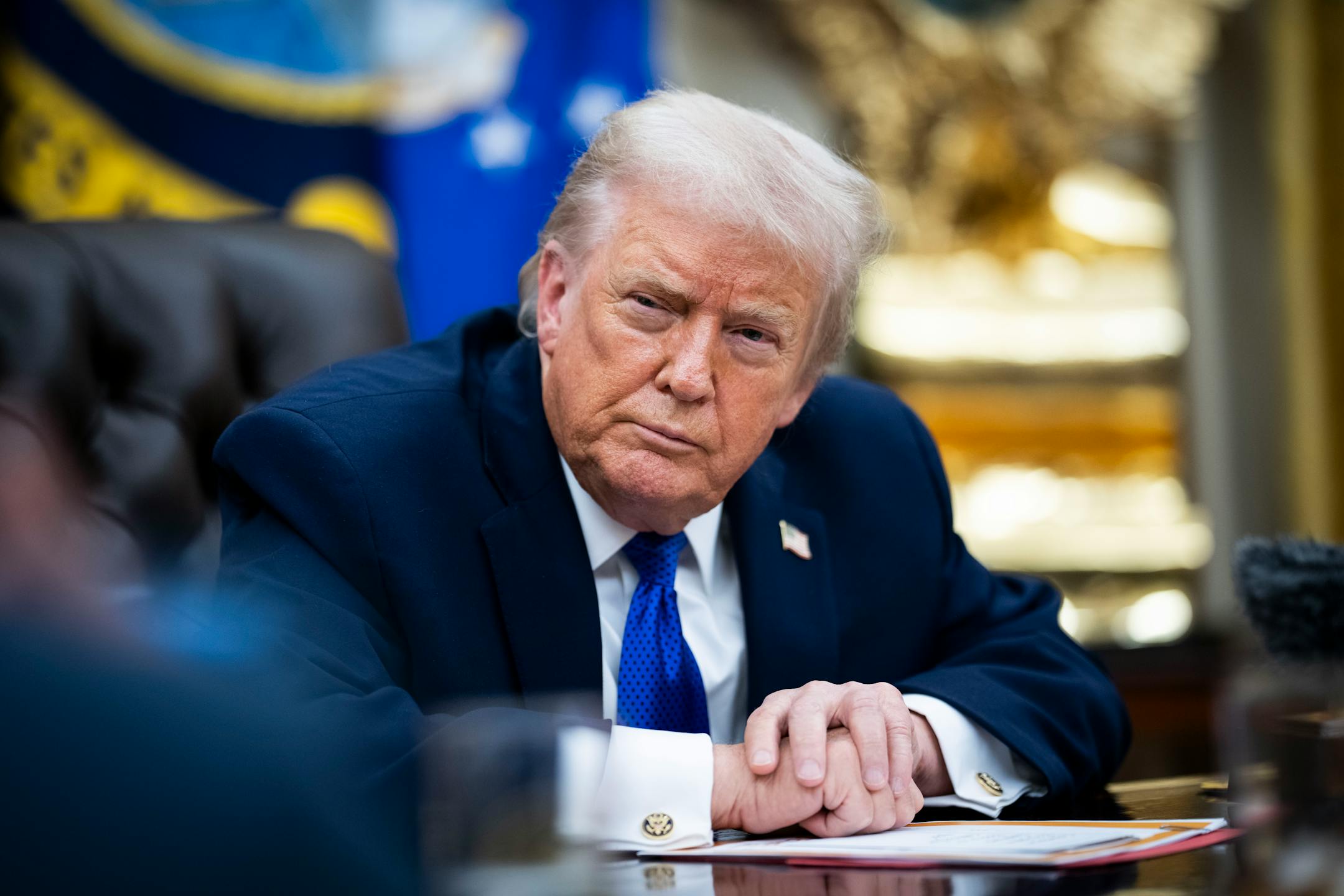
President Donald Trump during an interview at the White House in Washington on Jan. 7. (DOUG MILLS/The New York Times)

Opinion editor’s note: Strib Voices publishes a mix of commentary online and in print each day. To contribute, click here.

•••

Since NATO’s 1949 founding, the Soviet Union and then Russia have sought to counter, if not conquer, the alliance. Remarkably, despite the invasion of Ukraine degrading Russia’s defense and diplomatic standing, Moscow’s malevolent objective may finally be in reach.

But not because of pressure from the Kremlin. Rather, from the White House.

That possibility was posited by Mette Frederiksen, the Danish prime minister, when asked about the threats from the Trump administration to Greenland, a self-governing part of the Kingdom of Denmark. “If the United States chooses to attack another country militarily, then everything stops,” Frederiksen said, specifically noting “NATO and the security that has been provided since the end of the Second World War.”

President Donald Trump’s targeting of Greenland grew after seizing Venezuela’s president and hegemonically claiming the country’s oil. He said on Jan. 9 that he was “going to do something on Greenland, whether they like it or not” and that “I would like to make a deal the easy way, but if we don’t do it the easy way, we’re going to do it the hard way.”

Washington’s bellicosity toward Copenhagen and by extension every other NATO nation’s capital was amplified by White House Deputy Chief of Staff Stephen Miller, who seems to act as Trump’s ideological id.

On CNN on Jan. 5, Miller denigrated Denmark and other alliance members by crowing that “nobody is going to fight the United States militarily over the future of Greenland.” Later in the interview, in an instantly infamous amplification, Miller said that “We live in a world … that is governed by strength, that is governed by force, that is governed by power. These are the iron laws of the world since the beginning of time.”

Miller’s cynicism and America’s aggression against an ally has led to diplomatic, not fighting, words from key European leaders, who said in a statement that “Greenland belongs to its people” and that “it is for Denmark and Greenland, and them only, to decide on matters concerning Denmark and Greenland.”

The velocity and ferocity of Trump’s upending of the domestic and global order usually makes any one individual episode dissipate. But this shouldn’t disappear: White House press secretary Karoline Leavitt actually warned a NATO ally that the administration is “discussing a range of options to pursue this important foreign policy goal and, of course, utilizing the U.S. military is always an option at the commander in chief’s disposal.”

Denmark, along with 11 other countries including the U.S., was a founding member of NATO. The Scandinavian nation, along with every other alliance member at the time, answered the post-9/11 call when the U.S. became the first and only member to trigger Article 5, the collective-defense mechanism that treats an attack on one as an attack on all.

“I was ambassador to NATO on Sept. 11, 2001,” Nicholas Burns, a career diplomat who served in multiple countries under Republican and Democratic administrations, said in an interview. “I spoke with the Danish ambassador to NATO that afternoon in Brussels, where we were located. The Danes were among the first countries to stand up and say, ‘We are with you, and we will support you.’”

Which they did (in Afghanistan’s bloody Helmand Province, no less). Its battlefield deaths were greater per capita than any alliance member except America’s. Denmark is “one of the top countries in trying to help the United States, standing with the United States,” said Burns, now at Harvard.

The U.S., said Burns, “is stronger with allies than without them, and we have a unique advantage: Russia doesn’t have anything close to the number of American allies that we do in NATO. China doesn’t either. So why would we want to throw away that advantage that every president since President Truman has thought was part of the core strength of American foreign policy?”

Especially since the president already has previously negotiated protocols to achieve what he states are his objectives. The U.S. “does not have to invade Greenland or even attempt to purchase Greenland,” explained Burns, because “the Danish prime minister and her government has been very consistent for the past year in saying publicly that Denmark welcomes much more expansive American military presence in Greenland, and welcomes American investment by American companies in the rare earths and other critical minerals that are present in Greenland.”

The U.S., Burns said, is right to be concerned about Russia and China building up their Arctic military capabilities. However, he continued, “the best way to limit the Russians and Chinese is through the seven members of NATO that are all Arctic powers.” (Russia is the sole non-NATO Arctic nation.)

Such solidarity benefits America, said Richard Atwood, the executive vice president of the International Crisis Group, based in Brussels, the home of NATO. “The alliance system has been a huge source of strength in the U.S.,” he said. Trump is right, Atwood added, to press Europeans to increase defense expenditures (as previous presidents have), “but he’s completely wrong to think that blowing up the alliances or not valuing the alliances or mistreating allies is a recipe for American strength of power projection.”

In fact, the opposite, suggested Burns, reflecting on his recent role as U.S. ambassador to China during the Biden administration. Individual military treaties, not collective defense organizations, are the architecture of Far East security, said Burns. But the salutary effect is similar: “The Chinese fear the fact that the United States has all these treaty allies and security partners that can help us to limit the expansion of Chinese power,” said Burns. “And to the extent that the United States does not stand up for its allies in Europe, or in this case, tries to bully a small ally, Denmark, that gives their propaganda machine … the ability to say to its own people, but also the people of the Indo-Pacific, ‘you see, the United States is not a faithful ally. Don’t stay with the United States; it’ll desert its friends at every opportunity.”

America should defend, not desert, its friends. Especially allies like Denmark, which along with Greenland should alone decide its own direction.

about the writer

about the writer

John Rash

Editorial Columnist

John Rash is a columnist.

See Moreicon

More from Columnists

See More
card image
DOUG MILLS/The New York Times

Allies are an American advantage over Russia and China. But those bonds are imperiled by the president.