
Trump is opting some of the government out of the shutdown

The administration is finding ways to pay troops and for government work Trump favors, while targeting “Democrat programs” for layoffs or closures.

The Washington Post
October 16, 2025 at 3:09PM
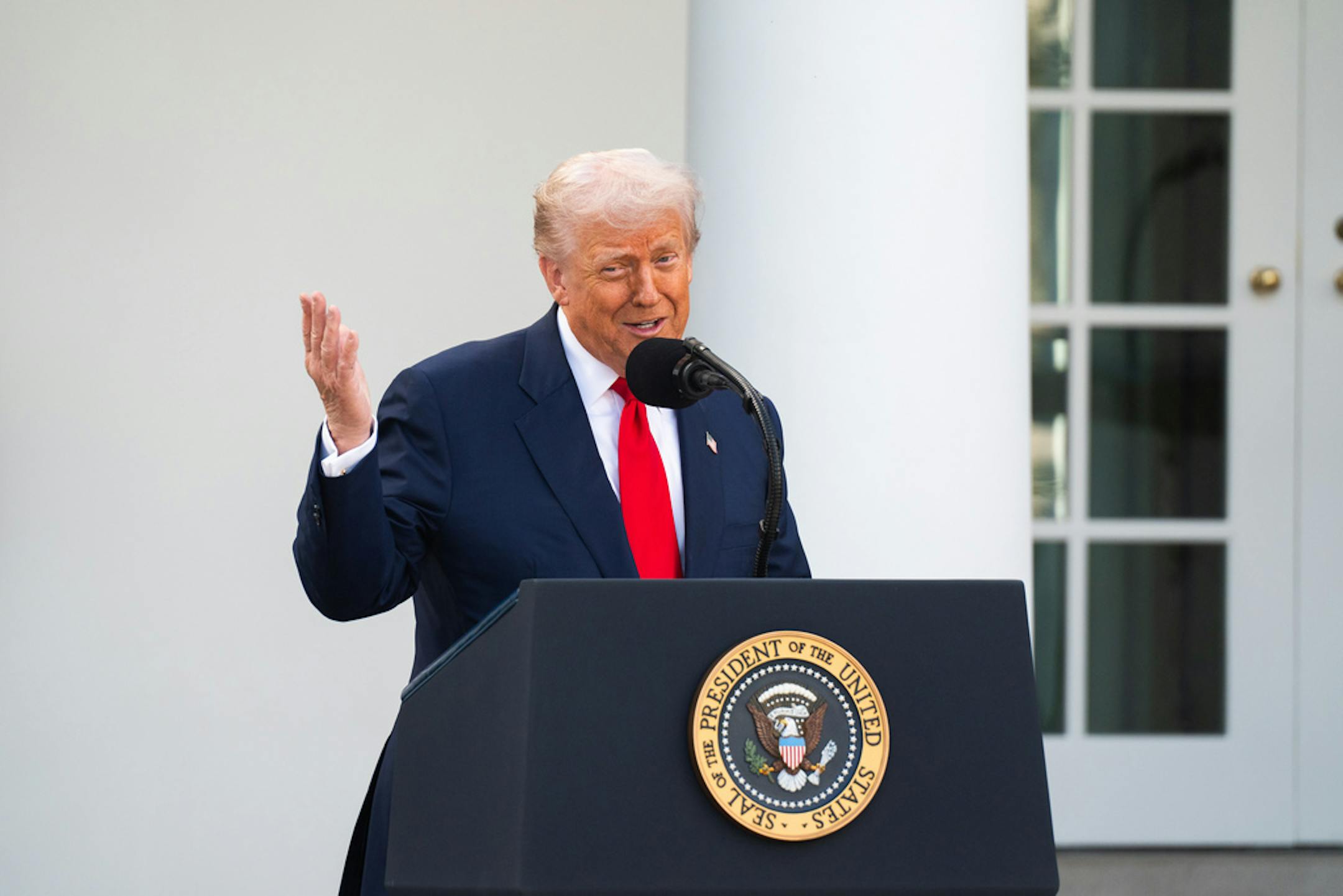
President Donald Trump speaks as he posthumously awards the Presidential Medal of Freedom to late conservative activist Charlie Kirk during a ceremony in the Rose Garden of the White House on Tuesday. (Demetrius Freeman/The Washington Post)

President Donald Trump is all but ignoring the federal shutdown for parts of the government he favors — keeping paychecks flowing for military service members and FBI agents and backfilling publicly sensitive social benefit programs in a push to alleviate political pain from the closure as it enters its third week.

The White House budget office on Tuesday posted on social media that the administration was preparing to “batten down the hatches,” lay off more federal workers and dig in for a prolonged impasse.

But Trump has also used the shutdown as an opening to seize additional power and render Congress — where negotiations are at a standstill — a nonfactor in managing the country’s finances.

The president moved last week to lay off more than 4,000 government workers, and his administration has already signaled more dismissals are on the way. He has repurposed leftover funding that is still available despite the shutdown away from government research to make payroll for active-duty troops. Money from his One Big Beautiful Bill, the mammoth tax and immigration package he signed into law in July, will go toward compensating members of the Coast Guard, part of the Department of Homeland Security.

FBI Director Kash Patel said Wednesday in the Oval Office that Trump “found a way” to compensate the FBI’s “1811 agents” — which refers to special agents — during the shutdown, though he did not elaborate on the funding source. That means that other people within the FBI who are not agents — including translators, employees who process crime images, analysts and more — remain unpaid.

“We got the people that we want paid, paid,” Trump said Wednesday in the Oval Office. “We’re getting rid of programs that we didn’t like but that were negotiated in. We’re terminating those programs and they’re going to be terminated on a permanent basis. And it’s thousands of people and it’s billions of dollars. We’re getting rid of a lot of things that we never wanted because of the fact that they made this stupid move.”

Revenue from tariffs, the crown jewel of Trump’s economic strategy, is filling the account for WIC, the anti-hunger program for women, infants and children.

Trump’s military deployments to Democratic-controlled cities have been uninterrupted, along with nationwide immigration raids.


“We’re closing up programs that are Democrat programs that we wanted to close up or that we never wanted to happen. And now we’re closing them up, and we’re not going to let them come back. The Democrats are getting killed,” Trump said Tuesday. “We’re not closing up Republican programs because we think they work.”

The White House’s moves may not be legal. There are stringent laws about how and when the executive branch can redirect congressionally approved funding, and the administration appears to be running afoul of several of them, experts say.

“Congress has to say what money can be used for out of the general treasury. That’s the whole point of Congress,” Shalanda Young, the White House budget chief in the Biden administration, told The Washington Post. “I know they don’t believe in it, but they got to believe in it enough to know that they just can’t take money out of the treasury for whatever they want to do.”

But many of Trump’s moves are politically popular — House Minority Leader Hakeem Jeffries (D-New York) on Tuesday said he supported paying military members during the shutdown — and House Speaker Mike Johnson (R-Louisiana) goaded the president’s opponents into trying to stop him.

“If the Democrats want to go to court to challenge troops being paid, bring it. I’m grateful for a commander in chief that understands the priorities of the country,” Johnson said.

The White House did not immediately respond to a request for comment. The Office of Management and Budget declined to comment.

Just last week, Johnson and Senate Majority Leader John Thune (R-South Dakota) rejected suggestions Congress should pass a bill to fund military pay itself, arguing the fastest way to get the troops paid is for Democrats to support a GOP-led funding measure that has now been defeated on the Senate floor eight times.

“Where they are trying to find some of the funding is out of areas of the budget that obviously they will replenish and pay back,” Thune told reporters Tuesday, when asked whether it is legal for the president to use money for other programs to pay troops and other federal employees during the shutdown. “But these are decisions that get forced upon you when the government shuts down.”

Trump on Wednesday cited his authority as commander in chief and ordered Defense Secretary Pete Hegseth to tap “any funds appropriated by Congress” to the department that remain available in the 2026 fiscal year to pay active duty military personnel.

The president’s authority over the military is generally irrelevant to their more limited powers to control spending. The Constitution vests those abilities solely with Congress.

Over the weekend, the Pentagon said it would repurpose about $8 billion in military research and development funding to pay active-duty troops, enough for slightly more than a single pay period.(Trump said Tuesday that “a very wealthy person” had offered to cover “any shortfall” for paying military personnel, but he did not elaborate.)

But the president’s order Wednesday, which could well face legal scrutiny, would green-light vast sums for military payroll, further blunting the pain of a persisting shutdown.

Administrations do have flexibility to determine what programs continue with unpaid workers or close entirely during shutdowns. But Trump is exercising significantly more control than most past presidents have in previous funding lapses — and partisan considerations appear to be driving many of the decisions.

Trump and lawmakers in Congress remain deadlocked as the shutdown drags into a third week. Republicans control both chambers of Congress but lack the votes in the Senate to defeat a filibuster of legislation to fund ongoing operations. Democrats insist that Trump and the GOP must cut a deal to preserve health insurance subsidies as part of any agreement to reopen the government.

Lawmakers have sometimes — but not always — been briefed beforehand on the administration’s plans to reroute federal funds.

Sen. John Hoeven (R-North Dakota), who leads the Appropriations subcommittee overseeing the WIC program, said the Agriculture Department briefed him on the potential shortfall on the first day of the shutdown. As the funding cliff approached, USDA coordinated with him and the White House budget office to make a plan to support the hunger program using tariff funds under a 1935 law that directs customs revenue to food programs.

Hoeven said the administration moving funds around doesn’t diminish congressional authority over spending, even if money is spent in a way Congress did not originally intend.

“Democrats are leaving the administration and us no choice. When they shut down government, there’s no choice: By default the administration has to do what they can, and they’re going to follow their priorities, not the Democrats’ priorities,” he said.

The shutdown has already caused nationwide flight delays, closed taxpayer help lines at the Internal Revenue Service, snarled permitting approvals at the Environmental Protection Agency and the Transportation Department, and shut off some access to national parks.

Shutdowns are generally resolved because of political pain, lawmakers say privately: when missed paychecks or government benefits start to drag too heavily on the economy, when airport delays create chaos over major travel holidays or when outside events such as natural disasters compel Congress to act.

But Trump’s moves have generally smoothed over those pressure points, at least for the time being, when the White House has relatively noncontroversial methods of funding the agencies it prioritizes.

“I’m grateful for President Trump for finding a way to keep milk flowing to moms and babies through WIC, and paychecks going to our troops,” said Rep. Lisa C. McClain (Michigan), who chairs the House Republican Conference. “Yes, I’m happy, but that’s not going to last forever.”

Kadia Goba, Marianna Sotomayor and Theodoric Meyer contributed to this report.

about the writer

about the writer

Jacob Bogage, Riley Beggin, Perry Stein

The Washington Post

More from Politics

See More
card image
NATHAN HOWARD/The New York Times

U.S. President Donald Trump on Wednesday sent a letter to Israel's president asking him to pardon Prime Minister Benjamin Netanyahu in a long-running corruption trial that has bitterly divided the country.

card image
card image