
Opinion | Constitutional rights are under assault in Minnesota

Despite claims from the right, there is no insurrection occurring. The state’s response has been peaceful, relying on the Constitution, the laws and the courts.

February 16, 2026 at 7:25PM
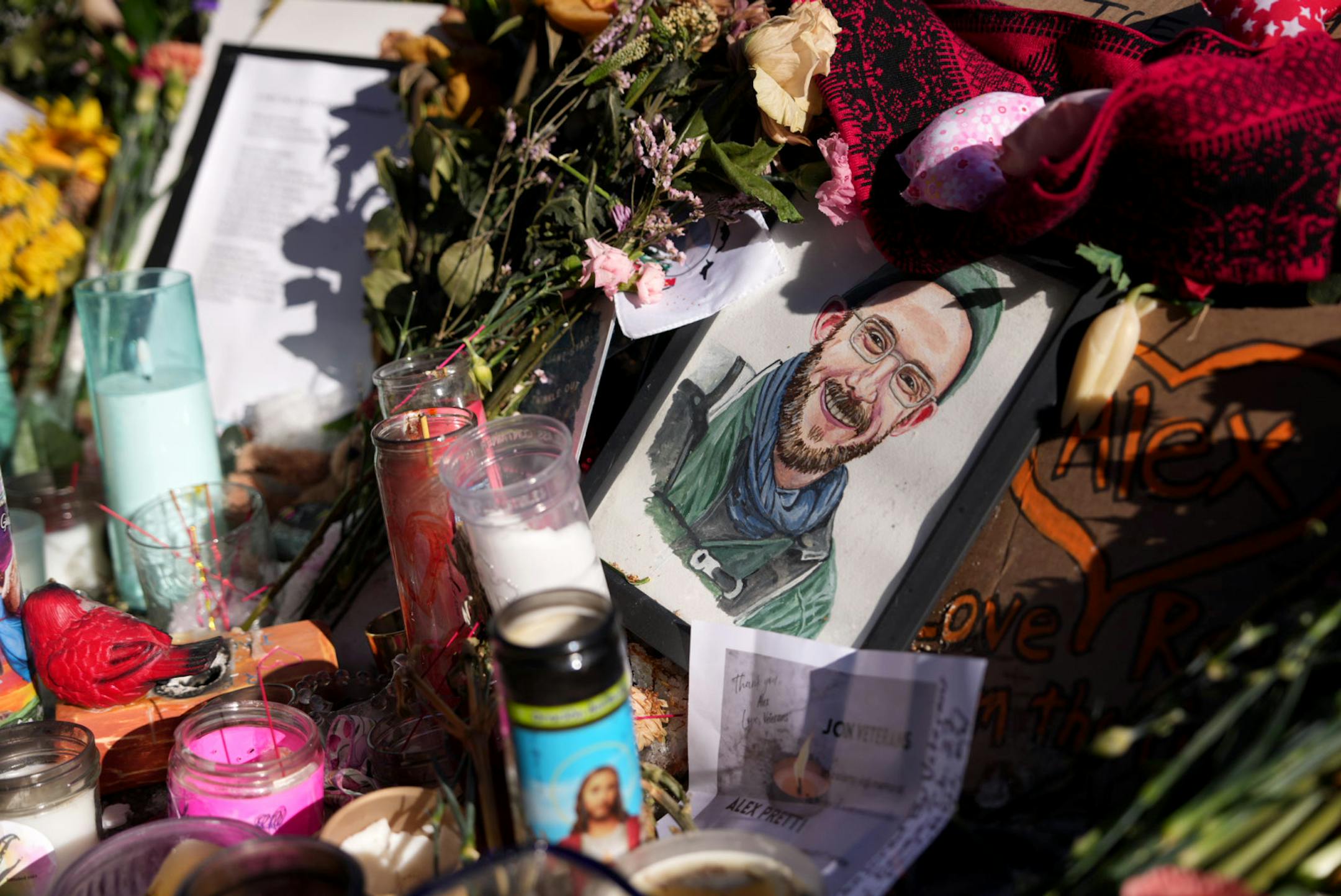
A picture of Alex Pretti is placed on his memorial in Minneapolis on Feb. 6. (Anthony Souffle/The Minnesota Star Tribune)

Opinion editor’s note: Strib Voices publishes a mix of guest commentaries online and in print each day. To contribute, click here.

•••

While the Trump administration has announced a withdrawal of a large number of federal agents, including ICE, from Minneapolis, there remains skepticism among many on the timing of the withdrawal and the number of federal agents that will remain within the city and the state of Minnesota. This announcement by the administration leaves many questions unresolved regarding the constitutional and legal legitimacy of the federal agents in Minneapolis. As such, this is an appropriate time to consider these constitutional safeguards and rights as federal agents will remain and in the context of the human injury and economic damage left behind and perhaps continuing.

During Operation Metro Surge, the American public was flooded, mostly through right-wing media and social media, with imaginary insurrection scenarios and speculation about the beginning of a civil war in Minnesota. Elon Musk posted explicitly on X to his 233,000,000 followers that there is an “insurrection” in Minnesota.

Nothing could be further from the truth. Minnesota’s conflict with the Trump administration is real. Protests against the massive deployment of federal ICE agents in Minnesota are peaceful. The issues will be resolved in courtrooms and at the ballot box. Nobody is threatening violent conflict between state law enforcement, or private citizens and federal officers.

The claims of looming civil war are just a pretext for President Donald Trump to invoke the Insurrection Act. Invoking the Act would be an end run around the Supreme Court’s decision only weeks ago that Trump had not justified National Guard deployments in Chicago, Portland and Los Angeles. Hopefully federal courts, and ultimately the Supreme Court, will be just as firm in rejecting attempts to resort to the Insurrection Act for the simple reason that there is no insurrection.

There are, however, important rights at stake. We begin with the First Amendment: right to freedom of speech and assembly, which includes the right to peacefully protest without harassment, arrest and assault by federal officers. Next comes the Second Amendment, violated in the killing of Alex Pretti. Pretti should not have been assaulted, much less executed for having a legally licensed, holstered handgun that was not used to threaten federal officers. The Trump administration’s position on the Second Amendment in this case is blatantly hypocritical. The ICE agents took Pretti’s gun away from him before they killed him.

The Fourth Amendment requires that a search warrant be authorized by a judge to enter a home or workplace, not just an ICE “administrative warrant.” The burden on the government is to provide fact-based evidence reasonably showing that a crime has been committed or is being committed.

Fifth Amendment (due process) requires that the government gives a person adequate notice of criminal charges and an opportunity to defend oneself. The decisionmaker must be neutral and unbiased. Due process rights must be afforded before there is an intrusion into a person’s life, liberty and property. And that includes federal officers separating parents from their children.

The Supreme Court is struggling with these issues. In his September 2025 concurrence in Noem v. Vasquez Perdomo, Justice Kavanaugh wrote that “apparent ethnicity” can be considered a “relevant factor” in determining reasonable suspicion for an immigration stop, provided it is not the sole basis for the detention. A few months later, amid public backlash over the so-called “Kavanaugh stop”, Kavanaugh included a footnote in the December 2025 Trump v. Illinois decision, writing that federal officers “must not make interior immigration stops or arrests based on race or ethnicity.”

The Tenth Amendment embodies the federalism doctrine governing the relationship between States’ rights and the power of the federal government. Rights that are not delegated to the federal government nor denied to the states in the Constitution are vested and flow to the states and to the people. Thomas Jefferson and James Madison would never have approved adoption of the Constitution but for a commitment that there would be a Bill of Rights, which includes the 10th Amendment, that protects the exact, present rights of the state of Minnesota from being infringed by the federal government.

Furthermore, the 10th Amendment guarantees Minnesota the right to enforce its own laws, unless expressly preempted by federal law under the Supremacy Clause of the Constitution. This includes criminal statutes prohibiting murder, manslaughter and assault, which apply as much to federal agents as they apply to everyone else. Under the common law and the 10th Amendment, states have the sovereign right to conduct grand jury investigations, perhaps resulting in indictments against federal officials who commit crimes in the course of their duties. While the Supreme Court may have granted immunity to ICE agents in civil lawsuits for money damages, to date it has not granted immunity for criminal violations by federal agents.

Under the 14th Amendment, persons born in the U.S. or naturalized, and subject to the jurisdiction, are granted both U.S. citizenship and citizenship in a state. These important citizenship rights give meaning to an individual’s rights under the Constitution and cannot be taken away by the federal government. ICE cannot rely on immigration laws to arrest natural-born citizens in Minnesota or anywhere else.

So, why the chaos in Minnesota?

Sadly, much of the blame is with the Supreme Court and its highly controversial 2024 criminal immunity decision in Trump v. United States. When a president is immune from criminal prosecution, his subordinates, ranging from the Secretary of Homeland Security to the ICE agents on the streets of Minneapolis, think that immunity also flows through to them. The Supreme Court did not rule on whether anyone other than the president is immune from criminal prosecution. But too many people in the executive branch are inferring that they can commit crimes, even murder, and get away with it.

Federal courts are starting to push back on abuse of presidential power. Most notable are the recent rulings by Minnesota’s Chief Federal Judge Patrick Schiltz (a George W. Bush appointee) that ICE has violated multiple court orders in Minneapolis. The Supreme Court must repair the damage it has done in the immunity decision by clearly drawing lines setting out the constitutional rights described above, letting presidents and federal agencies know what they can and cannot do. These constitutional “red lines” must be drawn now in Minnesota.

As for the Insurrection Act, it is a narrow exception to the general rule that domestic law enforcement is the primary responsibility of the states, not the federal government, and certainly not the U.S. military. The U.S. military is prohibited from entering a state for domestic law enforcement under the Posse Comitatus Act. The Insurrection Act is an exception to the Posse Comitatus Act, but it requires an insurrection or a physical incursion by outside forces. These conditions are not being met in Minnesota. There is no insurrection.

Fundamental, core constitutional principles and values such as the rule of law, due process and the separation of power are under assault in Minnesota and in civil society in other states. Democratic accountability of public officials by the people is being impaired. It must be restored.

The survival of our republic depends upon it.

E. Thomas Sullivan is the President Emeritus and Professor Emeritus of Law and Political Science at the University of Vermont and a former law school dean and provost of the University of Minnesota for 15 years. Richard W. Painter is the S. Walter Richey Professor of Corporate Law, University of Minnesota Law School, and former associate counsel to the president and chief White House ethics lawyer for President George W. Bush. Sullivan and Painter are co-authors of the recently published Cambridge University Press book, “The U.S. Presidency: Power, Responsibility and Accountability.” A version of this article first appeared in the Contrarian.

about the writer

about the writer

E. Thomas Sullivan and Richard W. Painter

More from Commentaries

See More
card image
Aaron Lavinsky/The Minnesota Star Tribune

The depletion of the department was and still is unsustainable.

card image