Vang: Why do so many Latinos join ICE and the Border Patrol?

Economic opportunity is one part of the story.

Columnist Icon
The Minnesota Star Tribune
February 14, 2026 at 7:30PM
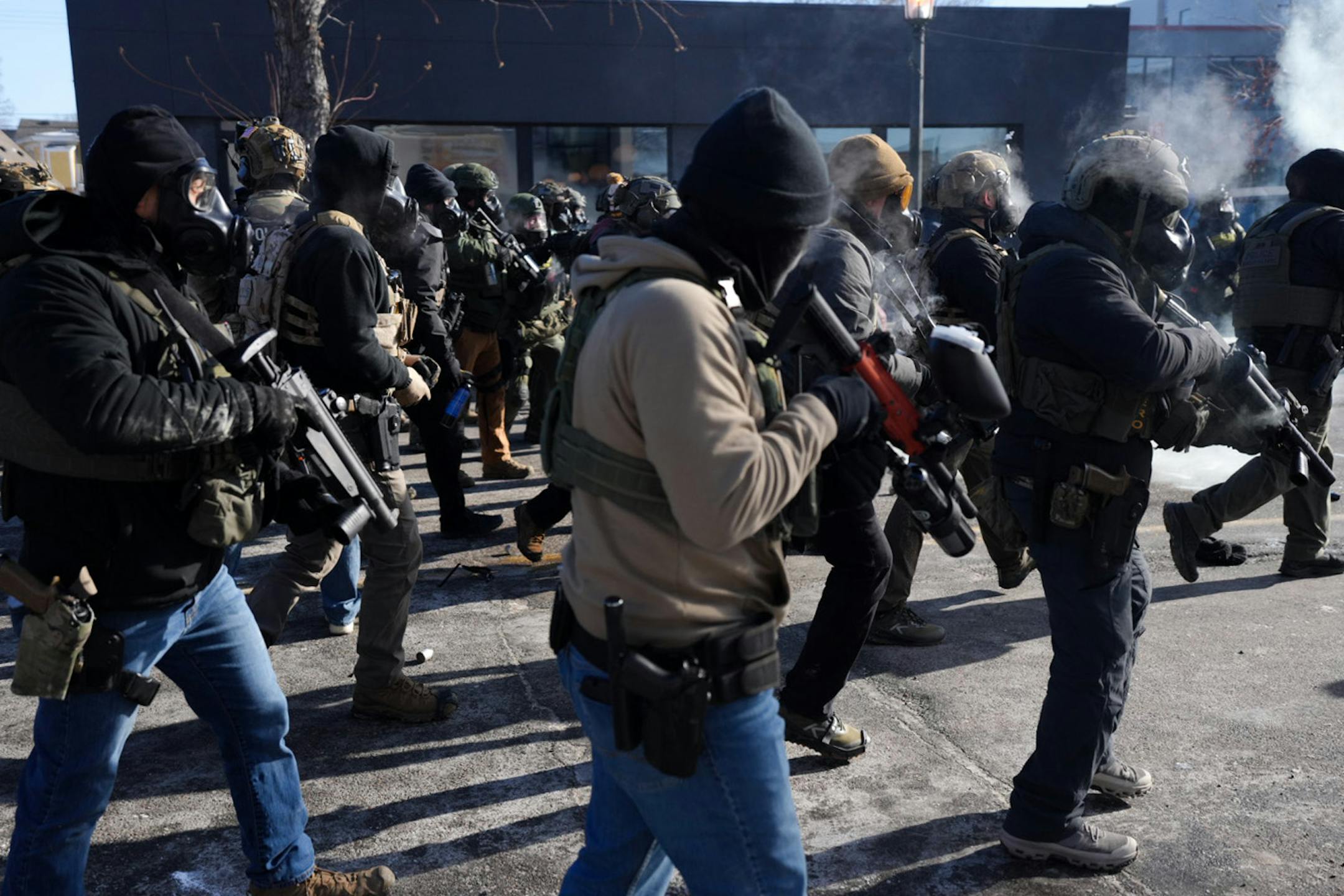
Federal agents attempt to control a growing crowd on Nicollet Avenue in Minneapolis after federal agents fatally shot Alex Pretti on Jan. 24. (Richard Tsong-Taatarii/The Minnesota Star Tribune)

Opinion editor’s note: Strib Voices publishes a mix of material from eight contributing columnists, along with other commentary online and in print each day. To contribute, click here.

•••

There is a video you might have seen among the many troubling viral videos from the past couple of months: A masked immigration agent with a thick Spanish accent demands papers from a Minnesota man whose accent sounds nearly identical to his own.

Two Latino men separated not by language, not by culture, not even necessarily by memory — only by power. One holds a badge. The other holds fear.

I’ll never forget another video I saw in recent weeks of a Hmong ICE agent demanding papers from a Hmong resident in St. Paul. Meanwhile, a Latina friend recently told me that her mother no longer automatically trusts people who look like her after a Latino ICE officer chased her into a business.

My friends and I have asked this question loudly, sometimes with tears in our eyes: Why would people of color and immigrants, particularly so many Latinos, join immigration enforcement? How can they serve an institution that harms people who look like them?

We have asked it as accusation. We have asked it as betrayal. Some have asked it as condemnation. But the truth — as it so often does — refuses simplicity.

It’s a question many Minnesotans may continue to ask in the weeks and months to come as we grapple with what has transpired in recent months. The questions will persist, even as thousands of immigration agents are reportedly leaving Minnesota this week after what has been called the largest immigration enforcement deployment in U.S. history.

I spoke with Irene Vega, associate professor of sociology at the University of California Irvine, who has spent years interviewing Latino immigration agents. Her recently published book, “Bordering on Indifference: Immigration Agents Negotiating Race and Morality,” attempts to answer this same question. She told me that many Latinos join immigration enforcement because of opportunity.

In many Southwest border communities, such as where Vega grew up, the most stable path out of poverty has long run through a uniform — military, then police, then immigration enforcement. Government recruiters build pipelines through community college programs and high school clubs. While other industries never arrive, the federal government does.

Vega calls it the “browning of immigration enforcement.”

At her suggestion I watched the documentary “At the Ready,” directed by Maisie Crow, a coming-of-age film set in El Paso, Texas. It follows Mexican American high school students enrolled in a criminal justice training program preparing them for careers in policing and as U.S. Border Patrol agents.

The central question in the film is the same one I have been trying to answer: How can you serve an institution that harms the people you love?

For some ICE and Border Patrol agents, earning $100,000 without a college degree is reason enough, Vega said. They receive a pension. Have health insurance. Are able to buy a house in a safe subdivision, which looks like paradise compared to the poor neighborhoods they grew up in. For people like me — and, I suspect, many Latino immigration officers — who translated for our parents at doctor’s appointments and negotiated hospital paperwork while we were still in grade school, stability is not abstract. It is survival.

That might explain why, according to Vega, as many as half of Border Patrol agents and about a third of ICE’s deportation officers are Latino.

So the first answer is painfully ordinary: economics. But that is not the end of the story. It is the beginning of the transformation.

Vega calls it political resocialization. The uniform does not simply clothe a person — it reorganizes them. You are no longer Latino, or Hmong, or Black, or an immigrant. You are Team ICE. The institution supplies a moral vocabulary: crime, security, order. Latino and other BIPOC immigration officers see themselves as the “good guys” who are “misunderstood” by white liberals and their own communities, she said. And the human mind, desperate to live without tearing itself apart, learns to reconcile contradiction. Indifference becomes a coping skill.

This is not self-hatred; it is adaptation. Yet adaptation turns cruel when ICE agents eat at Latino restaurants and then come back to arrest the workers at that same restaurant, as we’ve seen happen here in Minnesota, or use Spanish to draw families from their homes for a one-way trip to the Whipple Federal Building.

Along the border, Black and brown agents are familiar; in Minnesota, their presence has unsettled a public unaccustomed to seeing immigration authority in Latino faces.

In her research, some Latino officers told Vega they believed they were better at the job because they know the language, the customs, even the evasions families might attempt. Shared culture becomes a surveillance tool. The familiar becomes evidence.

“Throughout history, there has always been people willing to help those in power. There have always been Black slave catchers,” Vega said. “People do this because they want to live comfortable lives.”

While empirical research explains why Latinos have historically joined immigration enforcement, she is now working with a hypothesis that some Latinos have also joined during the Trump administration because they agree with Trump’s political and ideological values.

Vega argues that blaming individual Latino officers for the harms occurring in Minnesota leaves the underlying structural and systemic issues unexamined. It is neither fair nor accurate to have individuals carry the burden of accountability for government policy. While there is no official document stating this outright, it is reasonable to consider that employing officers of color to enforce immigration policy can function to shield the government from accusations of racism — effectively insulating the system from scrutiny.

Still, explanation does not erase consequences. Communities of color will remember who knocked at our doors, who separated families, and who killed Renee Good and Alex Pretti.

“If the government wants to use immigration agencies made up mostly of Latinos to bully a democratic state [Minnesota] into submission,” Vega said, “isn’t it easier to make people of color do it so they, ICE and Border Patrol, are not thought as racists?”

And now, there is the news that the ICE surge is concluding in Minnesota — big news, and good riddance. Though over the coming days, they will still be packing up, still driving our roads, still finishing whatever it is they came here to do. And already Minnesotans are asking the quiet question beneath relief: Where will they go next?

Because departure does not end the memory. It transfers it. Another community will soon see unfamiliar vehicles idle on familiar streets and ask the same unsettled question: How did the face at the door come to resemble our own?

about the writer

about the writer

Ka Vang

Contributing Columnist

Ka Vang is a contributing columnist for the Minnesota Star Tribune. She focuses on historically marginalized communities.

See Moreicon

More from Contributing Columnists

See More
card image
card image