Some rural Minnesota sheriffs hesitant to partner with ICE — for now

November 1, 2025
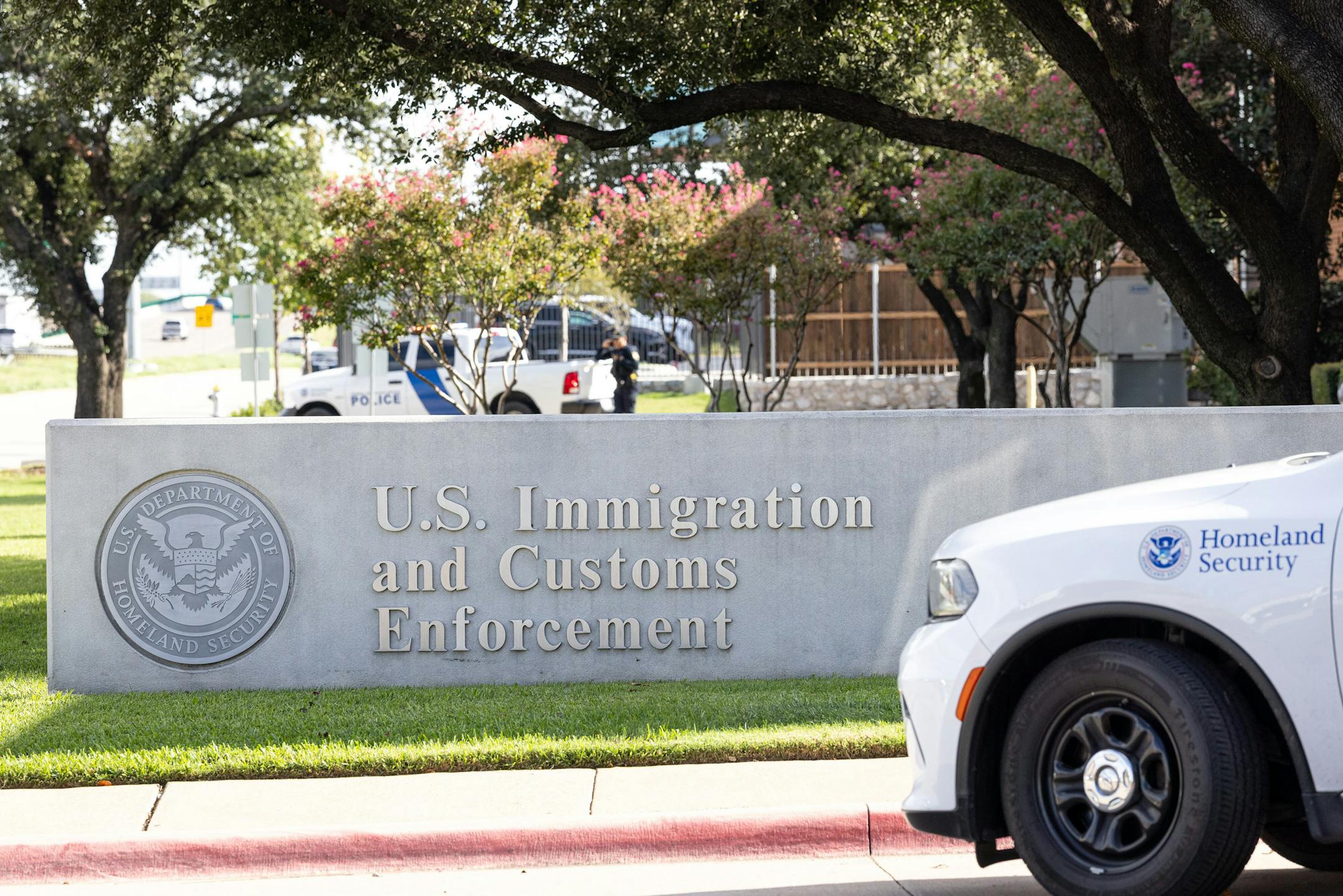
U.S. Immigration and Customs Enforcement wants local law enforcement to sign partnership agreements to aid in President Donald Trump's push for mass deportations. (Angela Piazza/Dallas Morning News)

Immigrant rights groups are trying to convince sheriffs in greater Minnesota it is a waste of their limited resources and will lead to community distrust.

The Minnesota Star Tribune

President Donald Trump’s administration has had limited success persuading Minnesota law enforcement agencies to sign partnerships with Immigration and Customs Enforcement to help with its mass deportation effort.

So far, only eight of 87 Minnesota counties — Cass, Crow Wing, Freeborn, Itasca, Jackson, Kandiyohi, Mille Lacs and Sherburne — have signed the agreements. Freeborn, Kandiyohi and Sherburne already had longstanding deals to hold detainees for ICE in their county jails.

The partnerships, which give local sheriffs authority to enforce federal immigration laws, are much more popular in conservative-leaning states with big immigrant populations. In Florida and Texas, 536 agreements have been signed. The deals garnered less interest in the Upper Midwest — including in neighboring Wisconsin, Iowa and the Dakotas — where a total of 31 agreements have been signed.

Most of the sheriffs who responded to the Minnesota Star Tribune’s inquiries about the partnerships said it is a difficult decision. They’re trying to balance limited resources with helping federal law enforcement partners while maintaining their community’s trust.

None of those who responded thought it would be a significant source of revenue, but they did say it would make it easier to help ICE when asked. Several sheriffs who haven’t signed on said it was largely due to staffing shortages and a lack of need.

Crow Wing County Sheriff Eric Klang said ICE leaders told him that at this point they’re not asking local officers to apprehend anyone. Klang says the agreement with ICE will make it easier for his deputies to transfer people already in their custody who have immigration cases to federal agents.

“We are not going to be going into meatpacking plants or Mexican restaurants or anything like that,” said Klang. “They don’t want to put us in a position that would cause conflict in our community.”

Homeland Security Secretary Kristi Noem emphasized the partnerships when she visited the Twin Cities Oct. 24, criticizing Gov. Tim Walz for refusing to assist ICE. Trump has tried to punish communities that refuse to help with his deportation effort and has branded them as sanctuaries for immigrants in the country illegally.
At a news conference, Noem claimed 4,300 immigrants have been arrested in Minnesota since January. The pace of immigration enforcement has increased dramatically nationwide since Trump returned to office, but arrests and deportations are hard to track because ICE has not provided detailed numbers since last year.

Data obtained under the Freedom of Information Act by the Deportation Data Project shows that in Minnesota, more than 1,000 immigrants were detained and 415 deported through the end of July. That’s a significant increase compared to the same time frame in 2024 under former President Joe Biden, federal data shows.

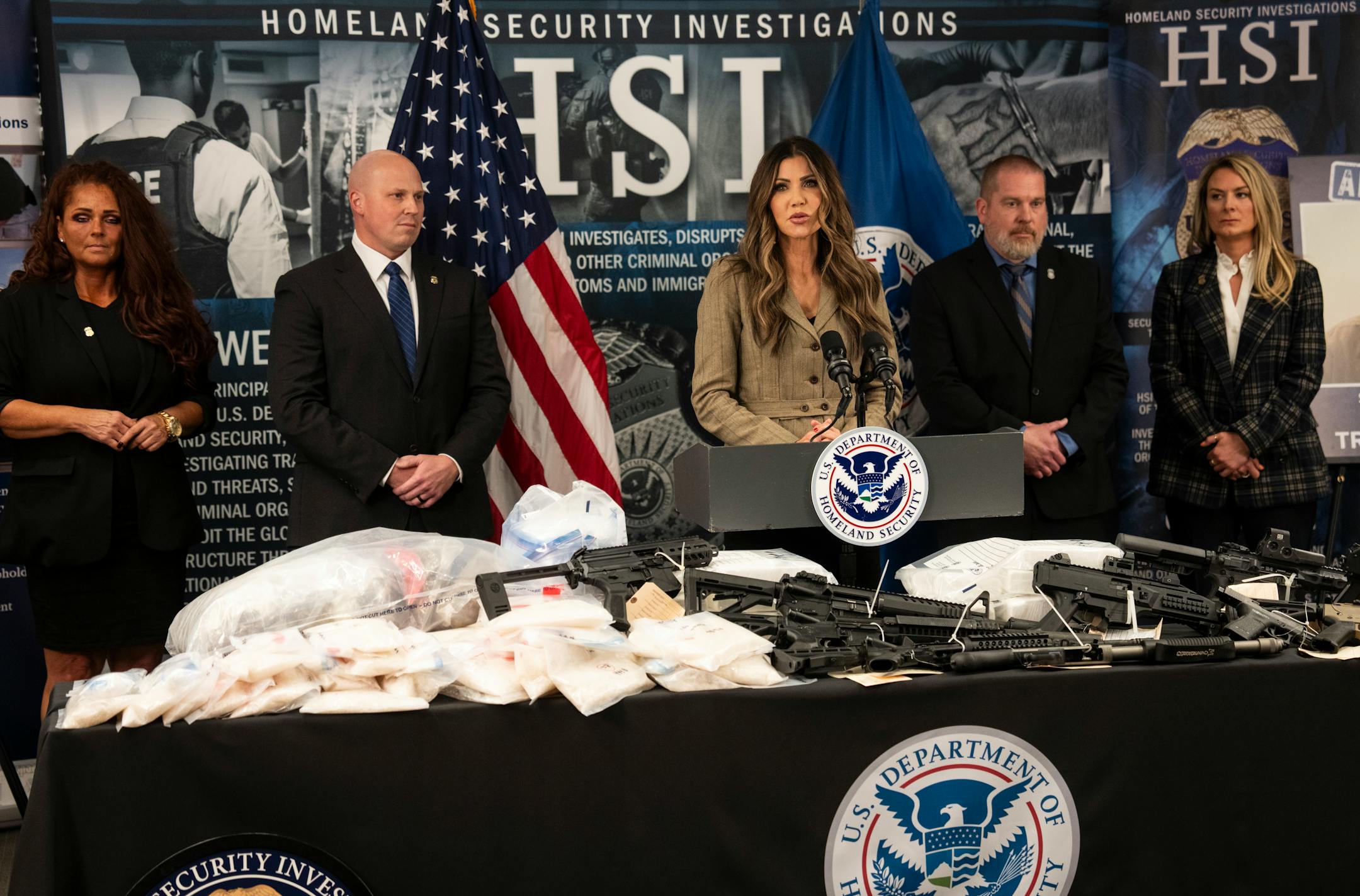
Secretary of Homeland Security Kristi Noem spoke in Minneapolis on Oct. 24, alongside ICE staff Tauria Rich, David Easterwood, Sam Westbay and Tonya Price. (Renée Jones Schneider/The Minnesota Star Tribune)

Entering the country without permission is a misdemeanor, and re-entering after being deported is a felony. Residing in the U.S. without authorization or overstaying a visa is a civil violation, and most cases are handled by the Executive Office for Immigration Review, a part of the Department of Justice.

The administration wants to increase the pace of removals even more and has expanded ICE’s powers, including pushing local law enforcement agencies to sign the partnership agreements.

In September, ICE leaders announced the signing of more than 1,000 of the agreements, a more than sixfold increase in the number of deals the agency had at the beginning of the year. Officials highlighted $14 billion approved by Congress to reimburse salaries, cover overtime and pay bonuses for officers who aid ICE.

Immigrant rights groups fear a partnership with ICE will lead to local officers working alongside masked federal agents who are arresting people in unmarked vans.

“We can’t trust anyone who signs on. It’s doing ICE’s job for them,” said Patty Keeling, a member of the nonprofit Fe y Justicia, or Faith and Justice. “Why would you do ICE’s work?”

How the agreements work

The Trump administration has expanded its immigration enforcement powers by relying, in part, on the 1996 Illegal Immigration Reform and Immigrant Responsibility Act. The act allows ICE to delegate some authority to local law enforcement.

ICE recently changed the required training from in person to online. Depending on the type of agreement, officers need between eight and 40 hours of instruction. Training was expected to begin Oct. 1 but is delayed because of the government shutdown.

Once local officers are trained, their departments can get salary reimbursements and bonuses for helping ICE.

There are three ways local law enforcement can partner with ICE, and some agencies sign multiple agreements. Minnesota has nine agreements in eight counties. The jail model allows officers to interrogate suspected noncitizens arrested on criminal charges, and a warrant model allows local law enforcement to execute ICE administrative warrants.

Both programs help address some of sheriffs’ liability concerns about holding people wanted by ICE in their jails beyond the end of their criminal cases. Anoka and Nobles counties were successfully sued for doing so, and a Carver County case is pending.

The third, a task force program, allows local law enforcement to do things like check citizenship status during their typical day-to-day work in their communities. If local officers suspect someone is in the country illegally, ICE will decide what to do next.

Mille Lacs County Sheriff Kyle Burton said his department signed up for the task force program. Burton said he hopes the partnership will be a “deterrent for anyone who is in the United States illegally and intent upon coming into Mille Lacs County to engage in violent or criminal behavior.”

Community groups push back

Members of the Immigrant Defense Network — a coalition that includes faith groups, political organizations, a sustainable farming nonprofit and the Minnesota chapter of the ACLU — are meeting with other sheriffs in deep-red parts of rural Minnesota to dissuade them from signing on.

They argue the partnerships are a misuse of local funds and push local law enforcement into roles that make immigrants less likely to report criminal activity.

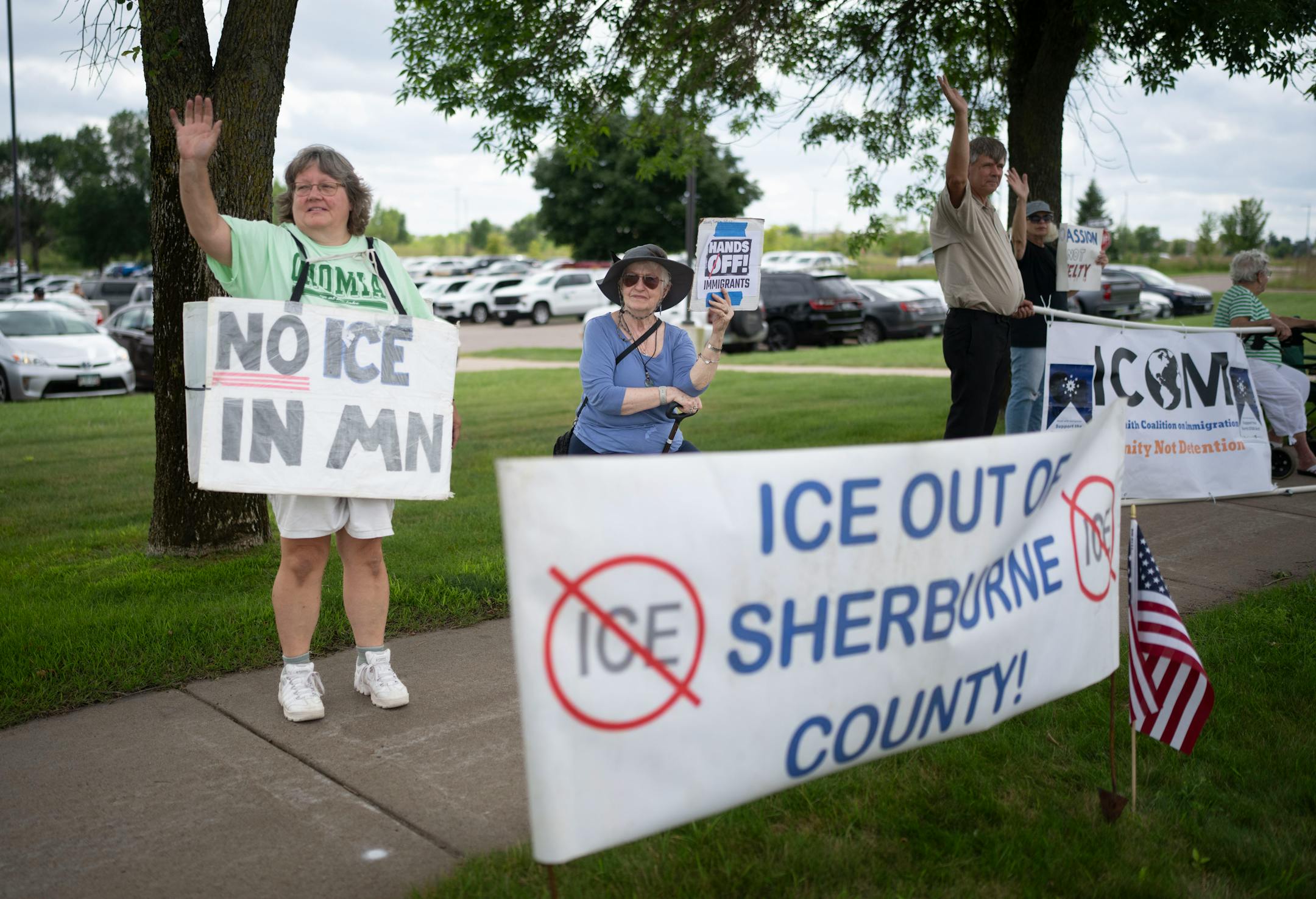
Darla Scouten and Rita Quigley wave to cars as they and others protest ICE in front of the Sherburne County Government Center, where ICE detains dozens of people, in August. (Renée Jones Schneider/The Minnesota Star Tribune)

Renée Cardarelle, a member of Wright County Indivisible Immigrant Aid, has met with community groups across the state and says a growing number of Minnesotans are uncomfortable with how the president’s deportation push is playing out. People are eager to tell sheriffs they’re shocked how quickly ICE’s focus moved from convicted criminals to immigrants seeking asylum and other protections.

“There’s an overwhelming anger that this is happening and they can’t stop it,” Cardarelle said. “We don’t want this to be part of what our country means. People are so appalled that we’ve become this.”

Immigrants rights groups say they’ve made progress persuading rural sheriffs not to sign up to partner with ICE. But sheriffs in Benton, Morrison and Stearns counties, who responded to questions about not signing contracts, said the reasons had more to do with limited resources and a lack of need than the politics of the partnerships.

“Our agency has no additional capacity to take on enforcement duties that are the jurisdiction of the federal government,” said Benton County Sheriff Troy Heck.

Stearns County Sheriff Steve Soyka said, “We are not seeing the volume of people that would justify it right now.”

Opponents of the partnerships say they will keep the pressure on. They worry the financial incentives could be hard for local officials to pass up as budgets tighten.

“When you talk to your local sheriffs, they will let you know, first and foremost, you are their boss,” said Nick Olson, an organizer with the Land Stewardship Project, a sustainable agriculture nonprofit. “We want to make sure our members and people in rural places know they have influence over their sheriffs.”

about the writer

about the writer

Christopher Magan

Reporter

Christopher Magan covers Hennepin County.

See Moreicon

More from Greater Minnesota

See More
FILE - In this July 16, 2004, file photo, a gray wolf is seen at the Wildlife Science Center in Forest Lake, Minn.
Dawn Villella/The Associated Press

Residents worried about safety say it’s time to drop the wolf’s protected status after several close encounters this month alone.

card image