
Readers Write: University of Minnesota/Fairview deal, the state of Minneapolis

You can’t win if you don’t play.

The Minnesota Star Tribune
November 15, 2025 at 1:00AM
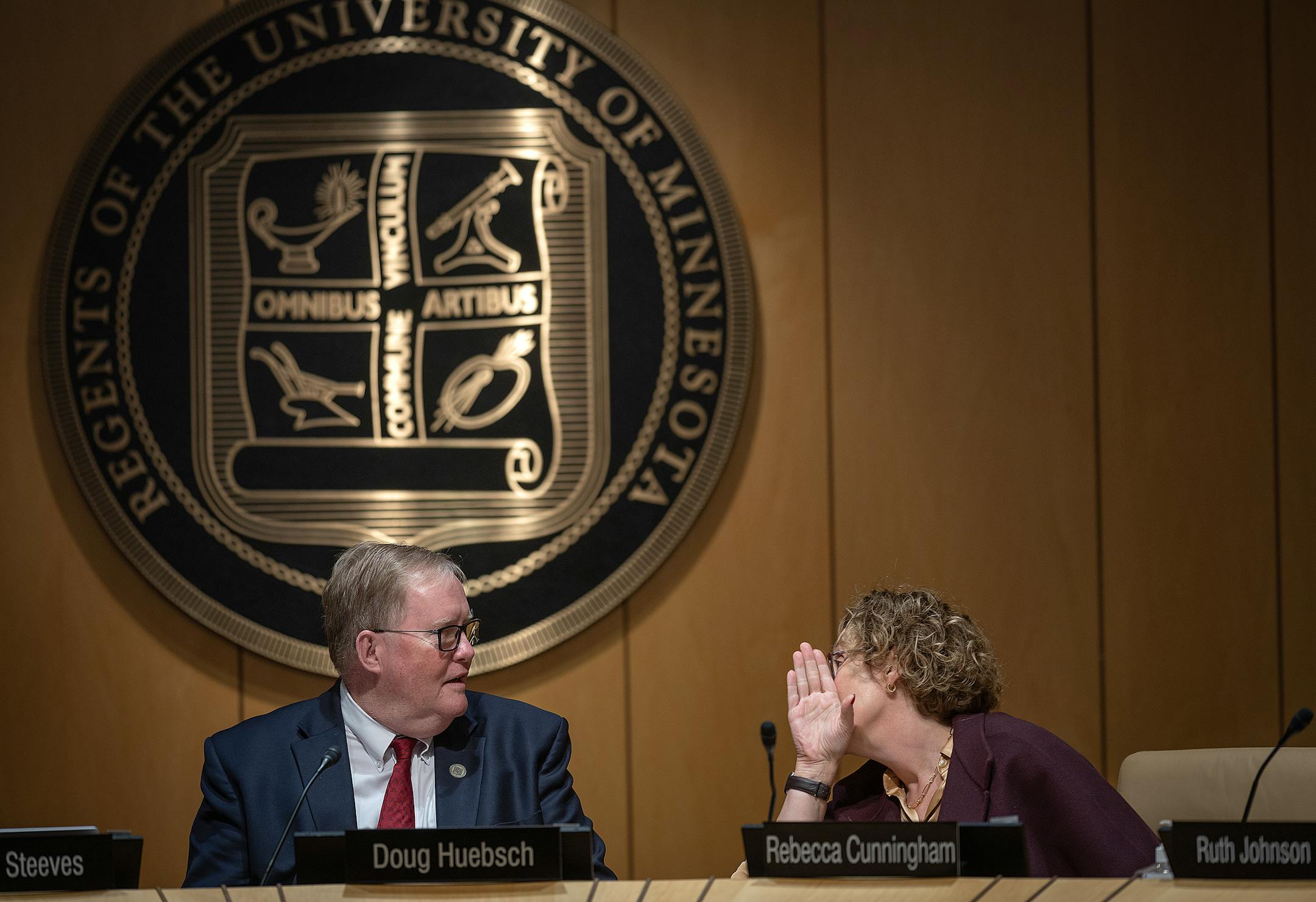
University of Minnesota Board of Regents Chair Douglas Huebsch, left, and U President Rebecca Cunningham chat before a discussion regarding the controversy over Fairview's plan to partner with University of Minnesota Physicians on a new deal. (Elizabeth Flores/The Minnesota Star Tribune)

Opinion editor’s note: Strib Voices publishes letters from readers online and in print each day. To contribute, click here.

•••

The University of Minnesota’s latest tantrum with regard to the Fairview negotiations is an embarrassment that reflects incredibly poorly on U President Rebecca Cunningham and the U’s Board of Regents — and, by extension, on Gov. Tim Walz for appointing several of the latter behind closed doors (“U says Fairview deal will have ‘negative’ effect on Medical School,” Nov. 13, and “U: Fairview deal unlawfully negotiated,” Nov. 14). It’s simple: You do not get to flip the table, storm out of the room and then get mad when the people who stay behind carefully put things back in order and carry on.

Refusing to meaningfully negotiate has been a recurrent theme of Cunningham’s leadership (see: the Teamsters’ strike), and the board now threatening to tighten the leash on University of Minnesota Physicians (UMP) is an alarming escalation. One almost wonders if this was the plan all along: Refuse to negotiate, gaslight the public about it and take advantage of the resulting casus belli to seize power over a hitherto autonomous entity within the medical enterprise. Of course, simple incompetence also cannot be ruled out.

One has to wonder how much patience the Legislature has for these antics at this point. Yet another embarrassment for Cunningham, the board and the U.

Cal Mergendahl, St. Paul

•••

For over 25 years, I coordinated clinical aspects of the U (and later, Fairview Health System) organ transplant programs for donor and recipient patients. It entailed working with organ donor systems, hospital providers, physician groups, insurance providers, federal and state governmental entities and, finally, patients themselves.

The current folderol brings me back to the beginnings of the Fairview and U merger and “here we go again.” If U representatives gasped, they should have done so quietly in a closet instead of whining that they weren’t at the table. If you are part of the collaborative and should have been in there, why weren’t you? UMP interim chief executive Dr. Greg Beilman and Attorney General Keith Ellison are the best ever leaders, and shame on you for not supporting them but proceeding to further thwart efforts to come together.

Drop it back, get in there, do your job and get on with it!

Barb Elick, White Bear Township

The writer is retired administrative director of organ transplant services for the University of Minnesota & Fairview Health System.

•••

The U has struggled with managing the university hospital for years. That’s why the hospital was sold to Fairview a number of years ago. The U has been unable to reach long-term service agreements with Sanford, Fairview and, most recently, Essentia (“Stalemate over U medical center ill serves Minnesota,” Strib Voices, Nov. 9). Time to put the U’s big ego aside and instead embrace the agreement between Fairview and UMP. Work this most recent agreement out and move on with the business of providing medical care for Minnesotans.

Richard Portnoy, Minneapolis

THE STATE OF MINNEAPOLIS

Can you listen to actual residents, please?

It’s frustrating to constantly read letters from people who live outside of Minneapolis talk about the “deterioration of the city” and the “only folks walking about [being] gangs of kids with seemingly nefarious intentions.” I’m also frustrated that the Star Tribune would allow opinion editor Phil Morris to write a piece that was so anti-Minneapolis and so filled with illogical and exaggerated comments. In his Nov. 13 column “Fear is the narrative the city can’t shake,” Morris gave credence to the claims of a Duluth children’s mental health professional, Richard Wolleat (as though that role gives him some special insight), that Minneapolis is no more than a den of criminal activity. To me, someone who has lived in downtown Minneapolis for the past nine years and never encountered a “criminal,” the real laughable part comes when Morris notes that the person who is making these claims about Minneapolis’ decadence has not “stayed downtown for five years” because he is scared stiff. Yet, Wolleat apparently feels comfortable stating that the only folks walking about are gangs of kids with nefarious intentions. How did he observe these gangs of kids when he hasn’t stayed downtown in the past five years?

My frustration from these types of comments, and this type of reporting, is that I am personally familiar with these stereotypes. From old friends and friends and family who grew up in western Minnesota, I hear these comments about how bad it is in Minneapolis. Yet none of the people making these comments ever visit Minneapolis; they’re too afraid. They all buy into the political groups that are well-served by depicting Minneapolis as a city that is run by far-left loonies who are willing to allow criminals to run rampant.

To put it all in perspective, from a strictly objective standpoint, I offer these calculations: Minneapolis has had 51 murders as of this writing, which equates to 1 murder per every 8,400 or so people who live in Minneapolis. Sadly, Hanska, Minn., recently suffered a double murder, which equates to 1 murder per every 200 or so people who live in Hanska; in essence, they are 42 times as likely to be murdered as is a Minneapolis resident. I realize that this is a ridiculous hypothesis, yet I submit that 99% of us who live in Minneapolis feel as safe and sound as do the approximately 400 residents of Hanska.

Much like the Hanska residents, we do not subject ourselves to danger where we perceive it may exist, so it is frustrating when people who don’t even come to our city claim that danger is everywhere.

Stephan Patnode, Minneapolis

•••

I enjoyed reading Morris’ recent column, “Fear is the narrative the city can’t shake," and agree that supporting public safety is foundational to any hope of a successful resurgence in the city.

Where I take issue is the subtle suggestion that the perception of crime in Minneapolis is overblown and unjustifiably impeding the city’s ability to succeed. Morris suggests that the perception is something that “could simply be dismissed as outstate hyperbole” but for incidents like a Minneapolis City Council member being carjacked.

The facts are that despite some declines in violent crime from recent peaks in 2021-22, violent crime in Minneapolis remained 45% higher in 2024 than it had been in 2018. Furthermore, despite representing just 7% of the state’s population, Minneapolis represents 33% of the state’s total number of violent crimes, 45% of its murders, 56% of its robberies and 78% of its carjackings.

Perceptions are matched by the data, and by the observations and experiences of Minnesotans who are tired of being labeled as hyperbolic or unjustifiably fearful. They are neither. Instead, they have witnessed a city that is in obvious decline and are making the rational decision to limit their exposure unless or until things improve.

Improvement does not start, as Morris suggests, “with showing up, walking the streets we claim to love.” It starts when city leaders prioritize a properly staffed police force and encourage that force to be proactive. Only then will criminals be “dehorned,” and citizens emboldened to reclaim the city.

David Zimmer, Minnetonka

The writer is a public safety policy fellow at the Center of the American Experiment.

about the writer

about the writer