
Burcum: Two decades, few solutions since Rocori, Red Lake school shootings

I covered both of these tragedies. The memories of those victims made Wednesday’s tragedy at Annunciation even more painful.

Columnist Icon
The Minnesota Star Tribune
August 29, 2025 at 8:30PM
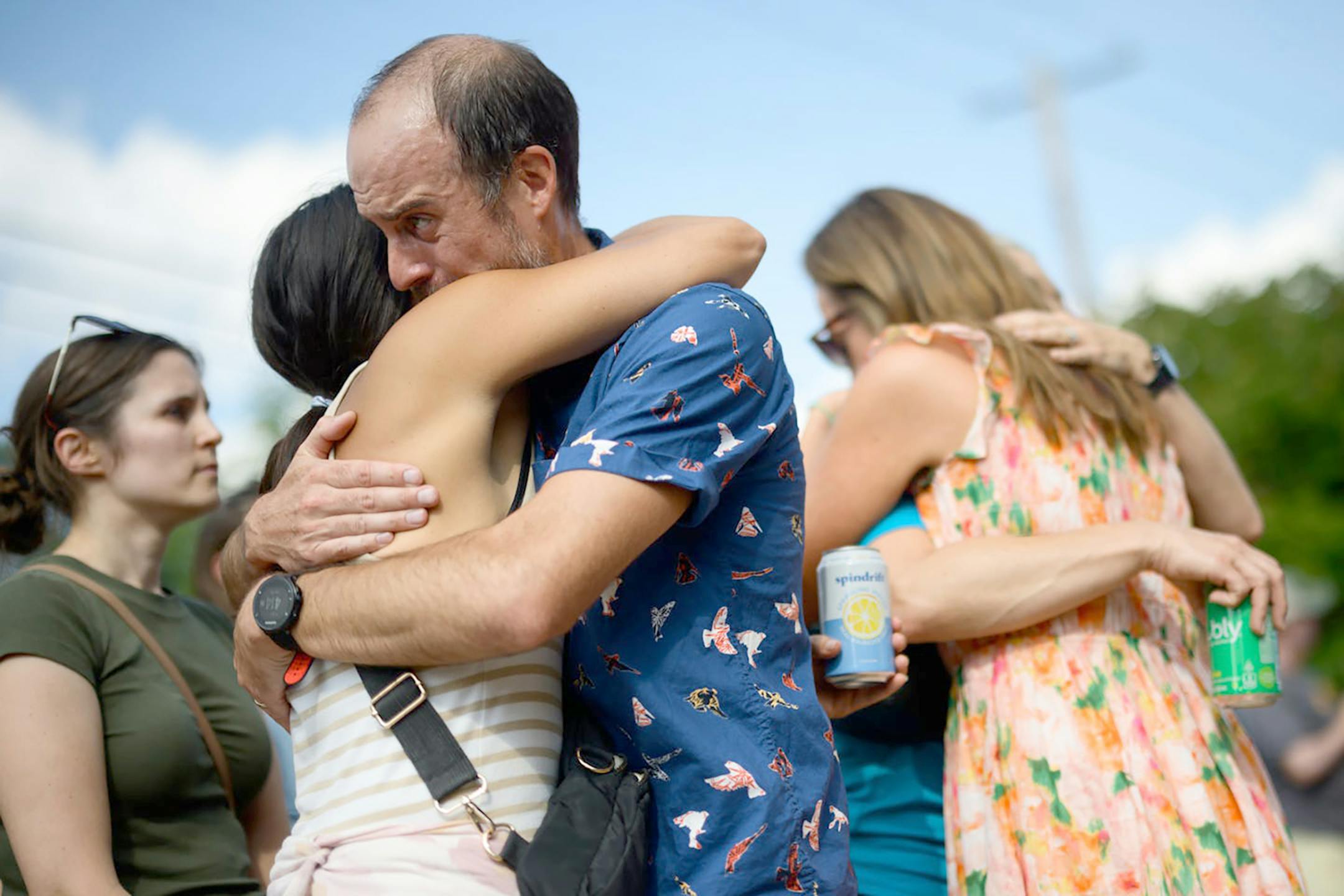
Community members embrace Jesse Merkel, whose son Fletcher was killed in Wednesday's shooting: We are no closer to solutions, writes Jill Burcum, than we were two decades ago. (Aaron Lavinsky/The Minnesota Star Tribune)

Opinion editor’s note: Strib Voices publishes a mix of commentary online and in print each day. To contribute, click here.

•••

Aaron Rollins would be 39 now. Seth Bartell, 36.

Chase Lussier would be in his mid 30s. The infant boy this young father didn’t get to see grow up: now in his early 20s.

As the horrific news of the massacre at a Minneapolis Catholic church and school broke Wednesday, memories of those who fell victim to previous school shootings in Minnesota added to my heartbreak.

In the early 2000s, I found myself on the road twice in two years to cover gun deaths at schools in rural Minnesota. Rollins and Bartell died in September 2003 at the hands of another student at Rocori High School in the small Stearns County community of Cold Spring.

Lussier was 15 when he died in March 2005 at the Red Lake High School on the Red Lake Nation north of Bemidji. He was one of five students, and four adults, killed that day by the perpetrator, another student who then took his own life.

That Minnesota has now added the names of an 8-year-old and a 10-year-old, who died at a Mass to start the school year, is an outrage. This crime plagues our era. Yet we are no closer to the consensus and solutions needed to end it than we were two decades ago.

The problem instead has grown worse. The Star Tribune reports that school shootings and mass shootings are on the rise in Minnesota and across the nation.

“The K-12 School Shooting Database counted just three from the 1960s to the 1990s ... . There have been, however, more than 30 school shootings in the state since the year 2000. No one died in most of them, and there were no physical injuries in many others.”

The deadly days at Rocori and Red Lake are the awful exceptions to that. I can’t help but think what a disgrace it is to the memories of Aaron, Seth, Chase and the other victims that this tragedy keeps happening.

I pray that a different Minnesota writer isn’t looking back at the Annunciation deaths after another tragedy 20 years from now and feeling equally bereft about solutions. But it’s hard to be hopeful when we’ve been able to do so little to keep guns out of the hands of those who would use them to harm.

On Thursday, several Minnesota doctors thankfully offered a pragmatic step individuals can take.

In their commentary for the Star Tribune, they note that firearm injury became the leading cause of death for American children in 2020. They recommend ensuring your own firearms are stored securely and asking the same of other parents before your child has a playdate at a friend’s house.

It’s not a panacea but it’s solid advice that, I might add, reminds us of the responsibility that accompanies Second Amendment rights.

There are firearm safes that can be easily opened with a code should you need quick access for home defense. Cable gunlocks offer another safety layer. If you can afford a firearm, you can afford this equipment.

There’s no excuse for not securing a weapon, though one pushback I’ve encountered is that this isn’t necessary because children in the home have completed gun safety courses.

To those who might argue this, let me tell you that part of my Rocori coverage involved interviewing the parents of the student perpetrator. He had undergone this training, too. And yet, he still made a deadly decision back in September 2003.

Medical research in the years since then may shed some light. A 2010 medical journal article concludes that “Longitudinal neuroimaging studies demonstrate that the adolescent brain continues to mature well into the 20s.”

In other words, while adolescents’ bodies increasingly look like adults, the brain requires additional time to mature, a reality that should warrant caution about firearm accessibility.

Wednesday’s tragedy also got me thinking about John Egelhof, a now-retired FBI agent who responded to take initial command of the homicide scene at Red Lake High School in March 2005.

Egelhof authored one of the most searing commentaries about school shootings that I’ve ever read. The column appeared in the Star Tribune on Dec. 29, 2012.

He doesn’t mince words, calling the high school a “charnel house left after a massacre perpetrated by a disturbed boy, aided passively by peers who knew at least that he was fascinated with school shootings and was talking about doing one.”

Egelhof also spent “countless hours reviewing video, chat logs and interviews.” He would have a non-fatal heart attack along the way.

What’s haunted me for years about Egelhof’s essay is his call to better wield technology to preempt tragedies like this.

Future school and mass shooters, he wrote, have “one significant vulnerability — their own obsessions.” By this Egelhof means that there are websites devoted to school shootings and a “cult of death” that frequents them.

The FBI has squads that track those who would sexually exploit children met online. Egelhof asked, could law enforcement employ the same technique to prevent school shootings and other mass casualties?

Almost 13 years have passed since then. I called Egelhof Wednesday night to see if he could answer his own question. But Egelhof declined to talk, other than saying he’s been retired too long to know.

For lawmakers looking to do something after the Annunciation tragedy, here’s a direction worth pursuing. Has Egelhof’s solution been tried? Does it work? If so, can efforts be scaled up or improved? And what can be done to help caregivers better understand when a child’s interest in mass casualty events veers into unhealthy obsession?

A hearing at the state or federal level could shed valuable light on this, with the potential to find common ground that so far has been heartbreakingly and shamefully elusive.

about the writer

about the writer

Jill Burcum

Editorial Columnist

See Moreicon