Advertisement

Washington: Instead of scrapping skyways, let’s work on getting people in them

From Duluth to St. Paul, there has been talk about dismantling portions of them. But let’s not forget why they were built in the first place.

Columnist Icon
The Minnesota Star Tribune
February 24, 2026 at 6:58PM
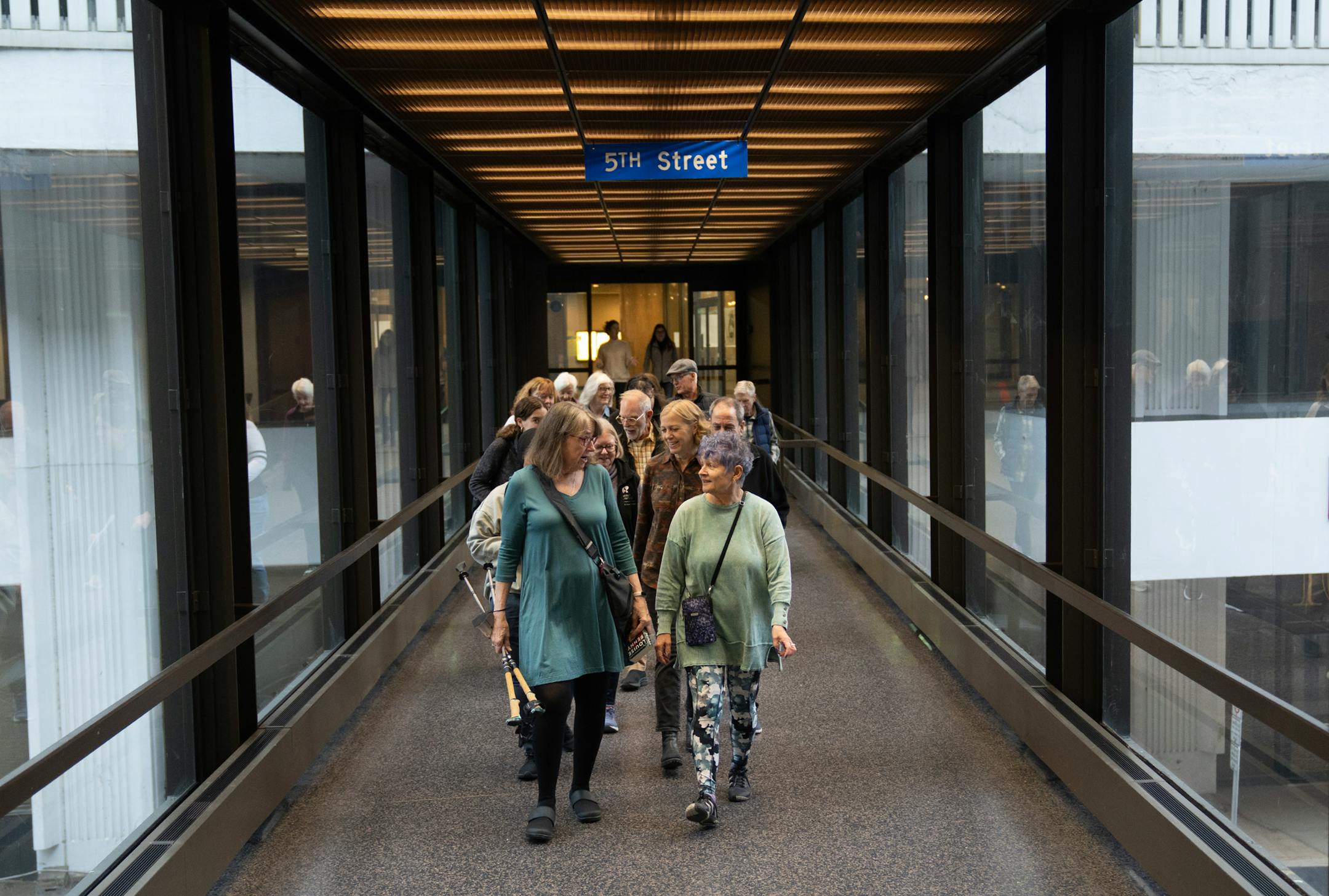
Peg Guilfoyle and Crystal Merriweather, left to right, lead the Sky Walkers, an active group of people who live in apartments connected by the skyway, on their weekly walk on Nov. 21, 2023, in the skyway in downtown St. Paul. (Alex Kormann/The Minnesota Star Tribune)
Advertisement

Opinion editor’s note: Strib Voices publishes a mix of material from eight contributing columnists, along with other commentary online and in print each day. To contribute, click here.

•••

If you’re a regular user of the skyway systems — as I am in both the Twin Cities and Duluth — you may have stopped short on your jaunts after hearing what an ex-mayor and current mayor have been saying about them lately.

In a December interview following his re-election defeat, outgoing St. Paul Mayor Melvin Carter seemed to throw that city’s skyways under a bus — or lower them in front of one.

“For all the conversations that we’ve had for the need for more street-level vitality downtown,” he told the St. Paul Pioneer Press, “we’re also unwilling to even discuss the possibility of taking down that whole big infrastructure that we’ve built to make sure nobody ever has to walk on the street downtown. I’m talking about our skyways.”

Not to be outdone, Duluth Mayor Roger Reinert was talking about the same thing a few days later, using that city’s slightly different name for them.

“We simply have more miles of skywalk than we can maintain and activate effectively,” he wrote in a Duluth News Tribune commentary, noting a city study to “determine which sections should remain open and which should be retired or returned back to the buildings through which they currently pass.”

The study, presented to Duluth’s City Council two weeks ago, cost $58,900 — though any skywalk user could have done it for less, throwing in the cost of the napkin. The arguments against them are hardly new: They’re old and demand upkeep. They attract unhoused people. No one uses them. There are scores of vacant storefronts. And they compete against street-level businesses.

Advertisement

Some of those concerns are valid. Others verge on illogical. For instance, if the skywalks are truly empty, who are those invisible customers they’re supposedly stealing from street-level businesses?

As for the issues with merit, the litany of woes concentrates on the skyways themselves, not the buildings and spaces immediately around them. Sections are indeed in disrepair, but so are other parts of the same downtown buildings they connect to. The same is true for occupancy rates. How would removing a skyway suddenly bring a rush of entrepreneurs to the third and fourth floors above it?

Even if there are legitimate concerns, they have to be weighed against the primary reason skyways and skywalks were built in the first place:

We’re in Minnesota. It’s cold as hell.

And that means for customers to get to those ground-level businesses, they have to find street parking, pull down their earflaps and climb over or around a 3-foot snowbank (which is how high they are in Duluth this week) just to find out whether an establishment is open.

That’s not hypothetical; it’s precisely what happened on Sunday when I tried to take a St. Paul couple, one of whom has mobility challenges, to lunch in Duluth’s downtown arts district. We parked in a nearby ramp and headed for the skywalk — and found it locked.

Advertisement

We got back in the car to search for street parking but quickly gave up as the piled snow was impossible for the person in our group using a cane. At that point we chose a restaurant up the hill with its own lot. So much for patronizing downtown businesses.

That speaks directly to the fallacy suggested by Reinert (whose aide kept putting off my requests for comment) that the answer is chopping off sections of skyways, which could be the part someone needs most. The point of them isn’t to provide a circuitous route from one end to the other, just as Interstate 35 wasn’t designed solely for drivers headed from Duluth to Mexico. Skyways are most useful when you just want to go a block and a half without bundling up or crossing busy streets.

That said, there are those who do go the distance — like the registrants for this Saturday’s Skyway 5K. An idea tossed around for a decade, the race will begin and end at St. Paul’s Union Depot, traveling through 16 buildings and over 16 bridges.

“Almost 40% of the people who’ve signed up have never been inside the skyway system before,” race planner Jess Fast told attendees at a downtown community meeting last week. “This is going to be a very memorable first time in the skyway.”

More than just something fun to do, the race directly addresses — and helps answer — the skyways’ biggest challenge: how to bring new people into them. As of Monday, 735 racers had registered.

To that group add skyway regulars, including a Tuesday morning walking group I’m part of. Borrowing the idea from mall walkers, our weekly St. Paul stroll covers a mile and a half indoors, with an occasional venture outside, weather permitting.

Advertisement

Another idea from one of my walking group buddies is to create a weekly progressive dining event for downtown residents to visit skyway-connected restaurants at a discount.

Each of these offers more of a solution than anything Reinert and Carter are proposing. (Carter called me over the weekend to say that when he spoke of “taking down that whole big infrastructure,” he didn’t mean tearing it all down, “but that they should be part of a discussion of the future of downtown.”)

Thankfully, two other mayors aren’t swinging the wrecking ball.

Communicating that there are no plans to dismantle the Minneapolis skyway system — the world’s largest — Mayor Jacob Frey said in a statement: “Our skyway businesses are a huge and important asset to our downtown, and skyways themselves serve as important transportation routes used on a daily basis.”

As for new St. Paul Mayor Kaohly Her, members of my walking group didn’t have to ask what she thinks. She voted with her feet and joined us last week.

“I used to walk the skyways on my first job,” she said before we headed out from the U.S. Bank building lobby.

Advertisement

“It’s so different than what it was back in the day, and it actually makes me quite sad to see what it’s become,” she continued. “I’m very much invested in what you all care about because that matters to me too, and I would love to see our downtown and our skyways and our St. Paul be what it used to be.”

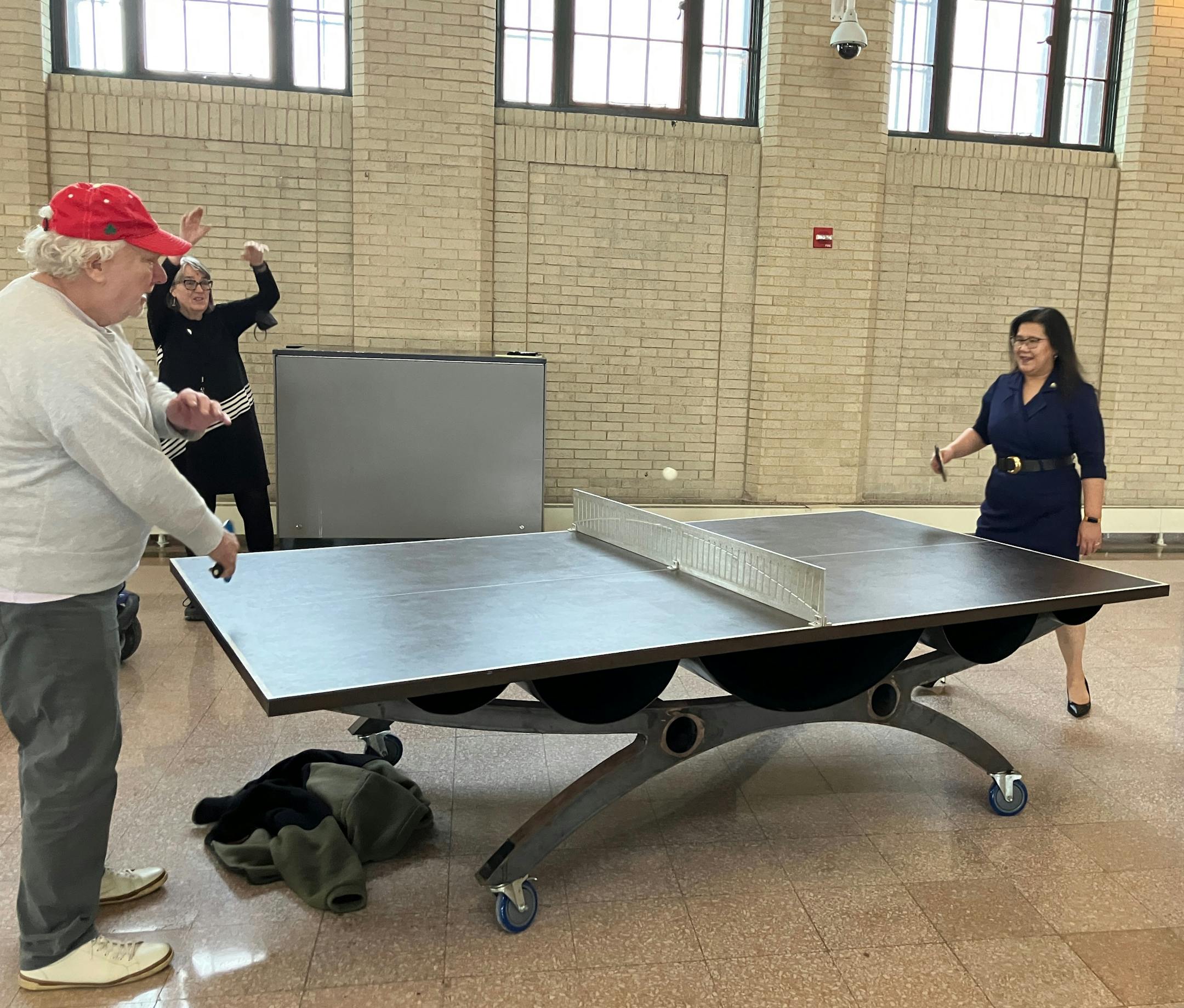
St. Paul Mayor Kaohly Her (right) faces off against skyway-walking-group member Gary Haley as Peg Guilfoyle looks on. The mayor joined the group for their Tuesday morning weekly walk through the St. Paul skyway system on Feb. 17.
St. Paul Mayor Kaohly Her (right) faces off against skyway-walking-group member Gary Haley as Peg Guilfoyle looks on. The mayor joined the group for their Tuesday morning weekly walk through the St. Paul skyway system on Feb. 17. (Provided by Robin Washington)

She wasn’t all business. In the Union Depot, she spied a ping-pong table and challenged a walker to a quick game.

She won easily. Score one for the mayor — and for the skyway that led her there.

about the writer

about the writer

Robin Washington

Contributing columnist

Robin Washington is a contributing columnist for the Minnesota Star Tribune. He is passionate about transportation, civil rights, history and northeastern Minnesota. He is a producer-host for Wisconsin Public Radio and splits his time between Duluth and St. Paul. He can be reached at robin@robinwashington.com.

See Moreicon

More from Contributing Columnists

See More
card image
Alex Kormann/The Minnesota Star Tribune

From Duluth to St. Paul, there has been talk about dismantling portions of them. But let’s not forget why they were built in the first place.

card image
Advertisement