
Film review: What went so wrong for Vikings QB Max Brosmer in his first NFL start?

A collective letdown around Brosmer led to one of the worst statistical first starts in recent memory.

The Minnesota Star Tribune
December 3, 2025 at 4:00PM
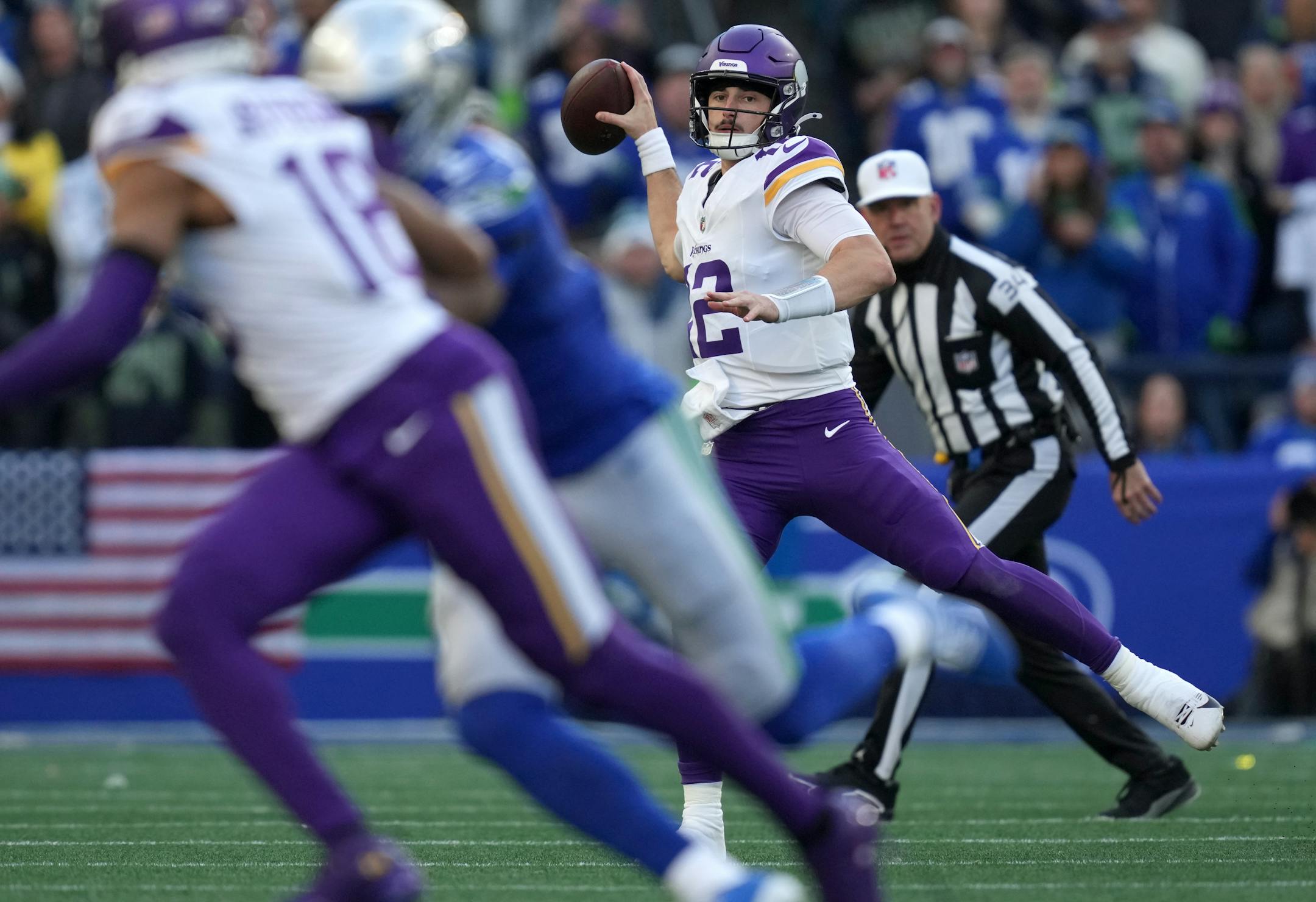
Vikings quarterback Max Brosmer completed 19 of 30 passes for 126 yards and four interceptions against the Seahawks in Sunday's 26-0 loss in Seattle. (Anthony Soufflé/The Minnesota Star Tribune)

Some statistical analyses rate Vikings quarterback Max Brosmer’s first NFL start as one of the worst in league history.

That’s what happens when a shutout loss meets four interceptions and 2.8 net yards per throw.

How exactly that happened against one of the NFL’s best defenses during Sunday’s 26-0 loss to the Seattle Seahawks does not fall just on Brosmer.

Kevin O’Connell, the reigning NFL Coach of the Year, took blame in the hours to follow as he oversaw a game plan that asked Brosmer to step into a simplified version of their vertical passing attack.

Receiver Jordan Addison dropped two passes. Guards Blake Brandel and Will Fries, among others, missed blocks.

“We wanted to allow him to function in our offense because he showed the ability to,” O’Connell said of Brosmer postgame. “Yeah, it’s a tough ask, obviously. I thought from a procedural standpoint, running the huddle, making some of the calls that he did, we tried to take as much of that off his plate as possible. I thought he was functioning at a high level.

“It won’t get harder than going to Seattle for your first start against that defense,” O’Connell added. “I told him that’s great experience. ... Knowing what it felt like, how you were seeing it, maybe even able as you get maybe more experience, which Max is going to play a long time in this league, the game will slow down a little bit.”

But Brosmer’s processing, accuracy and surrounding help were all problems in Seattle, where he completed 19 of 30 passes for 126 yards and four interceptions.

ADVERTISEMENT

Low success rate on league-leading screens

The Vikings’ quick-pass game leaned heavily on screens — 6 of 34 pass plays (17.6%) — and they often failed to block it correctly. Bears quarterback Caleb Williams was the only other passer to throw as many screens as Brosmer in Week 13, according to Sports Info Solutions.

They succeeded on just 2 of 6 such simple throws for Brosmer, although one failure was a white-flag play on third and forever at the end of the game. Success is judged by gaining 40% of yardage on first downs, 60% on second downs, and 100% on third and fourth downs.

Offensive coordinator Wes Phillips referenced a missed block on tight end T.J. Hockenson’s 3-yard screen in the red zone that, with a first down, would’ve avoided the fourth-and-1 situation that became the pick-six. Brandel, starting for the injured Donovan Jackson, appeared to miss Seahawks safety Ty Okada.

“Thought we could’ve had a little better production on the screen to T.J. down in the red zone,” Phillips said. “Had an opportunity to maybe block the back side, get vertical and, if nothing else, maybe get a first and goal there.”

In the video below, you’ll see two other screen failures. Seahawks edge rusher Boye Mafe (a former Gopher) dips around Fries and jars loose the football from running back Jordan Mason. When they tried a quick screen to Aaron Jones Sr., nobody blocked edge rusher DeMarcus Lawrence or cornerback Devon Witherspoon. Both plays involved receivers, Justin Jefferson and Myles Price, motioning into the backfield as decoys.

‘One play affects the next’

After the most successful screen, a 13-yard catch and run by Jones, Brosmer went through a rough stretch of intermediate to deep attempts. O’Connell didn’t go back to the quick-game well for about 2½ drives as Brosmer completed 3 of 8 passes for 25 yards while trying to push the ball downfield. This stretch ended in three consecutive punts.

After the game Sunday night, O’Connell said Brosmer sometimes was “processing too quickly” and got “sped up” in his progressions. On Monday, he gave an example where he felt one of Addison’s drops was affected by Brosmer’s throw made a tick early, perhaps due to taking a sack on the most recent dropback.

“Did that play speed him up?” O’Connell said of the sack. “We’re throwing that ball a little bit early, maybe, and it’s kind of what it’s been for us on offense. One play affects the next.”

In the video below, you’ll see those two plays. Fries gets beat by Seahawks defensive lineman Leonard Williams. Despite the quick pressure on Brosmer, O’Connell said “that play was really there to be had,” presumably to Addison, who is open over the middle.

Brosmer’s next standard pass play is Addison’s drop over the middle, in which O’Connell said the quarterback was “a little bit early” on the throw that still should have been caught.

Lack of run production/commitment

Why didn’t O’Connell call more runs?

The coach cited their repeated failures. They gained adequate yardage on 2 of 9 runs through three quarters. Blockers struggled to clear lanes for Jones and Mason. Seattle’s stout run defense was no surprise to Vikings coaches or players, so it was interesting that speedy receivers — Justin Jefferson, Addison and Jalen Nailor — weren’t given many underneath opportunities. Receiver Myles Price motioned into the backfield for a fake handoff, but they otherwise did not get him involved.

Late defensive movement often disrupted the Vikings’ run blocking. Left tackle Justin Skule, starting for the injured Christian Darrisaw, missed a blitzing linebacker on a 4-yard loss by Jones. In the video below, you’ll see Williams — Seattle’s Pro Bowl defender — spike inside against Fries, the right guard, as he runs a twist with Seattle’s nose tackle. Fries and center Ryan Kelly don’t react well, and Williams splits the two for a run stop. Later in the third quarter, Williams again finds daylight between Fries and Kelly to stop Jones.

It wasn’t a good look from the Vikings’ top free-agent offensive line signings.

“The run game was not as productive early on as it needed to be,” Phillips said.

Catastrophic errors

O’Connell blamed himself, saying he “didn’t like” the play call on the fourth-and-1 pick-six that tilted the game before halftime.

How did Lawrence chase down Brosmer so quickly?

The play-action bootleg design called for tight end Josh Oliver (No. 84) to block Lawrence (No. 0), who jumped around Oliver, saw Jones flare out to the sideline and attacked Brosmer.

It’s a great play by Lawrence followed by a game-altering error from Brosmer.

“Either make a play or eat it,” Brosmer said. “I made a bad decision with the football. It cost us heavy. Early in the game like that, giving energy to a team like that, it’s tough. We have to do a better job, me specifically, of keeping the ball in our hands.”

Sign up for the free Access Vikings newsletter to get exclusive analysis in your inbox every Friday and complete coverage of every game. Send your Vikings questions to accessvikings@startribune.com.

about the writer

about the writer

Andrew Krammer

Reporter

Andrew Krammer covers the Vikings for the Minnesota Star Tribune, entering his sixth NFL season. From the Metrodome to U.S. Bank Stadium, he's reported on everything from Case Keenum's Minneapolis Miracle, the offensive line's kangaroo court to Adrian Peterson's suspension.

See Moreicon

More from Vikings

See More
card image
card image