
Minnesota refugees with legal status being detained in sweeping operation

A federal operation launched on Jan. 9 focuses on refugees while a concurrent effort is detaining people who entered the country illegally. Both target Minnesota.

The Minnesota Star Tribune
January 21, 2026 at 12:00PM
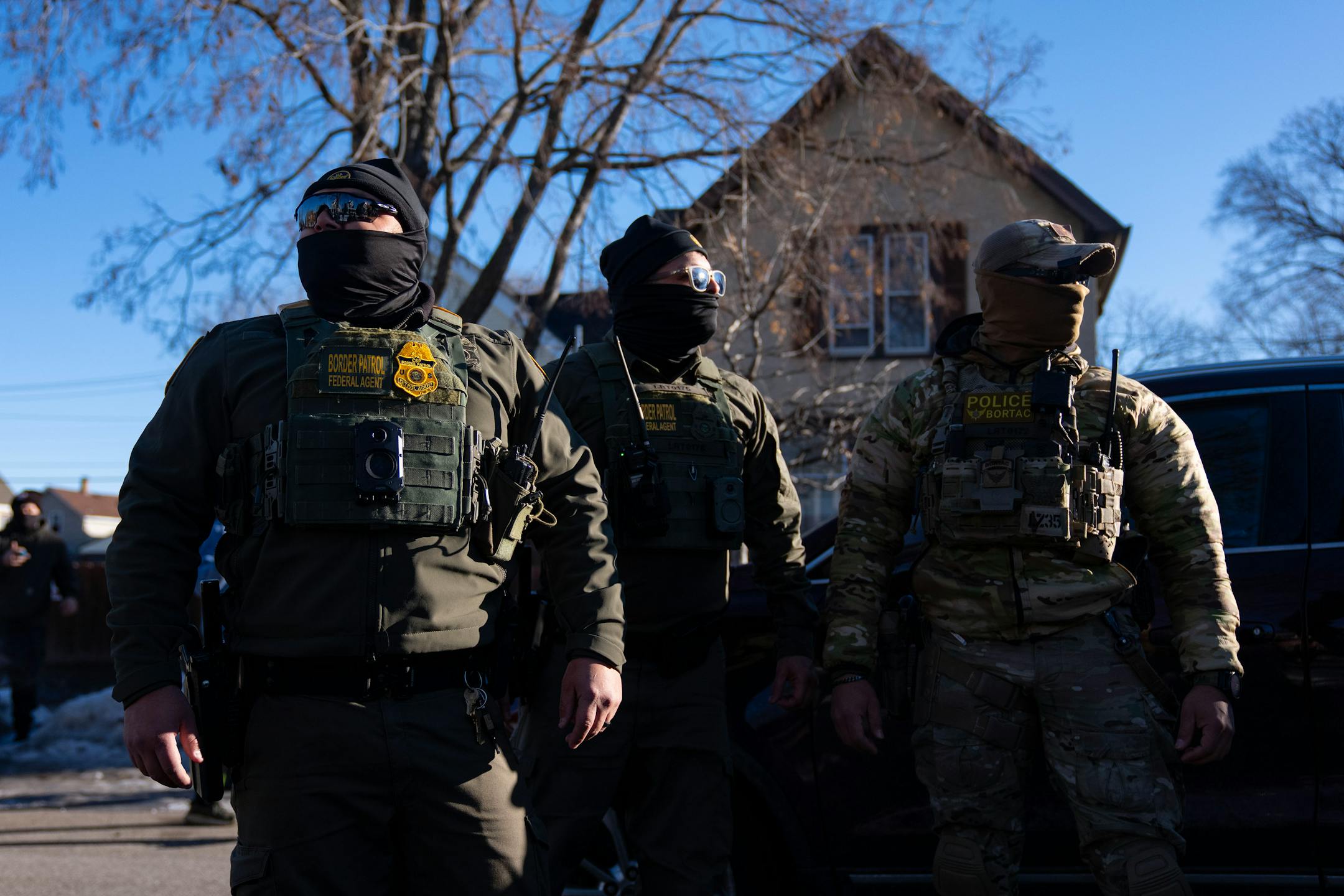
ICE agents walk down a block in Minneapolis on Jan. 14, 2026. (Alex Kormann/The Minnesota Star Tribune)

On the same day the federal government said it would re-examine the cases of refugees with legal status living in Minnesota, a refugee from Russia was pulled over by ICE agents a half mile from his Coon Rapids home.

The man’s brother-in-law told the Minnesota Star Tribune that he was detained and transferred to Texas, but as of Jan. 16, his name could no longer be found in ICE’s online detainee locator system.

“This has been extremely distressing for our family, especially given his refugee status and the lack of communication or due process,” said the man, who asked not to be named out of fear for his brother-in-law.

In addition to several thousand agents working to identify and detain undocumented immigrants, the federal government also launched “Operation PARRIS.” The Department of Homeland Security now plans to review Minnesota’s 5,600 refugees who have gone through a robust screening process and are on a pathway to citizenship.

The action has startled refugees, who often wait years to legally enter the country.

Federal agents started making house calls as soon as the DHS announced the operation on the heels of a federal investigation into social services fraud in Minnesota.

“This operation in Minnesota demonstrates that the Trump administration will not stand idly by as the U.S. immigration system is weaponized by those seeking to defraud the American people. American citizens and the rule of law come first, always,” the DHS said in a statement to the Star Tribune.

The DHS declined to answer where detained refugees are being held, how their applications are being assessed and what will happen to those determined to be fraudulent.

‘They’re here in lawful status’

The Russian family is connected with Arrive Ministries, a nonprofit that supports new refugee arrivals in Minnesota.

Rebekah Phillips, Arrive Ministries volunteer coordinator, said her organization had about 10 people across six families detained in the first week of Operation PARRIS. In one case, a client called an Arrive Ministries staff member from a detention facility in Texas.

People have been detained while dropping kids off at school, shopping for groceries and driving home after work.

“We’re taking every step we can to support these families in this process as it is evolving quickly, and there are still many unknowns,” Phillips said.

Refugee agencies estimate about 100 refugees from Africa, Asia, Central America and Europe have already been swept up in an unprecedented focus on people with legal resident status, who the agencies say are among the most highly vetted people in the United States.

Operation PARRIS is targeting Minnesota’s refugees who have not yet obtained permanent resident status, a process that typically begins one year after arriving in the United States. Some refugees wanted for federal questioning have pending green card applications, but for anyone from a country listed on President Donald Trump’s travel ban list, those applications have been stalled.

In an announcement on Jan. 9, the DHS and USCIS said they would put refugee cases through new background checks and “intensive verification of refugee claims.”

Many of Minnesota’s refugees have not gone out in public during the DHS crackdown on illegal immigration. But because refugees are required to register their home addresses with the federal government, support agencies are advising them to not open the door.

“They’re here in lawful status, and we haven’t seen any justified authority that DHS has issued to detain or arrest these individuals,” said Lindsey Greising, policy counsel for the social justice organization Advocates for Human Rights.

Griesling said the organization is filing emergency legal petitions to prevent the refugees’ transfer to out-of-state facilities.

The next step is to figure out what kind of legal representation they will need, as it isn’t clear what process the DHS is using to re-examine their refugee cases. Lawyers in Texas and nationwide are trying to figure that out, while lawyers are also having nascent conversations about bringing a lawsuit based on the Refugee Act of 1980, she said.

Resettlement program frozen for most refugees

A 31-year-old Sudanese woman who lives in south Minneapolis with three other adults and four children told the Star Tribune that federal agents went to their house on Jan. 9, and took pictures of their car and mailbox.

They returned on Jan. 12 and knocked on the door, claiming they could provide a warrant if the family opened up. The woman, who requested the Star Tribune not name her for fear of retribution, asked the agents if her family members were listed on the warrant, growing suspicious when the agents did not seem to know their names. She demanded they slide it under the door.

“We’re so scared because at that time, the kids were at school, we’re at home, and if something happened to us, we don’t know about the kids,” said the woman, who left war-torn Sudan in 2003 and arrived in Minnesota 20 years later after living in a Chadian refugee camp. “From that day, we stay home. We don’t go to work.”

The agents eventually left, saying they would return.

The International Institute of Minnesota helped the Sudanese woman and her family resettle in Minneapolis.

Operation PARRIS is the latest step by Trump to transform the United States’ approach to refugees. He froze the resettlement program for most refugee arrivals when he returned to the White House last year, and Minnesota agencies that served them for decades have now largely stopped resettling newcomers.

Jane Graupman, executive director of the International Institute of Minnesota, said her organization is actively doing wellness checks on the refugees they’ve helped in recent years.

One family went to their office in tears because federal agents went to their door, got them to open up by saying they needed some paperwork filled out, and detained their 21-year-old son, who has no criminal record, Graupman said.

She stresses that refugees already have legal status.

“You’ve gone through an immense amount of screening, biometric screening, health care screening, FBI checks, immigration checks, DHS checks,” she said. “There isn’t a more vetted population than refugees.”

Detentions of refugees continue to happen.

Nimco Jama, 17, called the Star Tribune on Jan. 19 and said ICE detained her father, Abdikadir Sheikyusuf, a day earlier after forcing open the door of their home in Shoreview. When the family objected, the agents showed them an administrative warrant, not a judicial warrant required for legal entry, Jama said.

She said everyone in her family was a citizen except for her father, who was a permanent resident in the process of renewing his green card.

“They took my dad, and while they were leaving, they took pictures of the door, and then as they left, they kept on telling us that it was our fault,” Jama said, referring to the agents breaking down the door.

Jama, who translates for her mother, was searching for legal representation on Monday but was finding it difficult because of the federal holiday. She said she believes her father had refugee status before becoming a permanent resident.

about the writer

about the writer

Susan Du

Reporter

Susan Du covers the city of Minneapolis for the Star Tribune.

See Moreicon

More from News & Politics

See More
Michele Tafoya, sideline reporter for NBC Sunday Night Football, lives in Edina with her husband and two children. Tafoya recently joined Tom Barnard on the popular KQ Morning Show.
Brian Peterson/The Minnesota Star Tribune

She is running as a Republican and looks to win the seat held by Democrat Tina Smith, who is not seeking re-election.

card image
card image