
Minneapolis teachers union votes to authorize strike

Union leaders said they’re still hopeful they can reach an agreement with the school district. The next mediation session is Thursday.

October 28, 2025 at 11:27AM
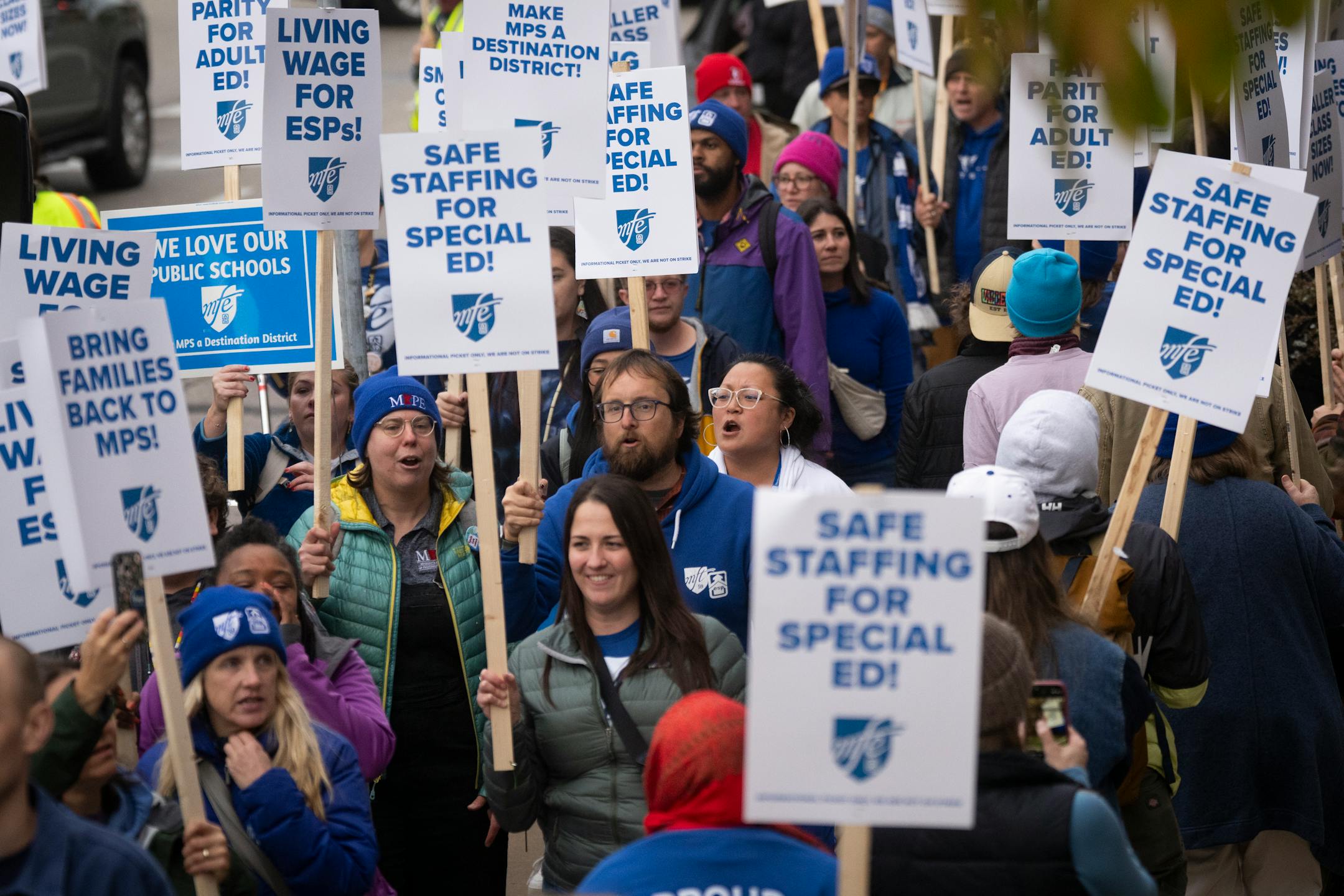
Hundreds of people march with signs chanting during a Minneapolis Federation of Educators rally after a vote to authorize a strike at Minneapolis schools' headquarters on Tuesday. (Renée Jones Schneider/The Minnesota Star Tribune)

Minneapolis teachers and support staff members have given their blessing to a potential strike in November after seven months of contract negotiations with the state’s third-largest district.

But union leaders said Tuesday that they’re still optimistic an agreement can be reached before the union — at odds with the district largely over pay, special-education caseloads and class sizes — actually hits the picket lines.

“We’re still hoping that they will meet us at the table with a solution,” said Marcia Howard, president of Minneapolis Federation of Educators’ (MFE) teacher chapter. “They just keep delaying and disappointing us with the lack of preparedness. They don’t have their math ready. It’s a big building with a lot of people making a lot of money, and they’re just not prepared for what’s at stake.”

The union, which represents teachers and other licensed staff members, announced Monday night that 92% of its members who cast ballots voted to authorize a strike. Nearly 3,600 members cast ballots over three days, the union said.

The union’s executive board still has not called for a walkout, said Catina Taylor, president of the chapter representing educational support professionals (ESPs). If a strike is authorized by the board, state law requires a 10-day waiting period and continued mediation between the union and district.

An eighth mediation session is scheduled for Thursday. If the strike happens, it would be the third strike in the district’s history, including one in 2022.

In a statement last week, the district said it has to work with available resources and prepare for expected revenue losses, which it said could include state and federal budget cuts, and that space in some school buildings is too tight to make the union’s class-size proposal work.
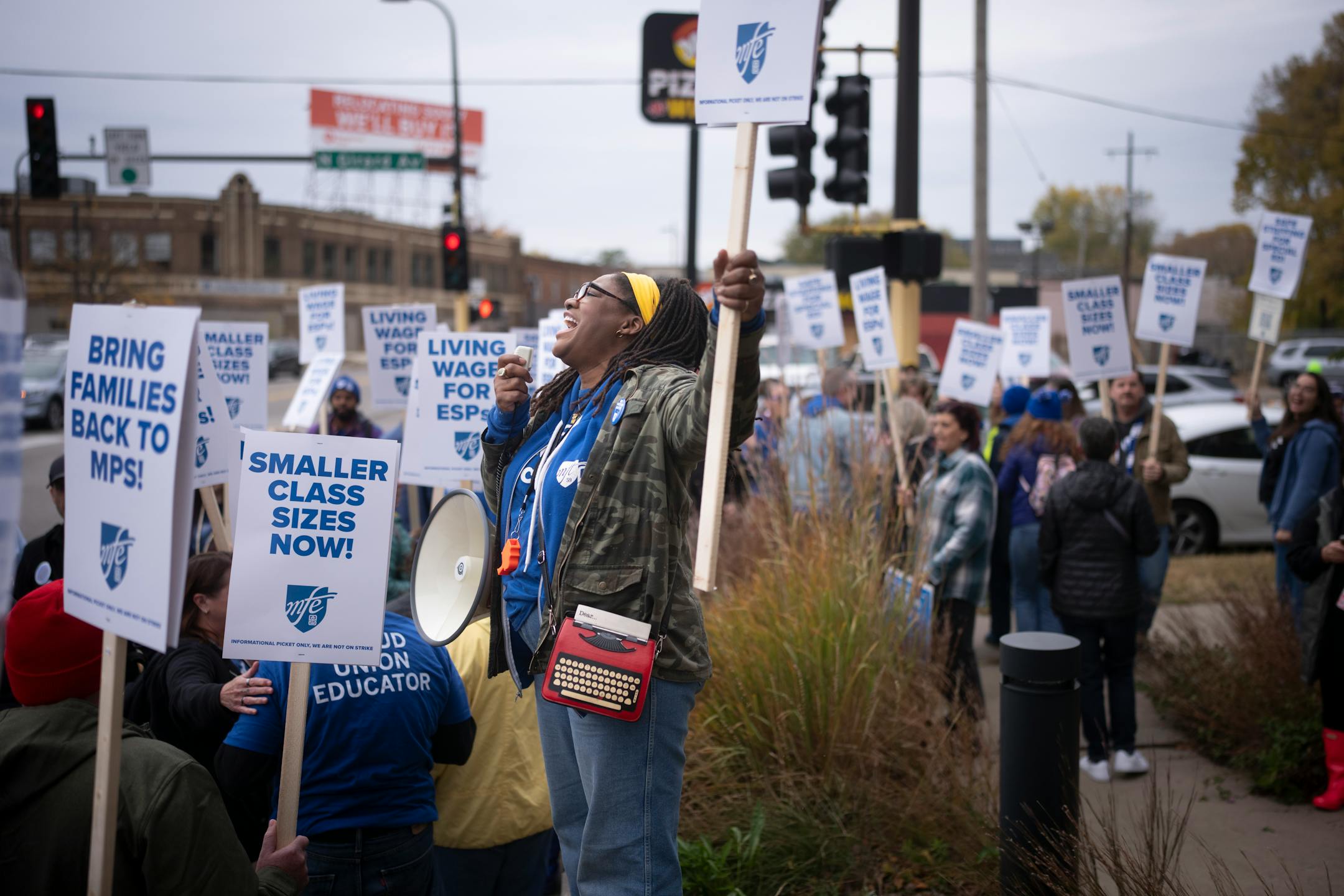
Marcia Howard, president of Minneapolis Federation of Educators, leads a chant during a Minneapolis Federation of Educators rally Tuesday. (Renée Jones Schneider/The Minnesota Star Tribune)

Debate over class sizes and pay

Educators kicked off a Tuesday afternoon rally by marching outside school district headquarters with signs reading “Make MPS A Destination District,” “Smaller Class Sizes Now,” “Competitive Pay In MPS” and “Bring Families Back To MPS.”

Union members brought drums and horns while chanting, including shouting: “Public schools are under attack — what do we do? Stand up, fight back.”

Kim Ambers, an education support professional who’s worked with the district for more than 33 years, said district officials have spoken dismissively of ESPs as “drive-by jobs” for people who don’t stick around long.

“ESPs are the glue that makes learning happen,” she said.

Alexis Dauenhauer, an education support professional with the MPS American Indian Education program, added that the district must provide equitable resources for Native students, families and community members.

The MFE held the strike authorization vote Thursday, Friday and Monday after the two sides did not meet a deal on educators’ contracts after mediation sessions last week. Negotiations started in April on the three separate contracts, which expired June 30 and cover more than 4,300 employees.

“St. Paul has already settled,” Howard said about the St. Paul Federation of Educators signing a new contract in September after bargaining since May. “Minneapolis [Public Schools] didn’t come back with counterproposals until August.”

Earlier this year, Superintendent Lisa Sayles-Adams pledged to protect class-size limits as part of this school year’s budget that required board members to fill a $75 million budget gap. The district now faces a projected shortfall of at least $25 million in 2026-27, according to a school board presentation in June.

Minneapolis, like St. Paul, has negotiated class-size caps into its contracts.

In addition to “enforceable class-size limits,” the federation is seeking pay increases of 7% in 2025-26 and 6% in 2026-27 for teachers and other licensed staff members — saying salaries then would mirror those in St. Paul. Increases of 12% and 10% are being sought for the ESPs, some of whom assist teachers by working closely with special-education students.

Nearly one-third of Minneapolis kindergartners were in classrooms exceeding contracted limits last fall, the federation claimed in a 44-page bargaining document.

The district says the union’s proposal for class sizes costs $34.2 million while the district’s proposal is $14.5 million. If the district agrees to part of the union’s proposal, estimated to cost at least $72 million, the district says it will have to do “significant” staff cuts and scale back or eliminate programs and services.

MFE has suggested the district could tap budget reserves and funds earmarked for outside contracts to cover any new agreements.

Past teacher strikes

Three years ago, Minneapolis educators hit the picket lines for a strike stretching nearly three weeks as they pushed for higher wages, additional mental health supports for students, class-size caps and protections for educators of color.

Then in April 2024, district and union negotiators reached an agreement on a previous contract giving teachers their highest pay increase in 25 years.

If a strike happens next month, the district says they will try to provide limited child supervision for students pre-kindergarten through fifth grade while other families would have to find child care. Depending on how long the strike lasts, the district could have to extend the school year so the nearly 30,000 students attending Minneapolis schools get the minimum number of instructional days needed.

Becca Dryden, who has two elementary school students enrolled in Minneapolis Public Schools, spoke at the MFE’s news conference Tuesday on behalf of Minneapolis Families for Public Schools. She said many families are standing with educators, hoping the district finds stability.

“I want to see the transformation in the district that means that we have long-term health and don’t have these constant disruptions,” she said. “And if the classroom is a hectic and overcrowded place and pay is better in surrounding districts, we’re going to keep losing really great teachers and families.”

Shannon Gibney, another parent, said she’s learned of kindergarten classes with 30 kids, and middle schools and high schools with more than 40 students in classrooms, and that class-size limits should be enforceable.

“We expect the district to deliver on this priority,” she said.

Tim Harlow of the Minnesota Star Tribune contributed to this story.

about the writers

about the writers

Eleanor Hildebrandt

Reporter

Eleanor Hildebrandt is a reporter for the Minnesota Star Tribune.

See Moreicon

Anthony Lonetree

Reporter

Anthony Lonetree has been covering St. Paul Public Schools and general K-12 issues for the Star Tribune since 2012-13. He began work in the paper's St. Paul bureau in 1987 and was the City Hall reporter for five years before moving to various education, public safety and suburban beats.

See Moreicon

More from Minneapolis

See More
card image
David Joles/The Minnesota Star Tribune

After a surge in Twin Cities auto thefts, Attorney General Keith Ellison investigated whether the South Korean car companies violated state consumer protection laws.

card image
card image