
Judge to weigh political motives in ICE surge

A federal judge has asked the Trump administration to respond to allegations from the state’s leaders that Operation Metro Surge is motivated by animosity toward Minnesota.

The Minnesota Star Tribune
January 29, 2026 at 9:32PM
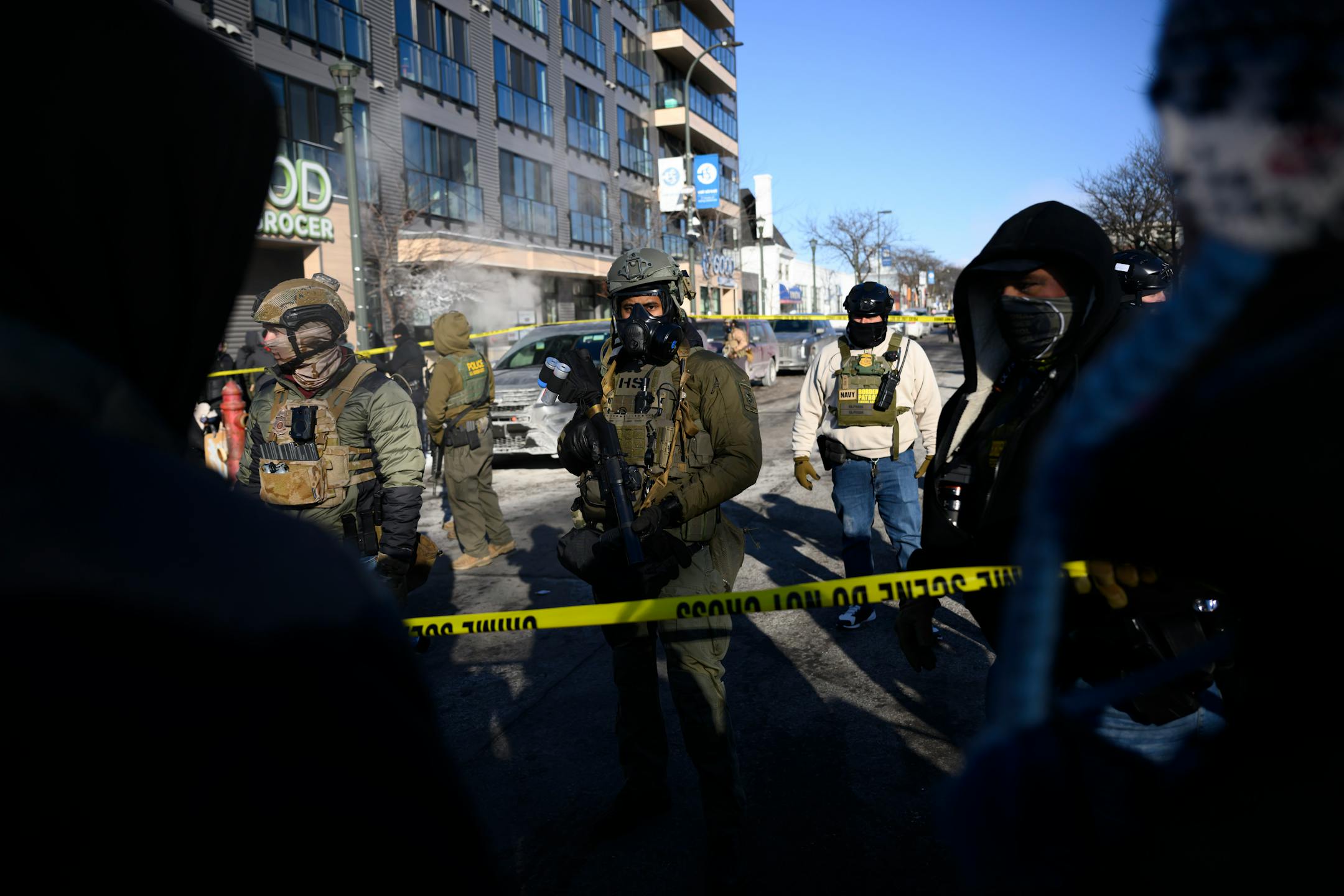
Officers with Homeland Security Investigations and the U.S. Border Patrol face off with protesters on Nicollet Avenue near W. 27th Street hours after federal agents fatally shot Alex Pretti nearby on Jan. 24 in Minneapolis. (Aaron Lavinsky/The Minnesota Star Tribune)

As President Donald Trump’s immigration crackdown in Minnesota draws backlash from around the nation, a federal judge is examining a claim that the operation was never about law enforcement.

Rather, state and local officials argue, it’s about Trump’s desire for political retribution. A lawsuit seeking to end the operation and remove federal agents alleges the surge is motivated by animosity toward blue states and Democratic leaders.

“It’s for a purpose — and an impermissible one, which is to punish our state until we do the bidding of the federal government,” said Minnesota Attorney General Keith Ellison, who filed the lawsuit with the mayors of Minneapolis and St. Paul.

The Trump administration launched Operation Metro Surge late last year, sending thousands of Immigration and Customs Enforcement and U.S. Customs and Border Patrol agents to Minnesota.

In court, Department of Justice attorneys have cast the operation as federal law enforcement filling in the “gap” between U.S. immigration law and Minnesota’s policies that limit what information local law enforcement shares with federal immigration agents.

The Department of Homeland Security did not respond to the Minnesota Star Tribune’s request for comment about the state’s accusations. Border czar Tom Homan is in Minnesota overseeing immigration enforcement and said agents will begin to leave the state if agencies help the federal effort in county jails and prisons.

‘No hint of a quid pro quo’

In a hearing on the case on Jan. 26, U.S. District Judge Kate Menendez repeatedly grilled a Trump administration attorney over a letter U.S. Attorney General Pam Bondi wrote to Gov. Tim Walz that demanded access to the state’s voter rolls and data on Medicaid and food stamp recipients, linking the demand to the ongoing ICE surge in the state.

The Trump administration has been seeking data on Minnesota voters and recipients of Medicaid and food stamps for months. Minnesota officials have refused to hand over information, saying they feared it would be used to target people for immigration enforcement.

In the letter, Bondi also called on Minnesota to “repeal the sanctuary policies that have led to so much crime and violence in your state,” saying the steps “will help bring back law and order to Minnesota and improve the lives of Americans.”

Brian Carter, an attorney for the state, called Bondi’s message a “a ransom note.”

“It’s a letter that basically says, ‘Hey, wouldn’t it be a shame if your restaurant burned down? And if you don’t want it to burn down, you might want to help me out,’” Carter said.

At one point during Monday’s hearing, Menendez said Bondi’s letter seems to “strongly suggest” the federal government is instead trying to strong-arm the state to change its laws, and ordered the DOJ to respond to the allegations.

DOJ attorneys responded on Jan. 28, saying Bondi’s letter — along with a Jan. 13 social media post from Trump promising a “DAY OF RECKONING & RETRIBUTION” — was not an attempt to pressure the state into changing its policies and that there is “no hint of a quid pro quo.”

“None of these statements indicate an unlawfully coercive purpose,” attorneys for the DOJ wrote. “Instead, they reflect a commonsense proposition: if a state or locality decides not to assist the federal government, the federal government may need to devote more resources to that jurisdiction.”

Challenging ‘worst of the worst’

As part of the lawsuit, Minnesota officials have also challenged the notion that ICE and Border Protection have limited Operation Metro Surge to the “worst of the worst,” a catchphrase the federal government uses to refer to violent offenders.

The operation has resulted in the arrest of U.S. citizens either for observing ICE or because of alleged racial profiling, and two Minnesotans, Alex Pretti and Renee Good, have been shot and killed by agents. Individuals with pending asylum claims or other forms of lawful status have been detained.

State officials have also pointed to Trump’s comments about Walz and claims that Trump won the majority of votes in Minnesota. After ICE agent Jonathan Ross shot Good in south Minneapolis, Trump was asked whether he thought federal authorities should share evidence in the case with state officials.

Trump said normally he would support sharing evidence, but he accused Minnesota officials of being “corrupt” and attacked Walz as “incompetent.”

He then claimed he had won the majority of votes in Minnesota in the 2016, 2020 and 2024 elections, implying the victory was stolen from him through fraud.

“I won it all three times in my opinion,” Trump said. No Republican presidential candidate has won Minnesota since 1972.

Trump has also posted on social media that Minnesota Democrats “love the unrest that anarchists and professional agitators are causing,” saying it distracts from the state’s fraud crisis.

“FEAR NOT, GREAT PEOPLE OF MINNESOTA,” Trump wrote. “THE DAY OF RECKONING & RETRIBUTION IS COMING!”

In response to the judge’s order requiring the Trump administration to address the state’s accusation, DOJ attorneys wrote: “This single and unclear reference to ‘retribution’ does not justify the unprecedented relief of ordering thousands of federal officers to leave Minnesota.”

about the writers

about the writers

Allison Kite

Reporter

Allison Kite is a reporter for the Minnesota Star Tribune.

See Moreicon

Sarah Nelson

Reporter

Sarah Nelson is a reporter for the Minnesota Star Tribune.

See Moreicon

More from News & Politics

See More
card image
Richard Tsong-Taatarii/The Minnesota Star Tribune

Border czar Tom Homan is in Minnesota overseeing immigration enforcement. He said if state agencies help the federal effort in county jails and state prisons, agents will begin to leave.

card image
card image