
‘It feels like we’re living in a prison’: Frustrations rise along fenced-in Franklin Avenue in Minneapolis

Fencing installed by state officials along the busy corridor to deter homeless encampments is still in place years later.

Sahan Journal
November 29, 2025 at 8:00PM
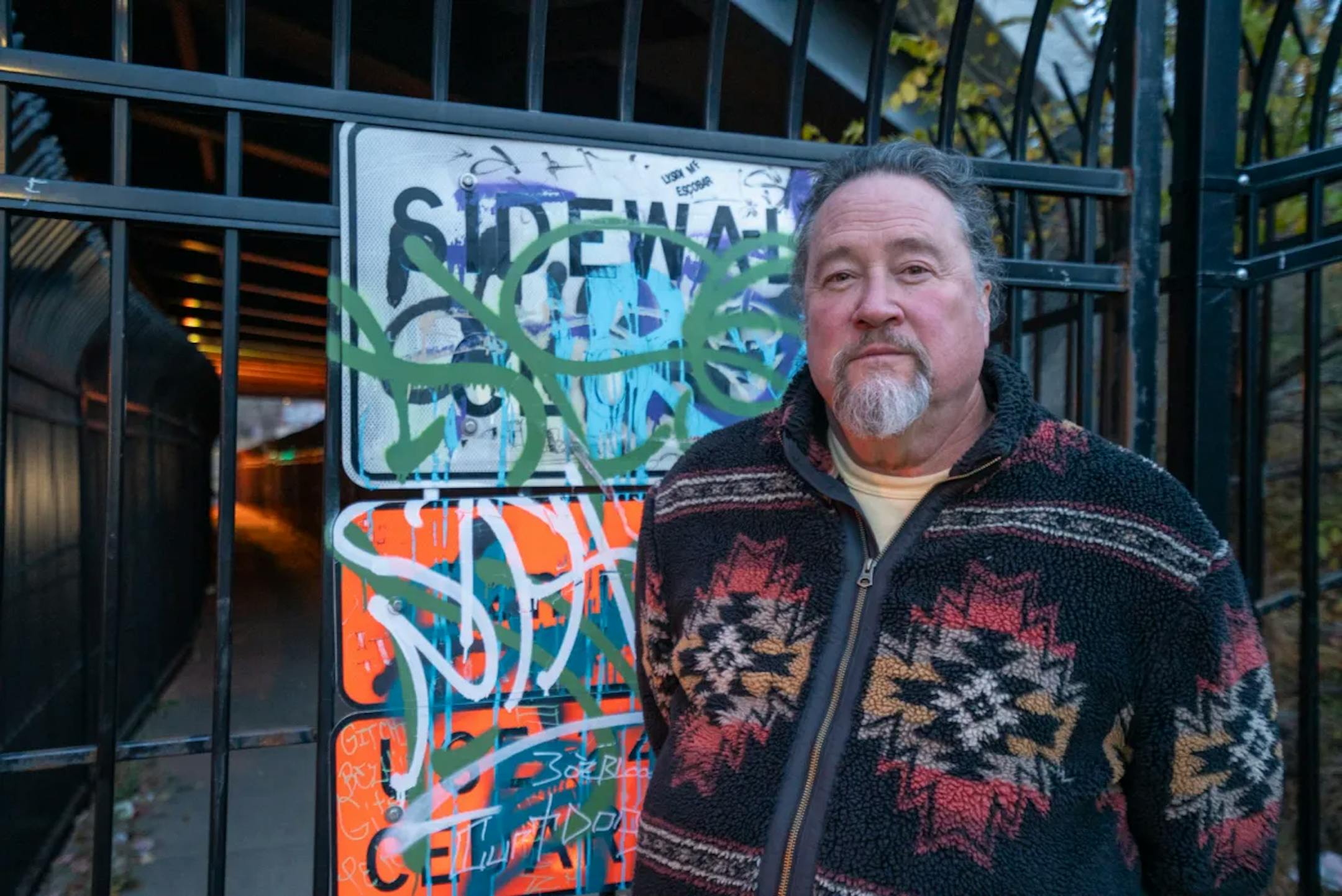
Robert Lilligren, president and CEO of Native American Community Development Institute and chair of the Metropolitan Urban Indian Directors, stands by the the Wall of Forgotten Natives, on Nov. 11. (Dymanh Chhoun/Sahan Journal)

In 2018, state highway officials began fencing off public areas in the Franklin Avenue corridor to deter homeless encampments near busy roadways.

Seven years later, with the fencing still in place, frustration is spilling over among those who use the high-traffic area and Native leaders who want to make it a cultural corridor.

Those concerns bubbled to the surface last month at a public safety meeting of the Metropolitan Urban Indian Directors (MUID), which brings together leaders of local Native-led organizations.

“The fencing is driving me crazy,” MUID Chair Robert Lilligren told Levi Brown, director of tribal affairs for the Minnesota Department of Transportation (MnDOT). “It feels like we’re living in a prison.”

Brown acknowledged that MnDOT had limited tools to address safety concerns along the corridor. In a follow-up interview, he said MnDOT is working on long-term engagement with the Native community and tribal government leaders for “community-led, community driven” solutions.

For many, those solutions can’t come soon enough.

The first time Angela Two Stars turned the corner from Cedar to Franklin to go to All My Relations Arts gallery in 2017, the first things she saw were murals under the Franklin Bridge. To her, it felt like a welcoming invitation into the heart of Minneapolis’ Indigenous community. “I thought, ‘Oh, here’s where my people are,’” she said. “‘This is my community.’”

The area no longer feels inviting, she said. ​​“The first thing you see is all these fences, and it makes you feel like, ‘Oh, here’s where the Natives are.’ It kind of creates this feeling of, it’s dangerous, it’s not safe. And that’s furthest from the truth of what we’re doing here,” said Two Stars, vice president of arts and culture at the Native American Community Development Institute (NACDI) and the arts director of All My Relations Arts gallery, a program of NACDI.

In 2018, government agencies began fencing multiple areas along the corridor — between 11th Avenue S. to Cedar and Franklin to 26th Street — as a temporary solution to deter homeless encampments and large gatherings.

The fencing now blocks access to sidewalks, forcing pedestrians to walk on the street or take a long detour to get from one part of Franklin to another. The area in question includes city streets, county roads and state highways, making jurisdiction and any response to encampments or community issues more complex. Minneapolis officials say they have no fencing in the area. Much of the current fencing was installed by MnDOT, as bridges and highways fall under its jurisdiction.

Ryan Wilson, an area manager at MnDOT said that site-specific fences are installed “as a measure to find a safe solution, at least for a while.”

“It’s not our goal to have that fence in there long-term, or any of the other barriers or things that have been out on that site,” he said.

“Fences aren’t inherently bad,” said Sam Olbekson, founder and CEO of Full Circle Indigenous Planning and Design. The firm has designed multiple spaces and businesses along the American Indian corridor like the renovation of the American Indian Center; the Native American Community Clinic, which is being expanded; All My Relations Arts gallery and multiple affordable housing units and temporary shelters in the area.

But, they are a “Band-Aid” and “just a symptom of not having a better design solution,” he said.

On Franklin Avenue, the fenced-off sidewalks force pedestrians to either walk half a mile out of the way or walk on the road through the underpass. Wilson said MnDOT is working to install a ramp in that underpass and put markers to create a makeshift sidewalk on the road by the end of the year.

At the Oct. 14 MUID meeting, Third Precinct Inspector Jose Gomez said the Minneapolis Police Department has stepped up its presence and enforcement in the corridor to respond to the community’s safety concerns and needs in the face of heightened opioid use and homeless encampments in the area.

Joe Hobot, president and CEO of the American Indian OIC, admitted that even though it is unsafe for his students to walk on the road, he said “that is far safer than having to walk through a crowd of folks that are seriously in the throes of addiction and mental health crises that have no qualms about physically accosting our students. So we chose the former over the latter. We prefer not to have any of it.”

He thinks that fences, although they are “an eyesore,” are a “necessary evil” to ensure safety. “We need a more cohesive plan to remove these encampments so they become a thing of the past, and once we get to there, then the next step would be taking these fences down,” he said. “But we don’t have that cohesive plan, and so fencing becomes a necessary evil.”

For Lilligren, the fences are more than just an eyesore or inconvenience. They have overarching historical connotations.

“We were incarcerated, put into encampments, and so this feels very much like history echoing through the community today,” he said. “It’s exactly contrary to sovereignty.”

About the partnership

This story comes to you from Sahan Journal, a nonprofit newsroom dedicated to covering Minnesota’s immigrants and communities of color. Sign up for a free newsletter to receive Sahan’s stories in your inbox.

about the writer

about the writer

Shubhanjana Das

More from Minneapolis

See More
card image
Elizabeth Flores/The Minnesota Star Tribune

DHS Secretary Kristi Noem was in Minnesota to highlight arrests and a major deployment, but details remain limited.

card image
card image