
Rash: A Nobel Peace Prize and Mideast peace pact offer hope

The Trump-brokered Mideast accord and a Venezuelan opposition leader’s Nobel Peace Prize bolster diplomacy.

Columnist Icon
The Minnesota Star Tribune
October 10, 2025 at 9:03PM
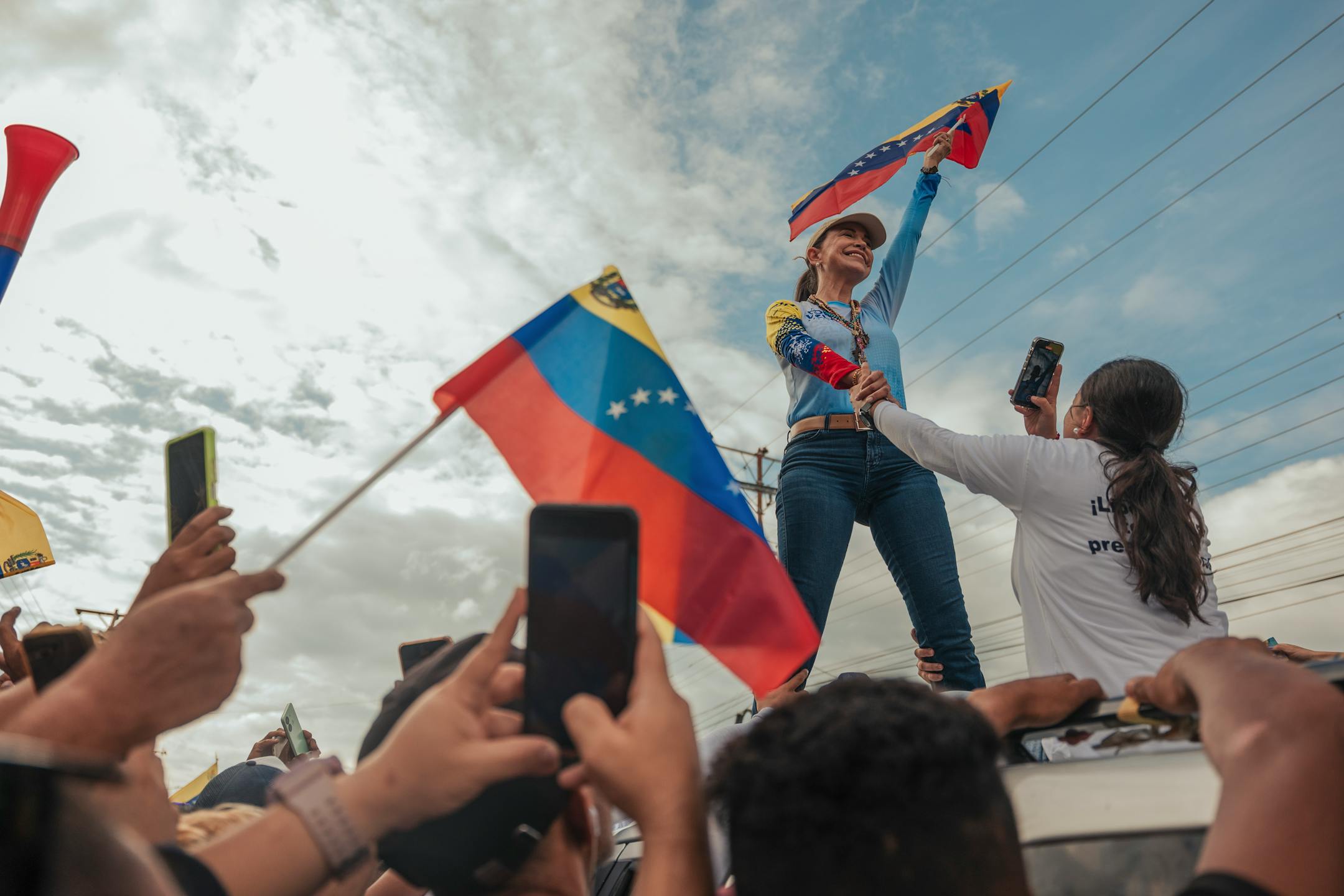
Opposition leader María Corina Machado greets supporters during a rally in Guanare, Venezuela, on July 17, 2024. Machado, who built a powerful social movement and has been living in hiding since last year, was awarded the Nobel Peace Prize on Oct. 10. (ADRIANA LOUREIRO FERNANDEZ/The New York Times)

Opinion editor’s note: Strib Voices publishes a mix of commentary online and in print each day. To contribute, click here.

•••

An Israel-Hamas peace pact and a Nobel Peace Prize for a Venezuelan opposition leader provide hope amid a bleak geopolitical landscape.

However tenuous, the Mideast accord might mean an end to the horrific war that began two years ago this week, when Hamas terrorists killed about 1,200 people and seized 251 hostages from southern Israel. That attack triggered a ferocious military response, which some international experts have labeled a genocide, that has killed more than 67,000 Palestinians, according to Gaza’s Health Ministry, which doesn’t differentiate between civilians and combatants.

But a breakthrough, based on a 20-point peace plan developed by the Trump administration, means at least a temporary ceasefire and potentially an end to the war.

“It’s incredibly fragile — anything can go sideways at this point, as we’ve seen in previous ceasefires,” said David Schenker, a senior fellow at the Washington Institute for Near East Policy. Schenker, a former assistant secretary of state for Near Eastern affairs, added that “What’s different here is not only that we’re two years in, it’s that the president, in the aftermath of the Doha strike, has decided that it’s time for the war to finish.”

The references are to Israel’s recent attack on Qatar that incensed President Donald Trump, who deftly used his diplomatic leverage with Israel and several Arab countries to accept his peace plan.

“There’s not another leader,” Schenker said, “who’s going to push this forward.” Trump, he said, has developed “certain relationships with Arab leaders and importantly with Israel to be able to convince, compel, cajole all the partners to buy into the plan.”

Trump has tried to use a combination of convincing/compelling/cajoling in other disputes across continents, and now has an empowered potential partner in South America with the 2025 Nobel Peace Prize being awarded to Venezuelan opposition leader María Corina Machado.

In its announcement, the Norwegian Nobel Committee lauded the laureate “for her tireless work promoting democratic rights for the people of Venezuela and for her struggle to achieve a just and peaceful transition from dictatorship to democracy.”

Through oppression and mismanagement, oil-rich Venezuela’s president, Nicolás Maduro, has immiserated what was once one of the continent’s most consequential economies, resulting in 8 million Venezuelans fleeing to neighboring nations.

“It’s really hard for a country to kind of ‘de-develop’ itself,” said David Samuels, a University of Minnesota professor of political science. “It requires a special form of incompetence or malice for a country’s level of per capita income to truly decline over the long term.”

Many remaining have intrepidly insisted on democracy, despite the dictatorship stealing the 2024 election, as was widely alleged by international experts and everyday Venezuelans. Machado initially ran in that race, but after being disqualified by the regime she backed another candidate, Edmundo González Urrutia, who sought asylum in Spain.

Venezuela, Samuels said, “has clearly transitioned from democracy to dictatorship.” This has forced Machado, who the committee rightly claimed is “one of the most extraordinary examples of civilian courage in Latin America in recent times,” to live in hiding.

In an exceptional explanation of its decision, the Norwegian Nobel Committee concurrently made the case for democracy as “a precondition for lasting peace. However, we live in a world where democracy is in retreat, where more and more authoritarian regimes are challenging norms and resorting to violence.”

“The Venezuelan regime’s rigid hold on power and its repression of the population are not unique in the world. We see the same trends globally: rule of law abused by those in control, free media silenced, critics imprisoned, and societies pushed towards authoritarian rule and militarization. In 2024, more elections were held than ever before, but fewer and fewer are free and fair.”

When authoritarians seize power, the committee continued, “it is crucial to recognize courageous defenders of freedom who rise and resist. Democracy depends on people who refuse to stay silent, who dare to step forward despite grave risk, and who remind us that freedom must never be taken for granted, but must always be defended — with words, with courage and with determination.”

Among those also recognizing Machado’s courageous defense of freedom is Secretary of State Marco Rubio, who while still a senator joined several other Florida lawmakers (including fellow Cabinet member Michael Waltz, the U.S. ambassador to the U.N.) in nominating Machado for the Nobel.

Referencing the 2024 Venezuelan election, the delegation wrote that “Machado’s work has showcased her unwavering resolve and ability to inspire and rally others towards the noble cause of democracy. Her actions reflect a deep-seated belief in justice, human rights, and the rule of law — values that are foundational to the mission of the Nobel Peace Prize.”

These values aren’t just foundational to the mission of the Nobel Peace Prize, but to America, and should be the basis of the administration working with the Venezuelan opposition to reflect the will of their people.

Most recently, however, the administration has moved more militarily than diplomatically in confronting Caracas, including deploying naval assets closer to the country as well as sinking suspected drug vessels instead of the U.S. Navy or Coast Guard boarding the boats, as is usually done. This Nobel moment offers Trump and Machado, who has signaled tacit support of the tactic, an opportunity to reset toward a diplomatic strategy.

When contacted minutes before the official announcement, Machado told a Nobel official that “I have no words. Thank you so much, but I hope you understand this is a movement. This is an achievement of a whole society. I am just one person. I certainly do not deserve this.”

She does deserve it. And she shows how “just one person” can inspire a movement towards what everyone should want for Venezuela and everywhere else people live under repressive regimes: a “just and peaceful transition from dictatorship to democracy.”

about the writer

about the writer

John Rash

Editorial Columnist

John Rash is an editorial writer and columnist. His Rash Report column analyzes media and politics, and his focus on foreign policy has taken him on international reporting trips to China, Japan, Rwanda, Kazakhstan, Turkey, Lithuania, Kuwait and Canada.

See Moreicon