In the remote Nebraska Sandhills lies an unexpected water world

Nebraska’s vast Sandhills region rewards an explorer with a mysterious landscape full of lazy waterways.

The New York Times
October 9, 2025 at 1:53PM
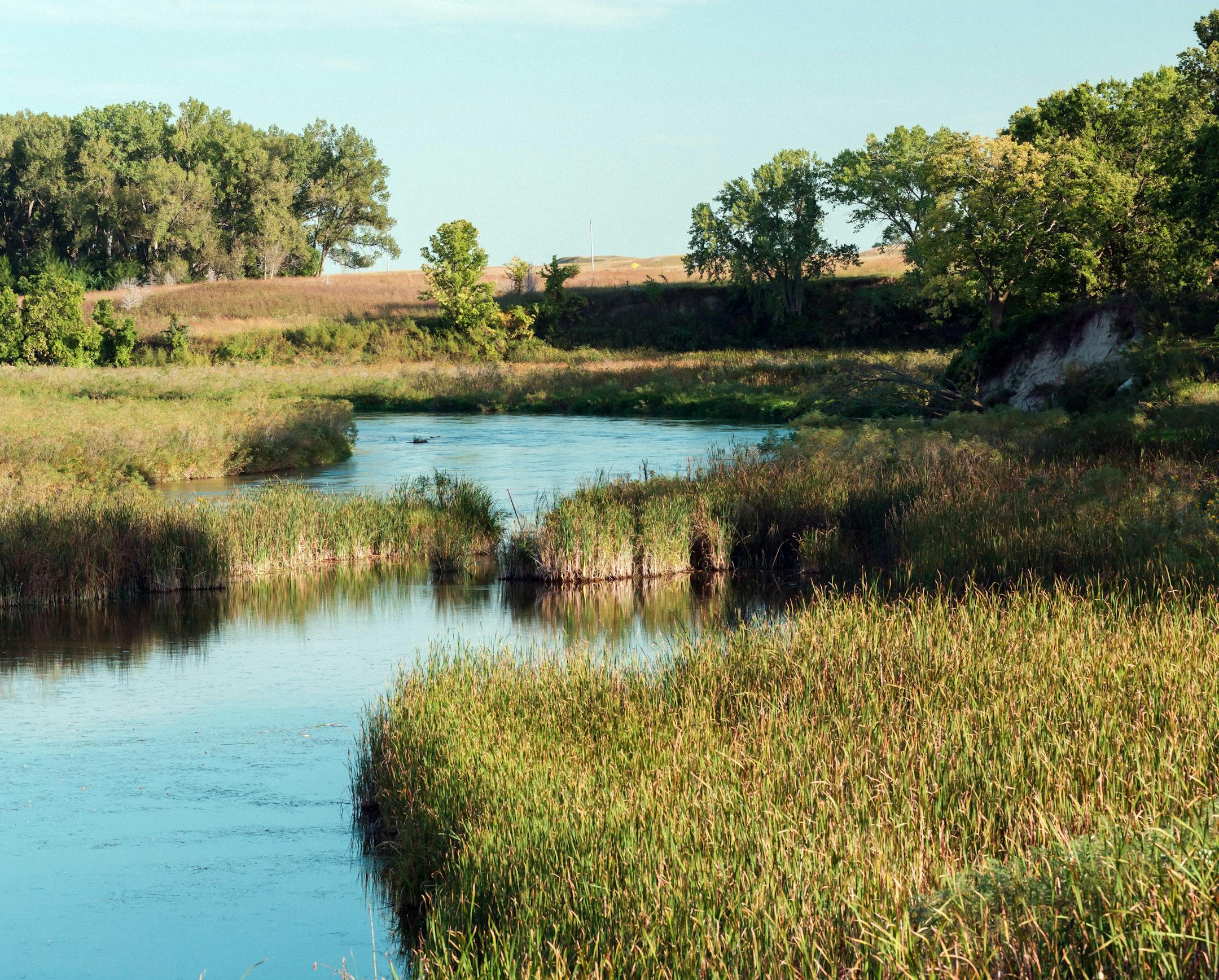
The Calamus River winds through the Sandhills in Loup County, Neb., on Sept. 12. The river spills into the 5,000-acre Calamus Reservoir. (Walter Pickering/The New York Times)

So the Rockies rose up, and the rivers bled out, and for roughly 15 million years, the last sandy dregs washed across the ancient savannas of north-central Nebraska, still busy with bear dogs and three-toed horses. Then the Ice Age dawned. The grass died back, the sand shook loose and the glacial winds swept it all together, sculpting the largest dunescape the Western Hemisphere has ever known, nearly 20,000 square miles.

By the time humans first laid eyes on this bewildering terrain, the grass had largely reclaimed it, the rolling dunes now hemmed in place, some of them miles wide and as tall as the Pyramids, others mere hiccups on the horizon. Novelist Jim Harrison once called it “without a doubt the most mysterious landscape in the United States.”

I was born and raised on the eastern fringe of this natural phenomenon — now the largest intact prairie in North America — in a cow town called Broken Bow, one of several self-appointed “gateways” to the Nebraska Sandhills. I’ve since moved to Chicago, but it’s the Sandhills I yearn for when the summer boils over. It’s the springs that gurgle up from the Ogallala Aquifer beneath it. The rivers that snake through the hills. The 1,600 lakes and untold marshes that fill the valleys. Nearly a tenth of the Sandhills, in fact, is wetland habitat — enough to blanket the entire state of Delaware.

Most of the Sandhills is now private rangeland, and while many credit this fact with preserving such a novel ecosystem, it also keeps the casual tourist at bay. But for outsiders willing to explore, the region more than repays the effort, unlocking a time and place untouched by overcrowding and selfie tourism.
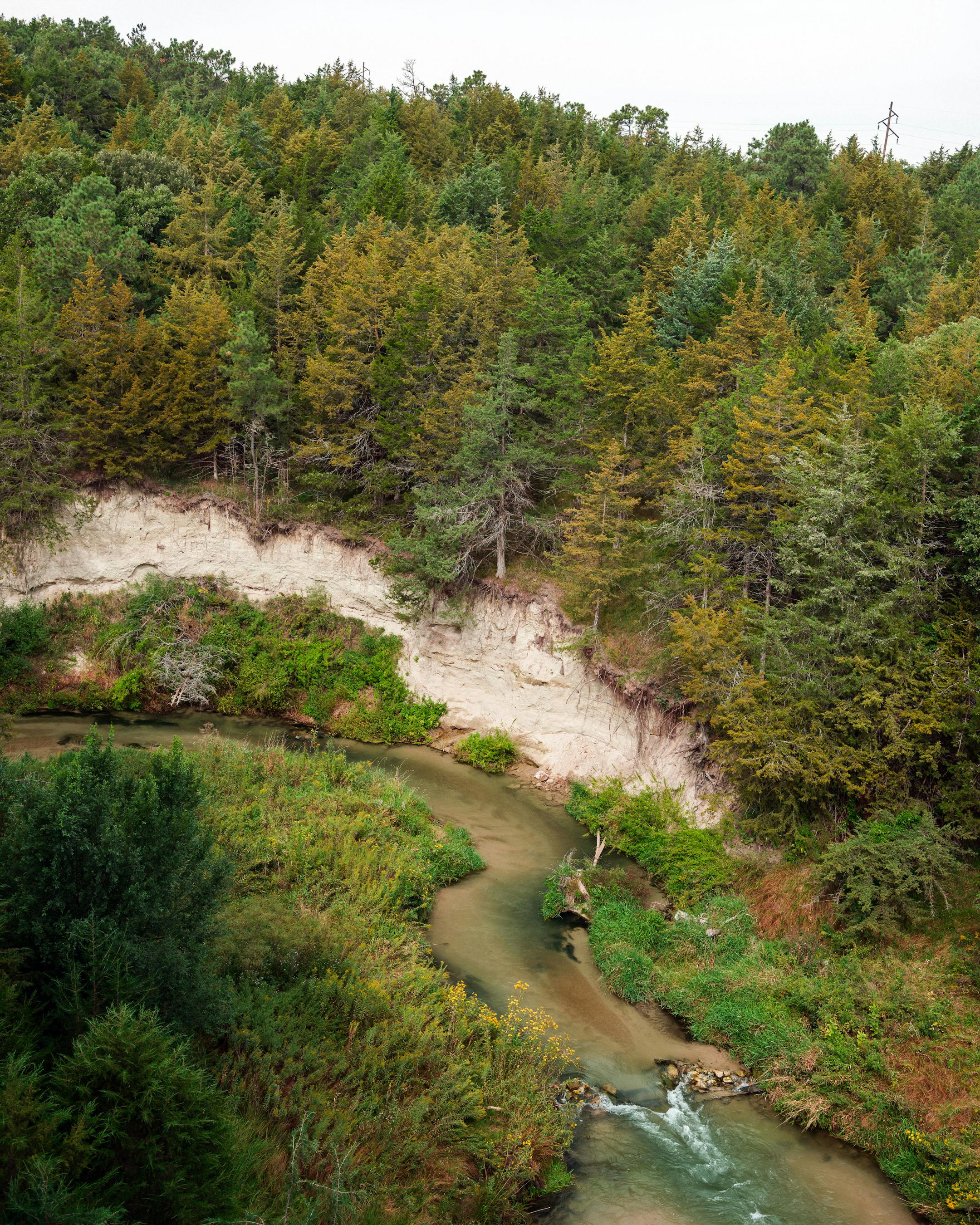
Long Pine Creek near Long Pine, Neb., on Sept. 13 The creek takes tubers on a lazy, meandering ride through the Sandhills near Hidden Paradise Resort. (WALKER PICKERING/The New York Times)

Paradise in an inner tube

In late July, I flew to Lincoln, the nearest legitimate airport. The woman to my left was browsing the latest issue of Reined Cow Horse News. The man to my right was building a PowerPoint deck titled “Bovine Genomics.” No doubt about it: We were bound for the Beef State.

I sped west from the capital, with plans to meet up with family for tubing the next day. I wove between thunderstorms on quiet highways, the rain falling in gauzy ribbons behind distant grain elevators. The full Sandhills panorama finally unfolded just north of Bartlett, and I kept driving until the storms caught up with me in Bassett, population 538, 90 miles later.

I parked on Clark Street and watched lightning crack the sky above the Bassett Lodge, a two-story Art Moderne hotel built in 1949 for the cattle buyers who once crowded the local livestock auction. I could hear the cattle lowing as I stepped inside. The lobby was a 1950s period piece: block glass, olive green walls, upholstered wainscoting.

The only thing missing was a pulse. So far as I could tell, I was the only one in the building. They simply left my key on the desk.

Just 20 minutes down the road, Long Pine Creek — popular with tubers and trout fishermen alike — seeps from the aquifer and slithers some 30 miles north to the Niobrara River. Along the way, it skirts the village of Long Pine, population 305, and cleaves a storied summer resort called Hidden Paradise, where I rendezvoused with my family for a day in its gin-clear waters, a cool 55 degrees year-round. A faded sign dangled above the road:

Hidden Paradise Resort. A heavenly place. Please don’t drive like hell!

Featuring a plunge pool and live entertainment — locals still brag about supposed visits by Lawrence Welk and Tommy Dorsey — the resort boomed when it opened in 1910. But eventually the owners started selling off cottage sites, and by the 1960s, the business had dissolved, leaving an enclave of quirky cabins looming over the creek like cattle at the trough.

Today, for every “No Trespassing” sign in the valley, there’s another welcoming tourists to the water from their cabin’s private landing. Forgoing a float through Hidden Paradise felt like skipping the slopes in Vail, so after checking into a cabin, my dad and I plopped inside our tubes with the grace of two tom turkeys and vanished around the bend.

We pinballed between wooden bulkheads and grassy banks, every footbridge another rung on a winding, Seussian ladder. Half an hour later, when the last cabin disappeared, we dragged our tubes onto a spit of white sand in the crook of an oxbow — Hidden Paradise’s unofficial beach.

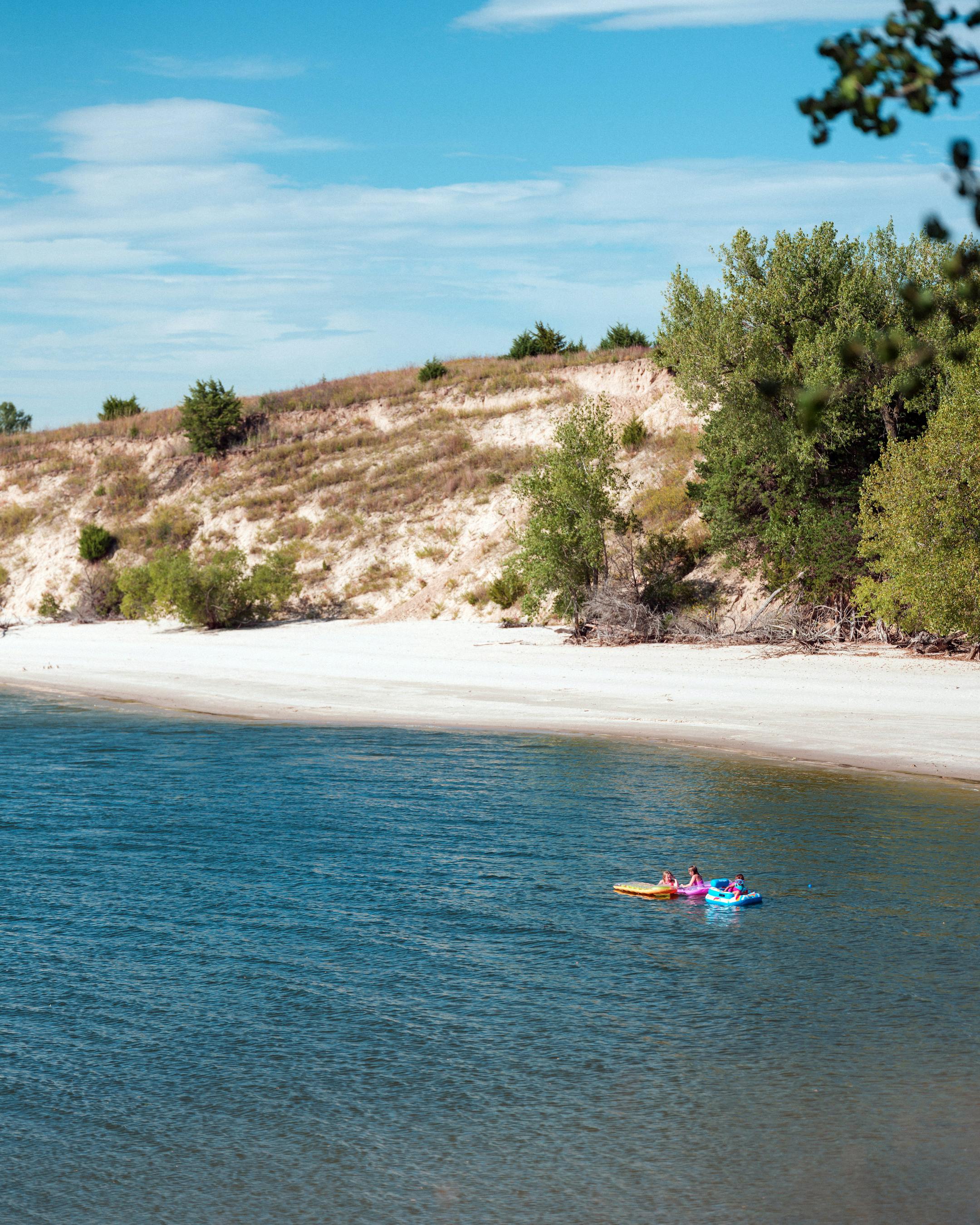
Children play in the shallow water of the Calamus Reservoir State Recreation Area near Burwell, Neb., on Sept. 12. In the Sandhills of north-central Nebraska, water from the sprawling Ogallala Aquifer helps feed the 5,000-acre reservoir along with numerous rivers and creeks. (WALKER PICKERING/The New York Times)

Meandering waters and minds

Culturally, both Long Pine and Bassett are Sandhills communities. Geographically, however, they cling to the loamy fringe. After another day tubing the creek, I ventured solo deeper into the dunes to kayak the last 10 miles of the Calamus River.

Here the Plains Indian tribes followed their game. And here canonical crime writer Jim Thompson, raised in nearby Burwell, set his first novel, “Heed the Thunder.” And here, not 10 minutes downstream from the Hwy. 183 bridge, where I parted the willows and shoved off the bank, my mind began to mosey.

For the next three hours, my imagination ran amok as I navigated shifting sandbars and cattail islets. An eagle soared, an oriole perched and I wondered what became of my 7th-grade girlfriend. I split a herd of fly-swatting cattle and pretended they were bison, the earth shaking beneath their hooves.

Beyond it all, the hills caressed the sky until the cottonwoods towered above and the smartweed tickled below and I was birthed, at last, into the roughly 5,000-acre Calamus Reservoir.

I spent the night in Broken Bow and cruised west alone down Hwy. 2, now the Sandhills Journey National Scenic Byway. Praising its “special nothing,” Charles Kuralt once named it one of the 10 most beautiful highways in America.

The dunes swelled a little more with every mile. You don’t notice it — then you do. Suddenly they’re breaking over the Middle Loup River. Now they’re looming over Seneca, population 33. And Whitman, smaller still. Now the cell tower’s a lighthouse and every windmill a buoy, and shortly after climbing south on a one-lane blacktop near Ashby, roughly 150 miles from the start, the Sandhills stopped me cold, green as the Scottish links land and grand as the best of our national parks.

With all due respect to Kuralt, this was something.

Everyone into the tank

I resolved to finish my swing through the Sandhills with the most homegrown hobby of them all: tanking.

I drove to Mullen, population 500; ate breakfast at Big Red’s Cafe, making “bladders splatter and livers quiver since 1949,” the coffee mugs warned; and walked across the street to Glidden Canoe Rentals, where I booked a two-hour joyride for three, myself, Auggie and my parents, down the Middle Loup in a circular livestock tank for less than a hundred bucks, shuttle included.

The next afternoon, on the banks of the knee-deep river, our driver stood an 8-foot-diameter steel tank on end, rolled it toward the water and sent us downstream.

There is no steering in a stock tank — just spinning. The paddles were useful to pry ourselves loose from sandbars, to shield ourselves from fallen cedars, but never to avoid them in the first place. And so we spun. And we rammed. And we spun a little more. We opened the cooler. We cracked open the beers. And for the next two hours, we let the river take the reins and made like the sand before us, washing over the prairie of north-central Nebraska.

about the writer

about the writer

Carson Vaughan

The New York Times

More from Midwest Travel

See More
card image
card image