
How to safely intervene and where to find help for domestic violence in Minnesota

A report from Violence Free Minnesota said domestic violence homicides have dropped from a record number in 2023. But deaths among bystanders and interveners remain at all-time high.

The Minnesota Star Tribune
December 29, 2025 at 12:00PM
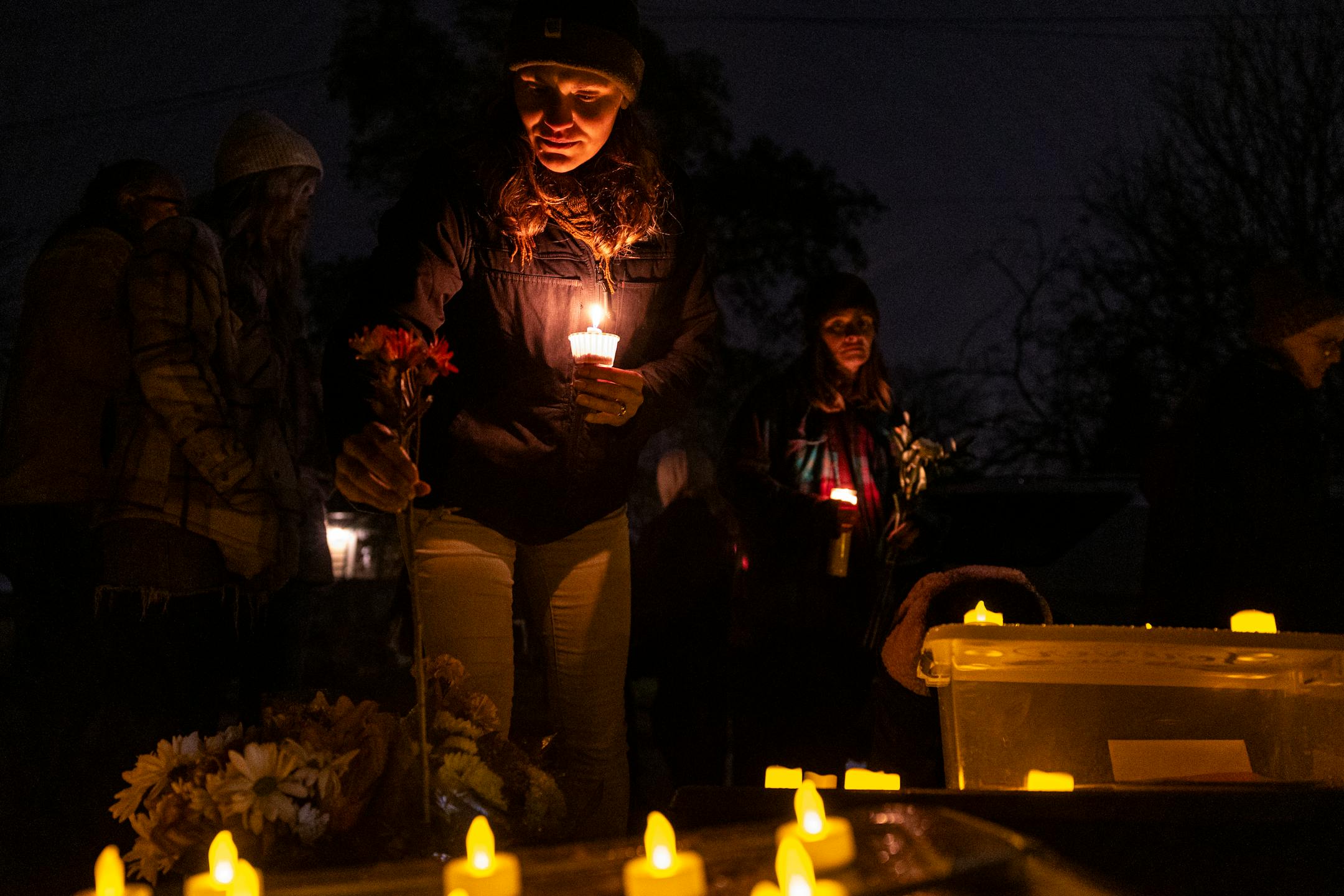
Mourners light candles and leave flowers outside a home in Duluth during a walking candlelight vigil memorializing four people who were shot and killed in November 2024. (Ayrton Breckenridge/The Minnesota Star Tribune)

Nearly half of the people who died in domestic violence incidents in Minnesota last year were bystanders or those who were trying to intervene.

Even as the state’s total domestic violence-related homicides in 2024 dropped from a record number set the year before, the number of bystanders and interveners who were killed remained at record levels, according to a report released this fall by Violence Free Minnesota.

The total number of victims last year dropped from 40 to 24. But for the second year in a row, 11 bystanders or interveners were killed, the report said, matching a mark first set in 1999.

There is an openness from the community to help someone in crisis, but it can be dangerous for an intervener, said Amirthini Keefe, executive director of the Minneapolis-based Domestic Abuse Project.

“We haven’t had a conversation about how to intervene safely as a bystander in the same way that we are having that conversation about other types of violence,” Keefe said.

Among those who were interveners or bystanders last year were two police officers and a firefighter-paramedic who were shot and killed in Burnsville while responding to a domestic violence call, as well as two children who were shot and killed in a quadruple homicide in Duluth.

Those events, and the numbers reflected in Violence Free Minnesota’s report, pushed advocates to again call for better gun control policy, arguing that easily accessible firearms play an important role in enabling fatal domestic violence and allowing it to escalate to mass violence.

“Firearms and domestic violence are a deadly combination, and they’re a deadly combination for more than just victims and their family members,” said Nikki Engel, the interim co-executive director of Violence Free Minnesota, which has conducted its annual homicide report since 1989. “That combination is incredibly dangerous for family members, children, bystanders, interveners, neighbors, community members, for the public, for all of us.”

Nearly half of all fatal domestic violence victims since 1989 have been killed with guns, the report said. Nineteen of the 22 bystanders and interveners who died in 2023 and 2024 were killed by guns.

One recourse members of the public have, advocates point out, is Minnesota’s red flag law, which went into effect in 2024. It allows family and household members to petition a court to temporarily remove firearms from someone deemed a danger to themselves or others.

Enforcement of the law has been spotty so far, according to a Minnesota Star Tribune analysis this year, and various officials have said the public still needs to be better educated on how it works. But Engel called it a “powerful tool” to protect people.

“I think it’s still early days with [red flag laws], but the data that we do have with how those are implemented across the state seems very positive,” Engel said.

Apart from better gun policy, there also needs to be more discussion about how to be in healthy relationships and how to intervene when witnessing something problematic, said Keefe, of the Domestic Abuse Project.

She said it’s important for an intervener to avoid being confrontational in an aggressive manner. That can escalate a situation.

“That’s the one thing I would not recommend,” Keefe said.

Instead, Keefe said, an intervener can cause a distraction. Make some noise either by coughing, starting a loud conversation on your phone, turning on loud music, or asking the people involved an unrelated question, according to Operation Safe Escape, a nonprofit that helps victims escape domestic violence situations.

Sometimes just being within an abuser’s line of sight may cause them to stop, and an intervener can also record an interaction on their phone and gather other people to approach as well, according to Operation Safe Escape.

An intervener can also call 911 if they believe the situation is dangerous.

If the victim and intervener know each other, Keefe said the intervener can follow up later on and ask how they are doing. Tell them they deserve to be safe and that what happened isn’t OK, Keefe said.

But Keefe said it’s important not to put pressure on a victim by giving them ultimatums or telling them what to do, such as to leave their abuser. Leaving an abuser can be dangerous, and there may be complicated factors preventing them from doing so, such as financial difficulties or children.

“Giving the victim options and making statements that really help them see what their choices are — but they’re the ones that get to make those choices, and there’s no judgment regardless of what choice they make — really helps establish you as a safe person that they can turn to,” Keefe said.

How to find help

For anyone in Minnesota experiencing domestic or intimate partner abuse, Violence Free Minnesota recommends contacting the 24/7 Minnesota Day One Hotline. Call 866-223-1111 or text 612-399-9995.

The hotline serves anyone experiencing sexual violence, domestic violence, general crime or trafficking.

A list of Minnesota agencies, by county, which serve domestic violence survivors can be found here.

Culturally specific agencies serving the Twin Cities area include:

For the Asian community:

24/7 crisis line: 952-912–9100

6645 James Av. N, Brooklyn Center

24-hour multilingual crisis line: 612-724-8823

651-495-1557

1075 Arcade St., St. Paul

651-756-1579

2356 University Av. W., Suite 230, St. Paul

For the East African community:

612-302-3400

3650 Fremont Av. N, Minneapolis

For the Latino/Hispanic community:

24-hour bilingual crisis line: 651-772-1611

For the LGBTQ community:

Anti-Violence helpline: call 800-800-0350 or email AVP@outfront.org

2446 University Av. W., Suite 112, St. Paul

651-756-1579

2356 University Av. W., Suite 230, St. Paul

For the Native community:

612-879-1700

1530 East Franklin Av., Minneapolis

612-728-2000

2300 15th Av. S, Minneapolis

Crisis hotline: 651-251-1609

about the writer

about the writer

Elliot Hughes

Reporter

Elliot Hughes is a general assignment reporter for the Star Tribune.

See Moreicon

More from News & Politics

See More
card image
Carlton County Justice Center

A man and child in a pickup truck survived their injuries, the Sheriff’s Office said.