
A state law has prevented school and workplace shootings, but enforcement is inconsistent

Public records show that the state’s red flag gun law has helped law enforcement confiscate guns from people with violent plans. Some counties, though, have rarely or never used it, raising worry about gaps in its effectiveness.

The Minnesota Star Tribune
October 4, 2025 at 4:47PM
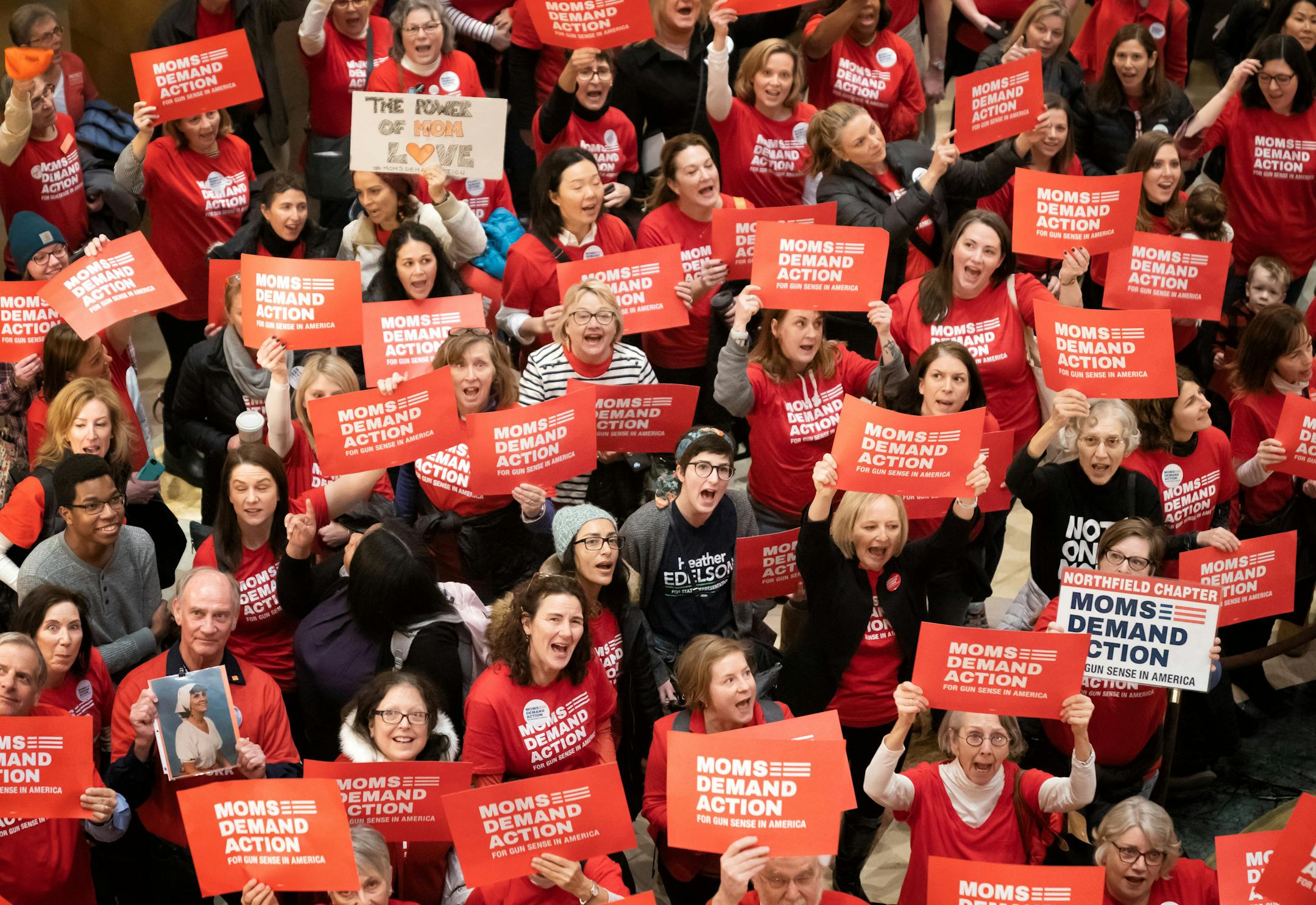
Protesters with the group Moms Demand Action rally in support of gun control legislation at the State Capitol in 2019. Minnesota later passed a red flag law, which went into effect in 2024. (Glen Stubbe/The Minnesota Star Tribune)

The warning signs were ominous.

A University of Minnesota student was spotted staring at a computer game that lets players pretend they are going on a killing spree at a middle school. A classmate told police that the student had become reclusive, and medical records revealed a history of depression and suicidal thoughts.

The 22-year-old also posted threatening photos of an assault rifle on social media, and neighbors had seen him carrying what appeared to be two firearm cases toward a light-rail station.

The Hennepin County Sheriff’s Office acted quickly. It asked a judge to allow law enforcement to take the student’s weapons under Minnesota’s new red flag law. Within hours, the request was granted. Police recovered two machetes, a shotgun and a rifle from the student’s apartment a day later.

This intervention last October is exactly the kind of proactive police work proponents of the state’s red flag law hoped for when Minnesota became the 21st state to allow authorities to take firearms from people who pose a threat to themselves or others.

Since the law took effect in January 2024, judges have used it to bar 281 people from legally owning guns for at least two weeks. That includes 10 people who had threatened violence at schools or day care facilities and 40 who openly discussed targeting a workplace or engaging in a gunfight with police officers.

Records show some of those people had dozens of weapons and large stockpiles of ammunition, and most of them lost those weapons for at least six months.

“We have clearly saved a lot of lives,” said state Sen. Ron Latz, chief author of the controversial legislation, which was opposed by some gun rights advocates.

But a Minnesota Star Tribune review of 301 cases filed in the past two years also reveals alarming gaps in the way the law is being implemented. Law enforcement sometimes dropped cases or failed to appear in court, allowing firearms to fall back into the hands of several people who later committed violent crimes.

Application of the law is spotty. Many law enforcement agencies have never used it, and the St. Paul Police Department has filed only two petitions.

In addition, firearms were rarely kept from troubled people for more than a year. That happens even though judges can extend the protective orders if there is “clear and convincing evidence” that problems persist.

Latz and other state lawmakers who championed the Minnesota’s red flag law said the Star Tribune’s findings could lead to legislative changes, including extending the length of protective orders and allowing more people to file petitions.

They said they may also push for more money to expand the law after federal cuts to anti-violence efforts.

“I don’t want to have a situation where someone files a petition and — because it is lacking some information — some individual doesn’t get the intervention they need and goes out and causes another tragedy,” said Rep. Cedrick Frazier, DFL-New Hope, chief House author of the legislation.

Where potential violence was stopped

The threats detailed in the requests before judges are chilling. Most have never been reported publicly.

In Bloomington, police seized a loaded assault rifle and four handguns from the sixth-floor hotel room of a Seattle man who set up a “shooting platform” overlooking a busy street next to the Mall of America last December.

The man asked for his weapons back after he was released from a local hospital, but a judge refused, saying his “delusional” thinking posed a “significant danger” to the public.

In Alexandria, police took a handgun from a mentally ill resident of an apartment complex after he repeatedly threatened the property manager in April, telling her he had “a bullet for her.”

In one confrontation, records show, the gun owner brought up his history of being bullied, saying, “This is how school shooters are made.”

Last June in Anoka, police took four firearms, including a semiautomatic rifle, from a 36-year-old man who threatened to kill two former co-workers at a Home Depot after he was fired, records show. He said he was prepared to shoot it out with police, telling his wife he was “preparing for war.”

Altogether, 141 of the 301 cases reviewed by the Star Tribune involved people who threatened others. The review included all cases filed through the end of August.

Besides permitting the seizure of weapons, Minnesota’s law allows judges to bar someone from buying a firearm from a licensed dealer. Judges can forbid people from owning or buying a firearm for six to 12 months, and they have the option of extending those orders.

Like many states, Minnesota also allows some family members, roommates and significant others to use the law. Other states allow broader groups of people such as co-workers, educators and medical professionals to ask a judge to take action.

Nobody, however, filed petitions involving the two people who allegedly engaged in shootings this summer that took the lives of a state lawmaker and her husband, and killed two children and wounded 21 others at a Minneapolis church. So far, no one has claimed there were warning signs in either incident.

Those killings led Gov. Tim Walz to push for a special session on gun control legislation, including an assault weapons ban. In 2023, Walz signed a sweeping public safety bill that included the red flag measure and a requirement of background checks on all gun purchases.

Connecticut implemented the nation’s first red flag law in 1999 after a fatal workplace shooting at the state’s lottery headquarters. Most states with red flag laws took action in the wake of a school shooting in Parkland, Fla., where the local sheriff’s department was criticized for ignoring warning signs.

The laws have been challenged in some states, but a 2024 ruling by the U.S. Supreme Court was broadly interpreted as a victory for red flag proponents. The 8-1 decision established the government’s right to take guns from people subject to domestic violence restraining orders. Red flag laws were patterned largely on domestic violence statutes.

Nationally, research indicates the laws have also prevented an estimated 2,500 suicides in the past six years, when the vast majority of all petitions were filed.

In Minnesota, court records show that the red flag law is the quickest way to remove weapons from dangerous individuals. Though it often takes months for judges to suspend the gun rights of someone through criminal or civil commitment proceedings, police agencies are typically granted the ability to seize weapons on the same day they filed red flag petitions, records show.

“I know these things were very controversial at the onset, but I think Minnesota did a pretty good job on this statute,” said Kandiyohi County Sheriff Eric Tollefson, who used the law twice in 2024.

“Everyone’s fear was that family members and estranged spouses would run rampant and take people’s guns away, but that’s not happening.”

Some critics, however, say too many red flag petitions have been filed unnecessarily.

“I am certain there are instances where there has been a net benefit, but the trade-off is: How many people have had their rights unduly infringed upon to make that happen?” said Rob Doar, vice president of the Minnesota Gun Owners Caucus, a St. Paul nonprofit that opposes a proposed ban on assault weapons.

Didn’t follow up, didn’t show up

Sometimes, records show, police failed to follow through on red flag cases that presented significant hazards.

In Winsted, Minn., a small town about 45 miles west of the Twin Cities, Police Chief Justin Heldt said it was a mistake to allow a 2024 case to lapse involving Justin Wang.

He said a city prosecutor decided a six- to 12-month order was not needed because Wang was barred from possessing firearms by an order for protection that existed at the same time. Unfortunately, Heldt said, the victim dropped the protective order.

Four months later, in May 2024, Wang was charged with felony assault and threats of violence after he threatened a former girlfriend with a gun that he retrieved from police when his red flag case was dismissed.

The woman told police she thought Wang was going to kill her and her children.

Wang pleaded guilty to felony charges last month and was barred from possessing firearms for five years while he remains on supervised probation.

“In hindsight, it would have been better for the prosecutor to file that,” Heldt said. “Then maybe, just maybe, that May incident may not have happened like it did. ... I can’t imagine how terrifying it was for that family.”

Some police agencies have been slow to use the law, with no cases filed in 39 of Minnesota’s 87 counties. In Ramsey County, where 24 petitions were filed, just two of those cases involved the St. Paul Police Department, and both were triggered by mental health workers who raised concerns about suicidal patients with access to guns.

Unlike other major police departments, St. Paul did not file any cases stemming from routine police work, such as domestic violence calls. The department also failed to appear at hearings on the two cases filed in the city, prompting a judge to deny issuing a protective order in one of those cases.

“It’s terrible that St. Paul only has two” cases, said Sue Abderholden, executive director of NAMI Minnesota, a nonprofit that promotes mental health programs and backed the red flag law.

A St. Paul police spokeswoman said the department is “actively working” on new policies to deal with the red flag law. She blamed the two no-shows on the city attorney’s office and said the Police Department was not notified of the hearings.

By contrast, the Mankato police department led the state by filing 23 red flag cases in the past two years. All but one of those cases led to a court order barring firearm access.

The department has sought extensions in three of nine cases that have come up for renewal. Jeremy Clifton, director of the Mankato Department of Public Safety, said he didn’t have enough evidence to justify extensions in the other cases.

“You have to respect the Second Amendment,” Clifton said. “We are only asking for extensions when it is necessary.”

Outreach impaired by sparse resources

Overall, Minnesota has embraced the red flag law faster than other states, according to data compiled by Everytown for Gun Safety, which bills itself as the largest gun violence prevention group in the U.S.

In the law’s first year, 137 petitions were filed in Minnesota, more than six of the 21 states with red flag laws. That list includes Massachusetts, which enacted its law in 2018 and accounted for just 24 petitions last year.

“Minnesota is in good shape,” said Chelsea Parsons, Everytown’s senior director of implementation. “In particular, the county attorneys in Hennepin and Ramsey did a really good job of training law enforcement to make sure people understand the law and how to make use of it.”

Red flag law proponents said more outreach would help community members who have struggled to implement the law.

“Individuals who are not familiar with the legal world don’t know what the court wants; they are not skilled at filling out a petition,” said Rana Alexander, who coordinates red-flag efforts for the Hennepin County Attorney’s Office.

Law enforcement leaders said other jurisdictions would likely file more cases if the state gave counties a training budget and supported the hiring of red flag coordinators.

Currently, according to the Minnesota Department of Public Safety, no state money is targeted for supporting the red flag law. The only funding has come from the federal government, which set aside $750 million for violence prevention efforts nationwide in 2022.

Minnesota has received $5.9 million from that fund, but red flag law advocates note that the Trump administration recently cut more than $150 million in community grants through the program — about half of what was allocated this year.

“We shouldn’t have this balkanization of resources,” said Ramsey County Attorney John Choi, who testified in support of the state’s red flag law. “We need training and a tool kit for every jurisdiction in the state of Minnesota.”

about the writer

about the writer

Jeffrey Meitrodt

Reporter

Jeffrey Meitrodt is an investigative reporter for the Star Tribune who specializes in stories involving the collision of business and government regulation. 

See Moreicon

More from News & Politics

See More
card image
Leila Navidi/The Minnesota Star Tribune

Friday’s morning commute and weekend travel could be impacted by the snow.

card image
card image