
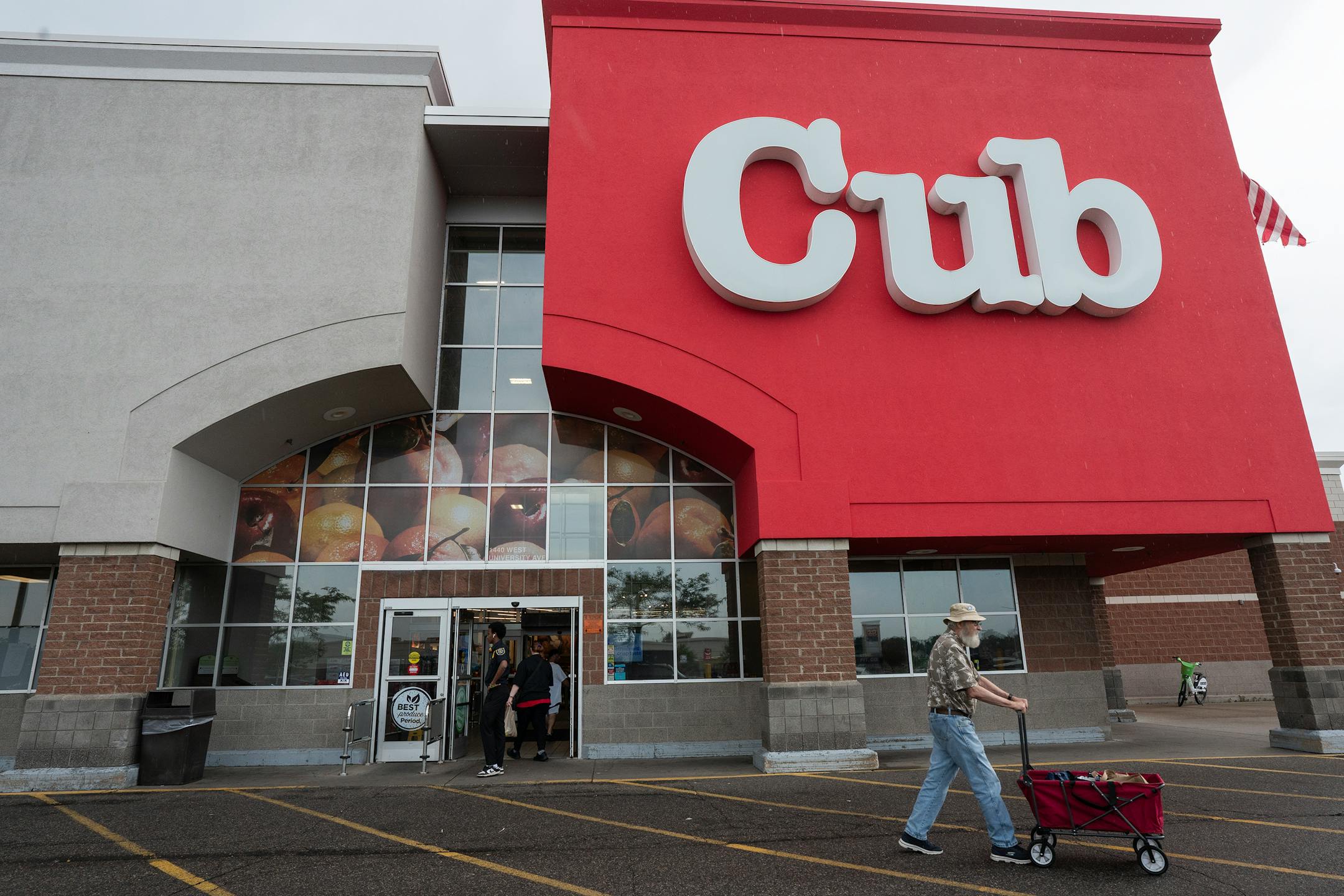
A booming big box retail market leaves St. Paul’s Midway behind

With Cub’s exit, Midway Marketplace will soon have four large empty stores. That’s unusual amid high demand for big box space.

The Minnesota Star Tribune
August 16, 2025 at 1:43PM
The Midway Cub Foods is closing at the end of August. (Richard Tsong-Taatarii/The Minnesota Star Tribune)

The Cub Foods in St. Paul’s Midway neighborhood is on its deathbed.

On a recent weeknight, the automatic door wasn’t working. There were no carts or shopping baskets in the entry. Some shoppers grabbed what they could carry to check out, much of it — pasta, cheese, jam — at a discount, as advertised by bright yellow “sale!” signs.

When it closes for good at the end of August, Cub will be the fourth large vacant space in Midway Marketplace, a suburban-style big box shopping complex on one of St. Paul’s main thoroughfares, preceded in death by an At Home store, a Herberger’s and a T.J.Maxx.

The mall’s vast array of vacant space is now a neighborhood talking point, a magnet for loitering, and a growing concern at City Hall. But it is also an outlier: a conspicuous dead zone in a retail environment that has made a strong recovery from the COVID-19 pandemic and led to low vacancy rates for big box spaces almost everywhere else in the Twin Cities.

Urban big boxes

It wasn’t supposed to be this way for Midway Marketplace. At a store grand opening in 1995, then-Mayor Norm Coleman lauded the center as an “explosion of economic energy” in a part of the city that had been in decline for decades.

“This is critically important to all of St. Paul,” he said.

At the time, big box retailers were reaching a saturation point in the suburbs, said Nicholas Dagen Bloom, a professor of urban policy and planning at Hunter College in New York City. “They were basically just kind of cannibalizing each other’s trade,” he said.

So many big box retailers expanded to urban areas, where they figured the density of customers would make up for their lower average incomes.

Decades later, Bloom said he’s not sure that model has performed at the level companies hoped, for several reasons: competition from online retailers and other chains, sometimes subpar management of stores in urban locations and low tolerance for challenges that sometimes come with city spaces, such as loitering, panhandling and higher shoplifting volume, real or perceived.

“They wanted the profit but not the urban condition,” Bloom said.

In some ways, big box chains aren’t built to handle those challenges, Bloom said: Large-format stores and gigantic parking lots with minimal staffing lend themselves to problems.

In this context, it’s not surprising smaller-footprint chains such as Aldi are the companies currently expanding in cities. Or that stores such as Target tend to have more petite format stores, which are more easily supervised, when they do go into urban areas, Bloom said.

Cub’s closure

Cub Foods’ parent company offered little in the way of explanation for closing the Midway store, except to say that it was part of an effort to “optimize our footprint.” In June, the company closed its Uptown location but did not respond to a request for comment for this story.

City officials said the closure came in spite of attempts to help address shoplifting and loitering issues.

“While we were hopeful about our progress,” St. Paul Mayor Melvin Carter said in a statement, “we became acutely concerned after Cub leadership recently failed to attend a scheduled meeting with the Mayor’s Office.”

Ward 1 St. Paul Council Member Anika Bowie, who represents the area, said she was disappointed in the closure, “especially after the city and Ward 1 office exhausted every effort to support the business,” including helping to return stolen carts.

Jeremy Jacobs, the executive managing director of the north central region at Colliers, a real estate services firm, said the Midway Cub saw a notable drop in foot traffic — 14% in two years. In the past year, it had the lowest foot traffic of any Cub in the metro.

The Midway store’s performance stands in sharp contrast to another Cub in another urban shopping center across town. Whereas the Midway Cub notched $550 in sales per square foot in recent data, the Cub at the Quarry in northeast Minneapolis had $750 in sales per square foot.

“Any business, given these conditions, might do what Cub did,” he said. “Then the next question is, ‘Well, why did the traffic fall as much as it did?’”

Jacobs listed a few possibilities: a smaller geographic pull than, say, the Quarry’s Cub, the condition of the neighborhood and competition from a growing number of nearby stores that sell groceries among them.

On St. Paul time

Beyond their Cubs, Midway Marketplace and the Quarry look very different in another way: The Quarry has almost no vacant space.

That’s typical right now. Big box retail space is currently in high demand, market conditions that make Midway’s empty big box storefronts stand out even more, Jacobs said.

“We have all sorts of tenants who are looking for space that might be fitness concepts or doggy day cares or, you know, whatever,” he said. “They would love to open up a new store or expand or move into a new market, but it’s just very, very tight.”

While Cub’s exit won’t make Midway a food desert, it means another vacancy and the loss of about 100 union jobs in a neighborhood that’s already feeling demoralized, said Matt Privratsky, who has served the Midway area as interim Ward 4 City Council member.

“I think folks in Midway are really, really exhausted of our empty lots era,” he said — not just at the shopping center, but also the boarded up CVS Pharmacy at the corner of University and Snelling and other empty, often trash-strewn lots along the corridor.

The timing is frustrating, too, he said, because long-awaited development at United Village is finally happening across the street. After the loon sculpture and playground opened last year at the Allianz Field site, United Village has broken ground on an office building and restaurant space.

“Buildings are literally going up,” Privratsky said.

Lee Krueger of Krueger Real Estate Advisors and the previous head of the St. Paul Port Authority expressed confidence in local developer Kraus-Anderson, the company that owns and manages Midway Marketplace, and RD Management, which owns the Herberger’s building. The Herberger’s building is managed by JLL, which declined to comment for this story.

“Retailer[s] that operate in this retail hub have enjoyed high sales volume stores for decades,” Kraus-Anderson Executive Vice President Jeff Hildahl said in a statement. “The long-term success of both this retail Hub and of Midway Marketplace itself gives us confidence we can fill the space with a quality tenant.”

Privratsky said Kraus-Anderson has been a good partner on new city projects but should be pressed on its long-term vision for Midway Marketplace. For now, he said, he’d like to see another grocery store in Cub’s former space.

Krueger counseled patience. He said he expects Midway Marketplace to recover — on St. Paul time.

“It does recover; it just goes slow,” he said. “Other cities tend to be a little bit more of a catalyst to make things happen.”

about the writer

about the writer

Greta Kaul

Reporter

Greta Kaul is the Star Tribune’s built environment reporter.

See Moreicon

More from St. Paul

See More
card image
Sofia Barnett

The City Council will take another week to finalize resolution language. The city will also fund immigrants’ defense and naturalization in 2026 budget.

The setting sun illuminated the St. Paul skyline, with city hall on the left, as seen from Harriet Island Park.
card image