
Editor's Pick

Editor's Pick

Violent crime is down in Minneapolis, but police overtime is up amid ICE surge

The department logged about $3 million in overtime for five days in which officers’ days off had to be canceled.

The Minnesota Star Tribune
January 24, 2026 at 12:00PM
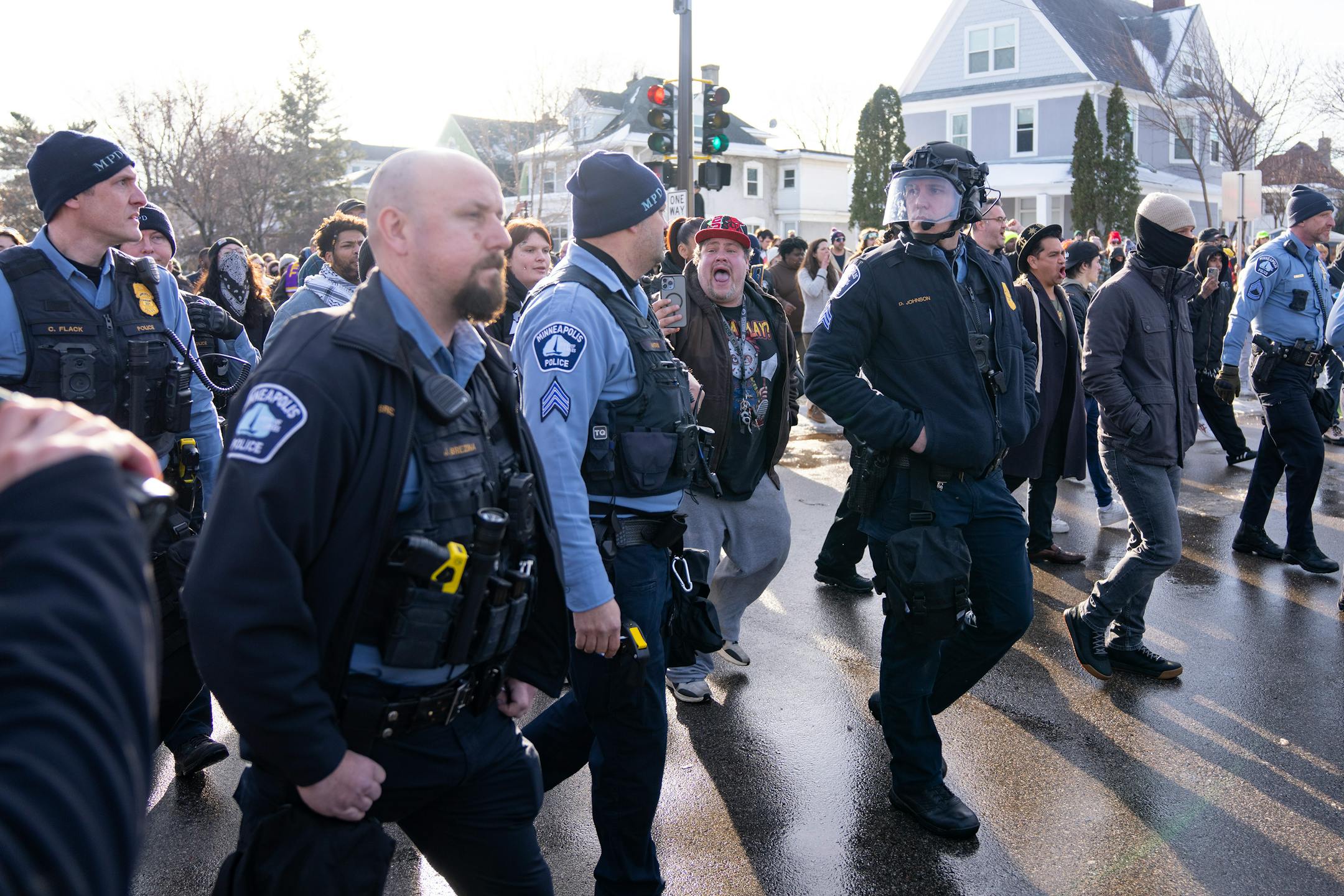
Community members and protestors yell at Minneapolis police officers as they begin to leave the scene where federal agents shot and killed a woman earlier on Portland Avenue in Minneapolis on Jan. 7. (Alex Kormann/The Minnesota Star Tribune)

Violent crime has fallen in Minneapolis as streets swelled with thousands of immigration officers over the past seven weeks.

It’s unclear if the flood of federal officers has been the cause of the reduction; Police Chief Brian O’Hara credits good police work, despite increasing demands on the police force as protesters clash with ICE agents.

As Mayor Jacob Frey has noted, so far this year, the city has recorded two fatal shootings, one of which was by an ICE agent who fatally shot 37-year-old Renee Good.

“ICE is making our city less safe right now,” Frey has said.

But amid all the federal agents and bone-chilling temperatures, violent crime is down so far this year across a number of categories. Homicides, shooting victims and burglaries have decreased.

The one homicide so far is a lower number than each of the past seven years, according to a Minnesota Star Tribune analysis of data from the Minneapolis Police Department. (Good’s killing is not included in Minneapolis police data for shooting victims because the department is not part of the investigation.)

So far this year, the number of reported gunshots fired is about a quarter lower than last year. The same goes for gunshot victims (four), which is lower than in 2019, before the pandemic and resulting crime spike, when there were a dozen by this point.

As with most cities, crime has mostly declined in Minneapolis since 2021.
Not all crime is down though: Aggravated assaults, robberies and vehicle thefts are up compared to last year.

O’Hara said the police department has made “significant progress” in combating serious violent crime and getting illegal guns off the streets, despite a staffing shortage and “unprecedented operational demands” due to Operation Metro Surge.

The Trump administration says it has sent over 3,000 federal officers to Minneapolis since Dec. 1 as part of an immigration crackdown. An already-tense situation exploded after the fatal shooting of Good, inciting weeks of angry protests.

ICE’s aggressive tactics have led to frequent clashes between armed, masked agents and residents, who follow the federal agents and alert neighborhoods to their presence with whistles and horns. Some have lobbed fireworks and objects at officers or blocked their path with vehicles. The two sides frequently clash, with some protesters arrested.

The Minneapolis police force has largely stayed out of the fray because a city ordinance bans them from assisting with federal immigration enforcement. But they still get a lot of calls for help related to the ICE surge: A week into the federal surge, the MPD began tracking the 911 calls and recorded over 80 related to the ICE surge from Dec. 9 through Jan. 12.

O’Hara said in a news release that his police force has delivered “exceptional results under extraordinarily challenging conditions.”

“Their outstanding police work demonstrates that focused, professional policing — guided by data and accountability, with support of our residents — can reduce violence, clear serious cases, and remove dangerous individuals and illegal guns from our communities,” he said.

$3 million in overtime for 5 days

Violent crime may be down, but with ICE in town, the department is logging heavy overtime.

Officers have had to extend shifts beyond eight or 10 hours, cancel days off and get called in for emergencies.

In order to be ready to respond to tension around the federal operation, the MPD canceled all days off from Jan. 7 through Jan. 11. That meant officers were unable to take 983 scheduled days off, according to a state filing for a lawsuit.

That resulted in nearly 14,000 hours of overtime that cost an estimated $1.92 million, according to the police department. Days off were also canceled on Jan. 17, costing the city up to $1.2 million in overtime.

Those five days alone will cost the city about $3 million. That’s more than the $2.3 million in overtime budgeted for all of 2026.

The MPD uses the savings from its vacancies to cover overtime overages. The department has been short-staffed since 2020 — it is down about 300 officers from then — and has heavily relied on overtime to function.

In December, the MPD was criticized by City Council members for going $19.6 million over budget, with a $31 million overtime bill a major culprit.

The police department is being called on to do more by people on both the political right and left: This week, Vice President JD Vance said ICE wouldn’t need so many officers in Minneapolis if they could get “a little cooperation” from local and state law enforcement to control “chaos.”

Frey responded by saying the antidote to the chaos is for the federal agents to “go home.” He said police have responded when safety is at issue.

Some council members also want the police department to do more — not to help ICE, but to help residents.

Council Member Robin Wonsley this week called on police to protect civilians, escort children to school and adults to work. She said the mayor’s office has been asked by council members to block off access to streets in “vulnerable communities” of immigrants being targeted by ICE, but so far hasn’t responded.

Jeff Hargarten of the Minnesota Star Tribune contributed to this story.

about the writer

about the writer

Deena Winter

Reporter

Deena Winter is Minneapolis City Hall reporter for the Star Tribune.

See Moreicon

More from News & Politics

See More
card image

A legal permanent resident believed he left his criminal past behind. Now the Twin Cities auto shop owner is facing possible deportation.

card image
card image