
Scoggins: Jerry Kill is ‘living the dream’ after surviving the nightmare

The former Gophers head coach who resigned after dealing with severe health problems is helping lead Vanderbilt and Heisman-contending QB Diego Pavia to new heights.

Columnist Icon
The Minnesota Star Tribune
October 29, 2025 at 7:30PM
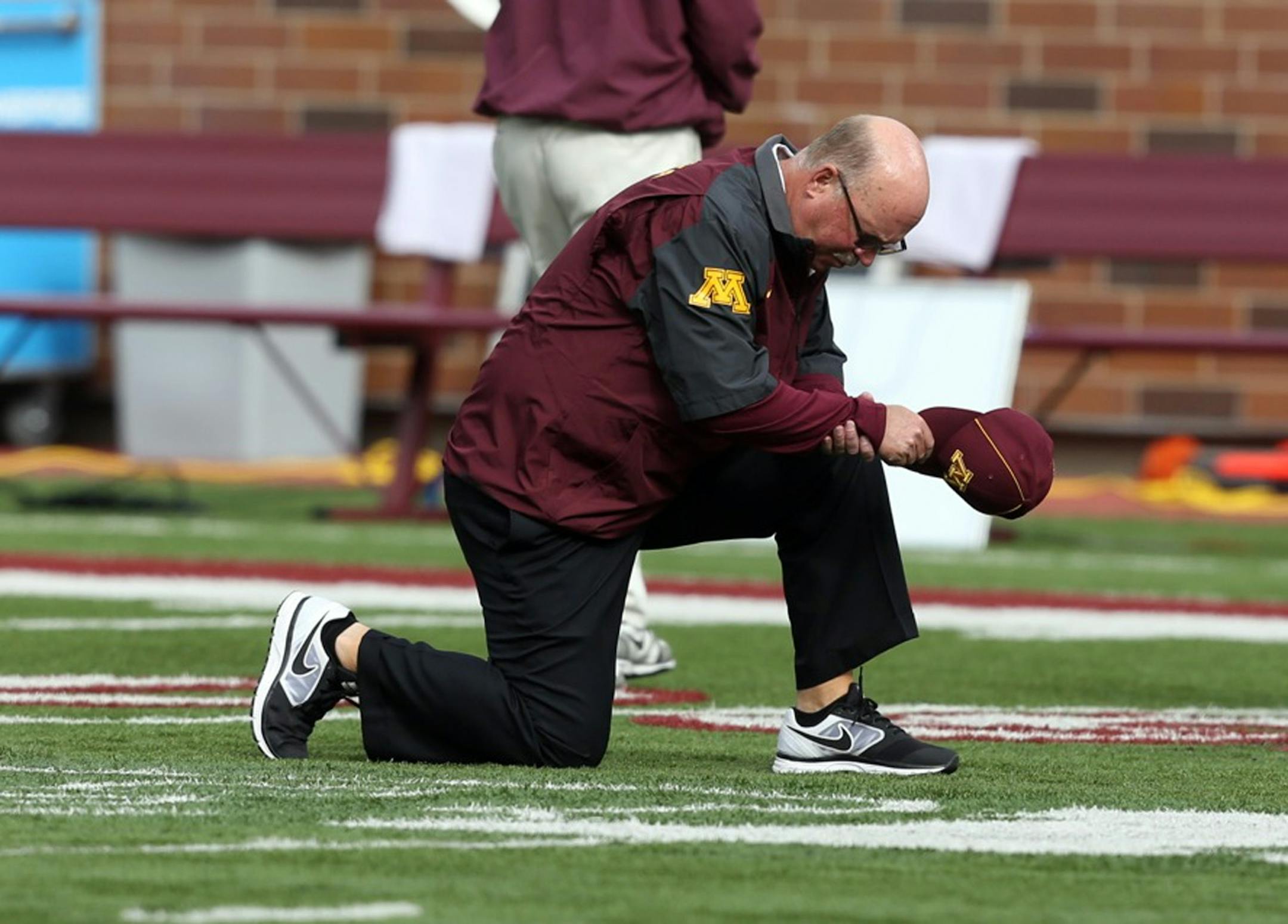
Gopher football coach Jerry Kill prays with the team . Last week he left the game at the half because of a siezure.
A decade after resigning as the Gophers head coach to due health problems that included seizures, Jerry Kill is a consultant for Vanderbilt, arguably the greatest story in college football this season. (Jim Gehrz/The Minnesota Star Tribune)

Tuesday marked the 10-year anniversary of the hardest moment of Jerry Kill’s coaching career. That day he sat alone at a podium and somberly announced his resignation as Gophers football coach by saying, “I feel like a part of me died.”

“I try to forget that,” Kill said by phone from Nashville on Tuesday.

Sitting in the news conference that day back in 2015, I thought Kill would never coach again.

He looked and sounded emotionally shattered. His epileptic seizures had become too frequent and too taxing on his body for him to continue.

I wrote in a column that day: “Kill has a heart bigger than Texas and today that heart is broken. Jerry Kill is no longer a football coach.”

Ten years later, he’d forgotten the date he stepped away, but not the job he left.

“Minnesota was the best thing that ever happened, and I have never gotten over it, to be honest,” he said. “And I never will.”

He doesn’t want to give the wrong impression though.
ADVERTISEMENT

He’s happy, healthier and helping perform a college football miracle in his role as chief consultant to Vanderbilt head coach Clark Lea.

The Commodores are 7-1 and ranked No. 9 nationally with three wins over ranked opponents.

Kill has a front-row seat — and integral role — in transforming a traditional doormat into one of the best teams in college football. Football excellence at Vandy is man-on-Mars stuff.

“We just changed the culture of the program,” Kill said.

Same as he did in Minnesota.

Kill inherited a mess after replacing Tim Brewster. He instilled accountability and put the program on solid footing again. He was tough, feisty and no-nonsense, but epilepsy became an opponent too difficult to contain with the job demands.

The way it ended still bothers him.

“Because the people treated me so good,” he said. “I was on a good roll. You can’t control what happens to you with a health situation. I’ve had to battle that stuff my whole life. …

“I was at the pinnacle, and we had things going and working on the new facility [Athletes Village]. I hit my head against that wall so hard. I gave every ounce I could to Minnesota. I mean every single ounce. Eventually, you’ve got to be able to sleep and you’ve got to be able to eat and I wasn’t doing any of it. All I could do was think about Minnesota football, and I gave everything I had. I look back at it and if I had been able to stay healthy, who knows what would happen.”

I’ve always wondered if Kill should have asked to take a leave of absence rather than retire abruptly. He brought up that theory unprompted in our phone conversation.

“I know a lot of people said you could have taken a year off,” he said. “That would have killed recruiting. It would have killed the program. You can’t take a year off and then come back, not with recruiting. I did what I had to do, and I didn’t cheat Minnesota.”

The desire to coach returned as his health improved.

He made various stops as an assistant before taking over as head coach at New Mexico State, a bottomed-out program that went 2-10 the season before he arrived.

He won seven games his first season, then 10 wins in 2023, including a 21-point rout of Auburn.

Kill refers to that turnaround as the “Miracle in the Desert.”

“The satisfying thing about that is I was able to go out my way,” he said.

He decided to retire and was “down in Mexico drinking margaritas” when he got a call from Lea with a job offer. Lea already had hired Kill’s offensive coordinator at New Mexico State, Tim Beck, to run the offense.

Lea asked Kill to help him find a new approach to jump-start a perennial SEC bottom-feeder.

Even though he had no previous connection to Lea, Kill put retirement on hold and signed a three-year contract. As a bonus, he’s only two hours away from his granddaughter (with another grandchild on the way).

“We went in and changed some things and developed a tough culture like we’ve been able to do everywhere else,” he said.

That cultural shift starts with Diego Pavia, the uber-competitive quarterback that Kill recruited to New Mexico State and then joined him in Nashville.

Pavia’s unlikely path began at New Mexico Military Institute where he played in the junior college national championship. Kill and Beck were recruiting the quarterback from Iowa Western in that game but decided to take Pavia instead, and now here is being mentioned as a Heisman Trophy candidate for a Vanderbilt team that is thick in the race for the College Football Playoff.

Try making sense of that narrative.

“He has so much confidence and swagger to him,” Kill said. “Did I think he was going to do what he’s doing right now? I don’t think anybody did. But he did. That’s what makes him so good.”

Kill said his relationship with Pavia is “as tight as you can get. It’s turned into a situation like a son. He is going to play his guts out.”

He also has forged a close connection with Lea, who leans on Kill’s advice and guidance in managing the program.

“It’s been a great marriage,” he said.

Now 64, Kill said he’s done being a head coach. He enjoys being an adviser and helping younger coaches advance their careers.

As for his health, he says “I’ve got it pretty well under control, the seizure part of it.” He loves living in Nashville, and the Commodores are taking a magic carpet ride that can continue to pick up speed with a win Saturday at Texas.

Kill said he’s “living the dream” after enduring a personal nightmare.

“Minnesota made me a better person,” he said. “The people were great to me. I made the best out of it and fought my way back.”

about the writer

about the writer

Chip Scoggins

Columnist

Chip Scoggins is a sports columnist and enterprise writer for the Minnesota Star Tribune. He has worked at the Minnesota Star Tribune since 2000 and previously covered the Vikings, Gophers football, Wild, Wolves and high school sports.

See Moreicon

More from Gophers

See More
card image
Alex Kormann/The Minnesota Star Tribune

Having already traveled to the west coast this season — a 27-14 loss to Cal — Fleck says his staff learned some ways to make the cross-country trip more accommodating for his players.

card image
card image