Advertisement

Charges dropped against three Minnesotans accused of assaulting federal agents

The defendants were initially accused of serious crimes. But when asked for evidence, the government dropped their cases.

The Minnesota Star Tribune
February 25, 2026 at 8:33PM
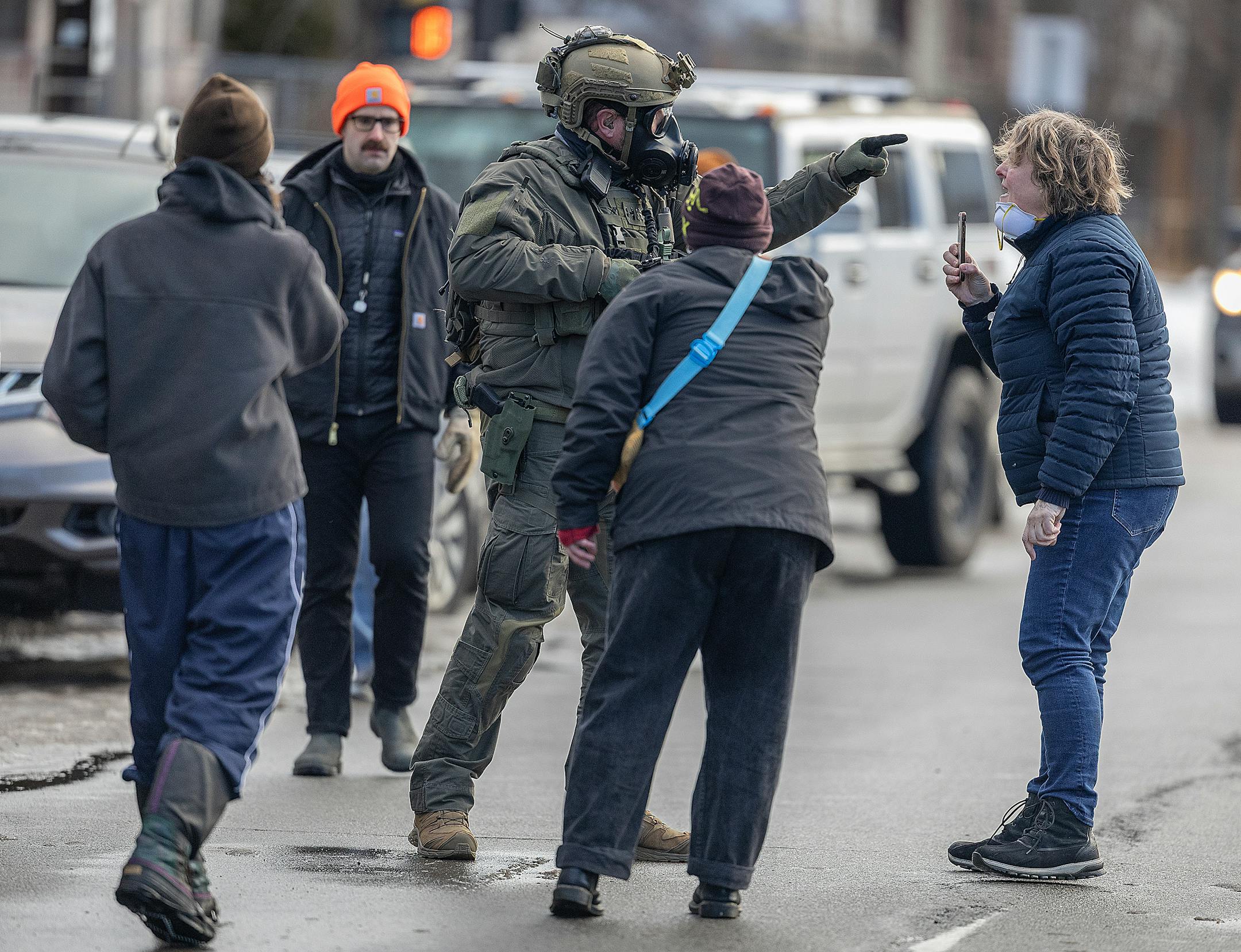
Protesters and federal agents collide in Minneapolis on Jan. 13. (Elizabeth Flores/The Minnesota Star Tribune)
Advertisement

Three Minnesotans accused of assaulting federal law enforcement officers during Operation Metro Surge had their charges dismissed this month.

The new dismissals are in addition to at least three other instances of protesters who had charges dismissed in January and February.

Madeline Tschida, a 24-year-old from Becker, was charged on Jan. 23 with allegedly assaulting a federal agent while protesting Immigration and Customs Enforcement (ICE) near Monticello, and kicking the door of one of their vehicles when agents attempted to arrest her.

U.S. Attorney General Pam Bondi blasted her in a social media post depicting more than a dozen anti-ICE protesters shackled and flanked by federal agents in late January, describing them as “Minnesota rioters.”

U.S. Attorney Daniel Rosen followed up that post with a news release naming Tschida as someone charged with a violent assault — an accusation that typically leads to felony charges pending a grand jury indictment.

“We do not tolerate assaults on federal officers and those who commit that crime will be held accountable,” Rosen said in the release.

On Feb. 3, the U.S. Attorney’s Office for the District of Minnesota quietly asked the court for a correction because an assistant United States Attorney, Matthew D. Evans, had “no knowledge of, or involvement with, this case” despite his name being used on a motion. The office asked that Evans’ name be removed from the case.

The following day, the U.S. Attorney’s Office filed misdemeanor charges against Tschida, canceling a probable-cause hearing where the government would have had to present its evidence against her. Tschida pleaded not guilty. On Feb. 19, the U.S. Attorney’s Office asked the court to dismiss her charges without providing a reason and without producing evidence to justify the accusations against her.

Advertisement

“She was in fact innocent of any criminal conduct relating to these events,” Tschida’s lawyers with Fredrickson & Byron wrote in her response. “Her counsel made clear that they sought an accelerated procedure and trial.”

Charges were also dropped against Moustaphe Youssouf, who was detained in the St. Cloud area on Jan. 21 by federal agents who stopped him in his car, demanded his ID and pepper-sprayed him in the eyes after he refused to comply, according to the complaint against him. Accusing Youssouf of fighting back when agents attempted to remove him from his car, the U.S. Attorney’s Office charged him with forcibly assaulting federal law enforcement.

On Feb. 15, Youssouf’s lawyer Kevin Riach filed a request for evidence, saying his client, a U.S. citizen with no criminal record, was “racially profiled, subjected to an unconstitutional stop, assault and arrest” and that they were going to bring a motion to dismiss the case for “outrageous government conduct.”

Three days later, the U.S. Attorney’s Office asked the court to dismiss Youssouf’s charges without providing a reason.

Maxwell Louis Collyard also had his assault charges dropped after the U.S. Attorney’s Office failed to indict him in timely manner.

On Dec. 16, federal prosecutors accused Collyard of having been part of a large group of protesters trying to intervene in a woman’s arrest when he allegedly tackled a federal officer who had pepper-sprayed him.

Advertisement

Collyard’s lawyer Bruce Nestor filed a motion to dismiss more than a month later, saying he had information that a federal grand jury had been in session, but that the government had failed to file an indictment against his client within 30 days of his arrest, as required by law. Nestor said multiple federal prosecutors informed him they intended to dismiss the case, but that they had not moved to do so. That same day, Jan. 20, the government also filed a motion to dismiss.

However, Collyard and the U.S. Attorney’s Office disagreed over whether the charges would be dismissed permanently, or if prosecutors should be allowed to pursue them again in the future.

On Feb. 17, U.S. District Judge Donovan Frank ordered permanent dismissal, calling the allegations against Collyard “vague and contradictory” and supported by “weak” evidence.

“Despite its decision not to present to a grand jury, the government failed to file a motion to dismiss until after the deadline set by the Speedy Trial Act,” Frank wrote in his order. “The government says it failed to file a motion due to miscommunication in the U.S. Attorney’s Office and technological issues. ... Miscommunication and technological issues do not explain a failure to file for at least two weeks.”

about the writer

about the writer

Susan Du

Reporter

Susan Du covers the city of Minneapolis for the Star Tribune.

See Moreicon

More from News & Politics

See More
card image
Aaron Nesheim/Sahan Journal

Deshon Bonnell will continue serving a life sentence for first-degree murder, but his appeal led the court to weigh, for the first time, the constitutional right to privacy in digital messages.

card image
Advertisement