
Advertisement

How private are Facebook messages? Minnesota Supreme Court opinion tackles murder, social media.

Deshon Bonnell will continue serving a life sentence for first-degree murder, but his appeal led the court to weigh, for the first time, the constitutional right to privacy in digital messages.

The Minnesota Star Tribune
February 25, 2026 at 9:46PM
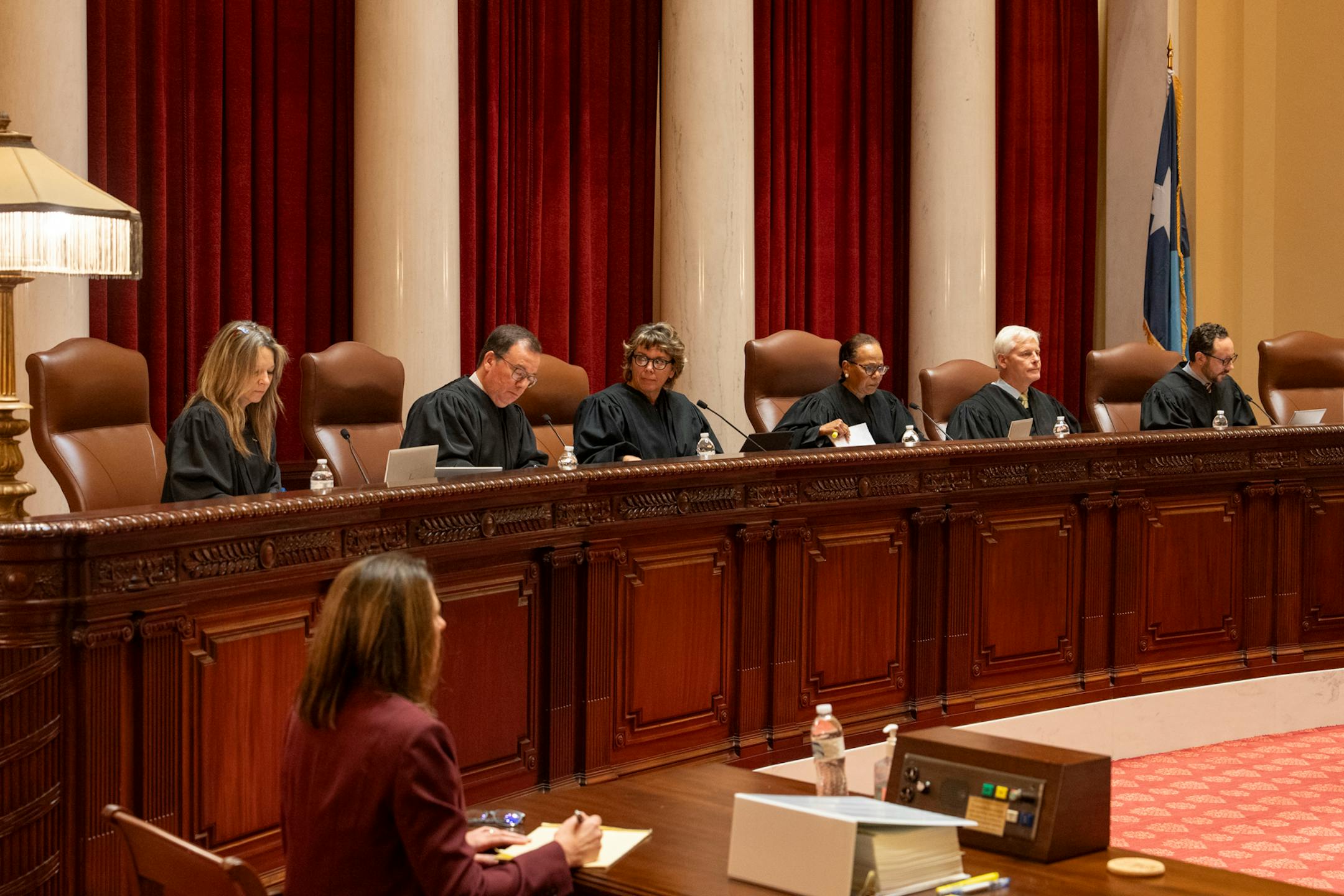
The justices of the Minnesota Supreme Court, shown in October 2024, ruled recently on privacy in social media accounts. ( Aaron Nesheim/Sahan Journal)
Advertisement

In upholding a first-degree murder conviction for an execution-style killing in 2019, the Minnesota Supreme Court ruled for the first time on the legal space that digital messages and social media occupy in Minnesota courtrooms.

A unanimous opinion, written by Chief Justice Natalie Hudson, shows that while Minnesotans have constitutional rights to privacy when it comes to their own social media accounts, if they send a message to another person’s social media account, they lose that constitutional protection.

Deshon Bonnell, Bailey French and Anthony Howson are all in prison for the murder of 33-year-old Joshua LaValley on the Mesabi Trail in St. Louis County in 2019. LaValley was blindfolded, led down the trail and shot twice in the head.

At the time of the killing, Bonnell was 18, French was 17 and Howson was 20.

While investigating LaValley’s death, law enforcement officers obtained a search warrant for 12 Facebook accounts —including one owned by French, two owned by Howson and two owned by Bonnell. (One of Bonnell’s accounts was listed under the alias “Pineapple Man.”)

Bonnell initially pled guilty to first-degree murder but was granted a new trial on appeal. He was convicted of first-degree premeditated murder by a St. Louis County jury in 2024. At trial, state prosecutors used his Facebook messages as crucial evidence in securing that conviction.

In his appeal to the state Supreme Court, Bonnell argued those messages should not have been admissible as evidence. “The sender of an electronic message retains a reasonable expectation of privacy,” Bonnell argued, even once the message arrives in someone else’s “separate and independent account or device.”

Hudson writes that while the Fourth Amendment grants citizens certain expectations of privacy when it comes to government searches, the question of what that means for digital messages sent between people had never been raised at the state Supreme Court.

Advertisement

In rejecting Bonnell’s argument, the court looked to decisions across the country that have considered the issue, including decisions by the Rhode Island Supreme Court and federal courts. Those courts determined that privacy laws on digital messages should be considered the same as physical letters — and “if a letter is sent to another, the sender’s expectation of privacy ordinarily terminates upon delivery.”

Hudson writes: “We agree that when an electronic message or physical letter is received by the recipient, the sender no longer has a reasonable expectation of privacy in the message or letter because the sender cannot control what the recipient does.”

That includes any digital copy of the message that is stored in a recipient’s account or device.

Because Bonnell could not claim any ownership of the social media accounts of French and Howson, the court ruled he had no constitutional protection from the searches and subsequent evidence gathered from their Facebook accounts.

Search ‘lacked particularity’

On another issue related to a person’s private social media account, the court sided with Bonnell.

When police obtained a warrant for the 12 Facebook accounts, they sought evidence including all contact information, all photos or videos, all activity logs, all messages between users and all IP data. The warrant did not provide a timeframe for searching those records. Facebook complied with the warrant and turned over the information.

Advertisement

Bonnell argued that because the warrant for his two Facebook accounts “lacked particularity” in subject-matter and time, it was invalid.

The state argued it needed access to the entire history of Bonnell’s Facebook accounts to prove he owned and controlled the “Pineapple Man” account. The Supreme Court disagreed, ruling that because the search of the accounts covered several years — from the day the accounts were created until the day of the search — and because investigators could have tailored the search of his accounts more narrowly to investigate the killing of LaValley, Bonnell’s constitutional rights were violated.

Despite that finding, the court found that because there was so much additional evidence presented against Bonnell at trial — including several duplicate messages from his Facebook accounts that were also in French’s Facebook account — the violation of his rights was “harmless” and not what led to his guilty verdict.

Bonnell also argued that several Facebook message he sent French from his “Pineapple Man” account should not have been allowed at trial because they described “prior bad acts” not directly connected to LaValley’s killing.

Those messages came days before LaValley’s murder and include Bonnell telling French he really wants to shoot someone and he’s a terrible person, and sending her a picture of himself with a gun.

The court declined to rule on that evidence, finding it didn’t impact the verdict.

Advertisement

Lastly, Bonnell’s defense asked the court to reverse the conviction because it was based on French’s testimony and “circumstantial evidence.”

French was Bonnell’s girlfriend at the time of the killing, and she had sent him several Facebook messages saying she had “someone your gonna wanna take care of,” with a picture of herself and LaValley. In another message, French said they needed to plan out LaValley’s annihilation.

The court ruled that while French was an accomplice to LaValley’s murder, her testimony was reliable and supported by additional evidence. That included Bonnell’s Facebook messages to French the day before the murder, which read, “I’m shooting someone tonight he knows too much ... I need you to find a spot we can go to dump.” And from the day of the murder: “I didn’t do it for payment I did it cause I love you.”

Bonnell will continue serving life without the possibility of parole. French and Howson both pled guilty to aiding and abetting second-degree intentional murder and are expected to be released from prison in 2044.

about the writer

about the writer

Jeff Day

Reporter

Jeff Day is a Hennepin County courts reporter. He previously worked as a sports reporter and editor.

See Moreicon

More from News & Politics

See More
card image
Aaron Nesheim/Sahan Journal

Deshon Bonnell will continue serving a life sentence for first-degree murder, but his appeal led the court to weigh, for the first time, the constitutional right to privacy in digital messages.

card image
Advertisement