Advertisement

Analysis: U.S. men’s hockey team takes a white-knuckle route to Olympic gold medal

Team USA ended a 46-year gold medal drought by withstanding a barrage from Canada’s NHL superstars to win 2-1 in overtime.

Columnist Icon
The Minnesota Star Tribune
February 23, 2026 at 1:47AM
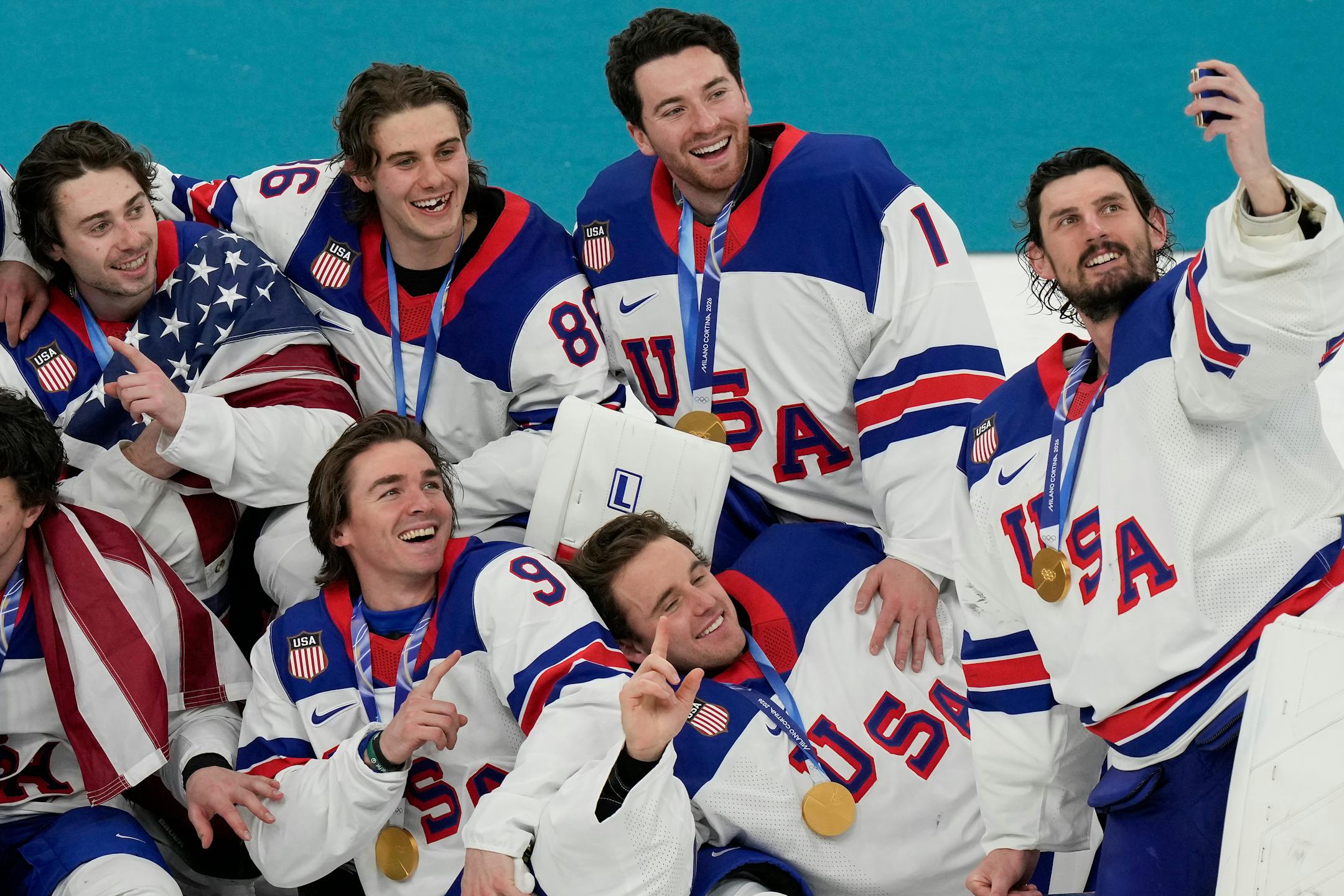
U.S. players take a group selfie after defeating Canada 2-1 in overtime in the men's hockey gold medal game Sunday, Feb. 22, in Milan. (Luca Bruno/The Associated Press)
Advertisement

The toll of gold was on Jack Hughes’ face.

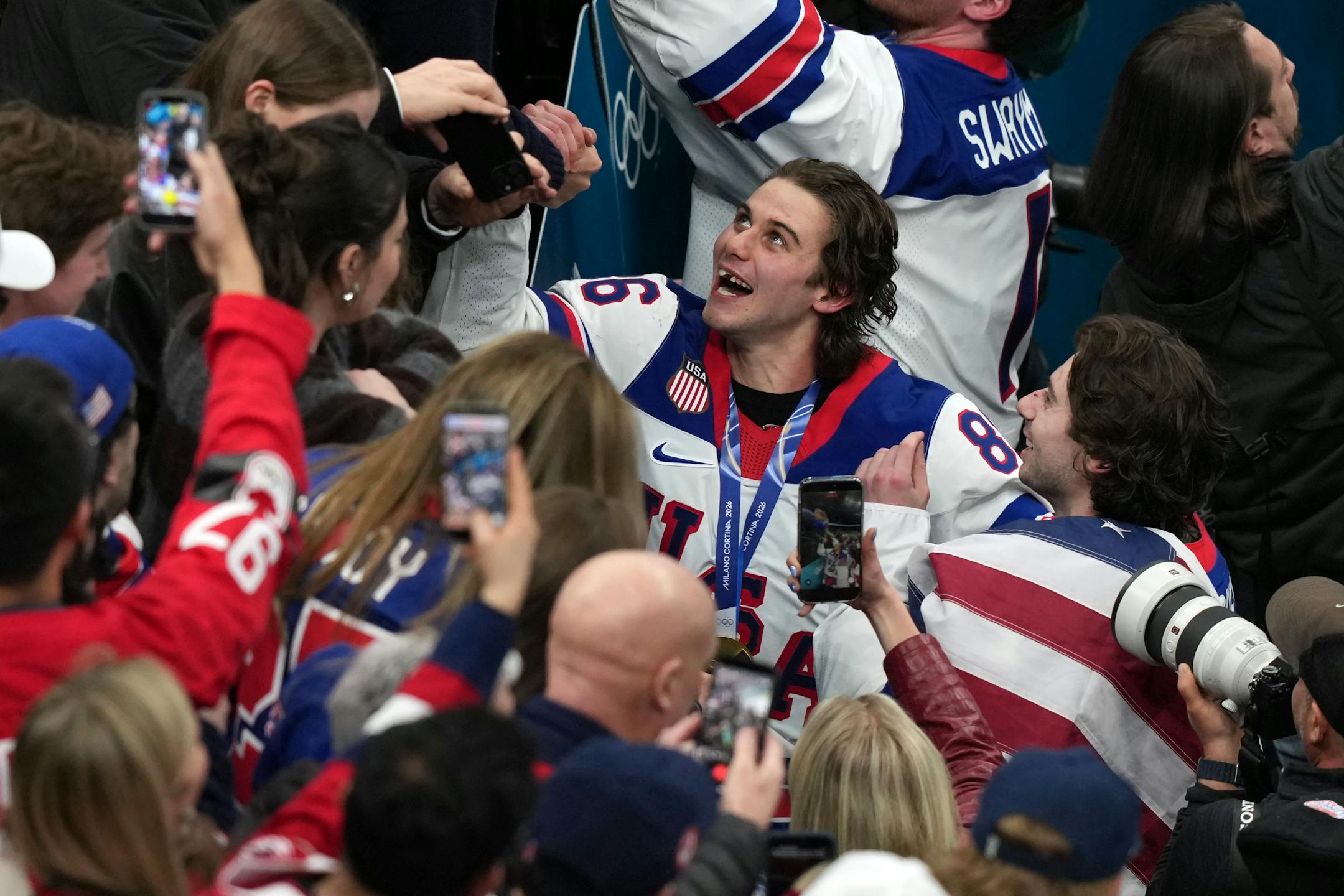
His lip was blood-stained, his front teeth missing, casualties of a high stick that could have led to a much less dramatic ending for the United States.

Instead, the Americans went the white-knuckle route, and that’s how Hughes also wore the elation of victory at last.

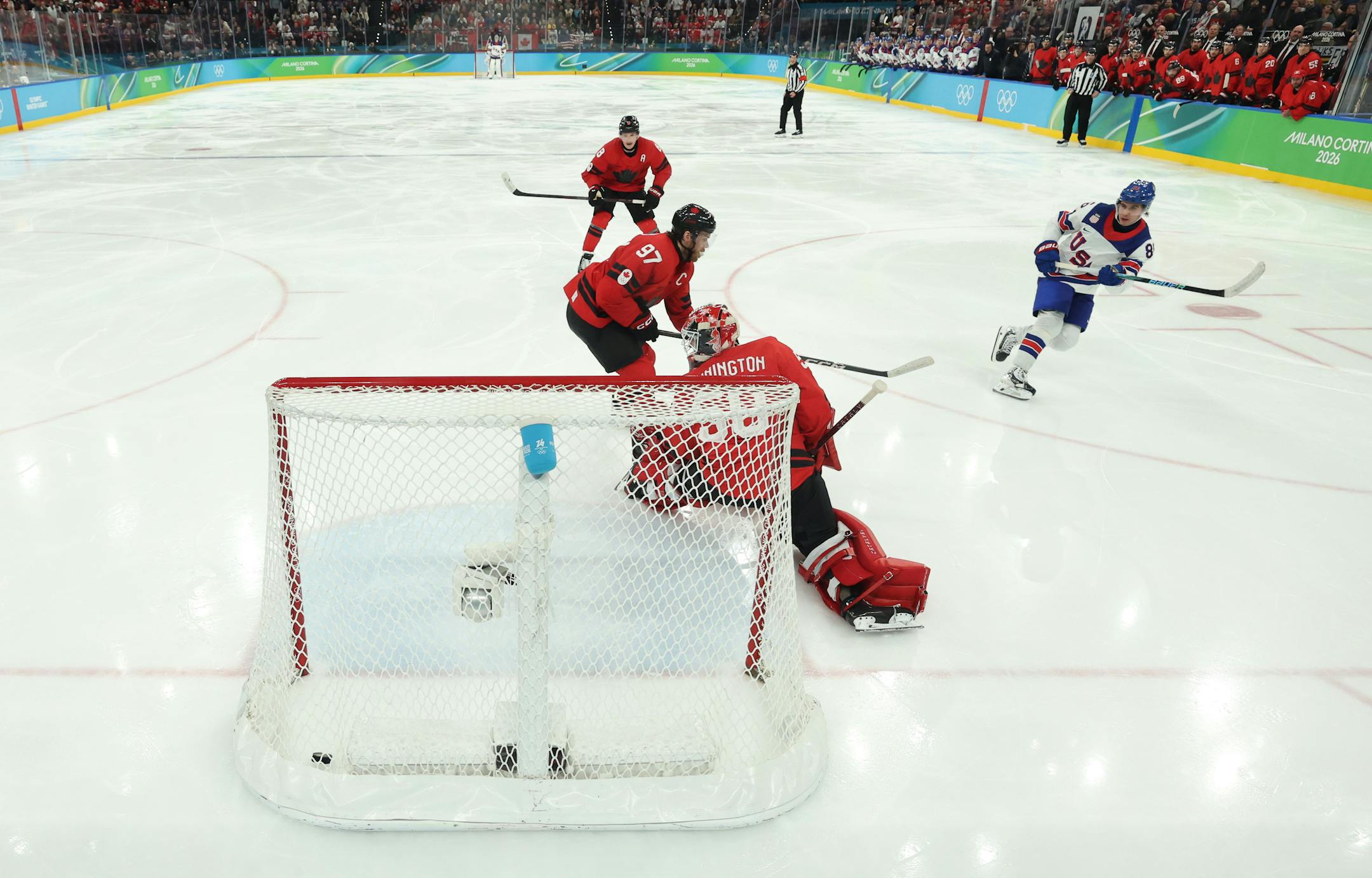
Hughes became an instant legend, scoring the golden goal in 3-on-3 overtime against Canada on Sunday, Feb. 22, at the Milan Cortina Olympics for a 2-1 victory that captured Team USA’s first gold medal in men’s hockey since the 1980 “Miracle on Ice” team in Lake Placid, N.Y.

A younger brother of the Wild’s Quinn Hughes, Jack wired a wide-open shot by Canadian goaltender Jordan Binnington only 1 minute, 41 seconds into overtime before flinging his helmet into the air and getting surrounded by teammates for a jubilant celebration.
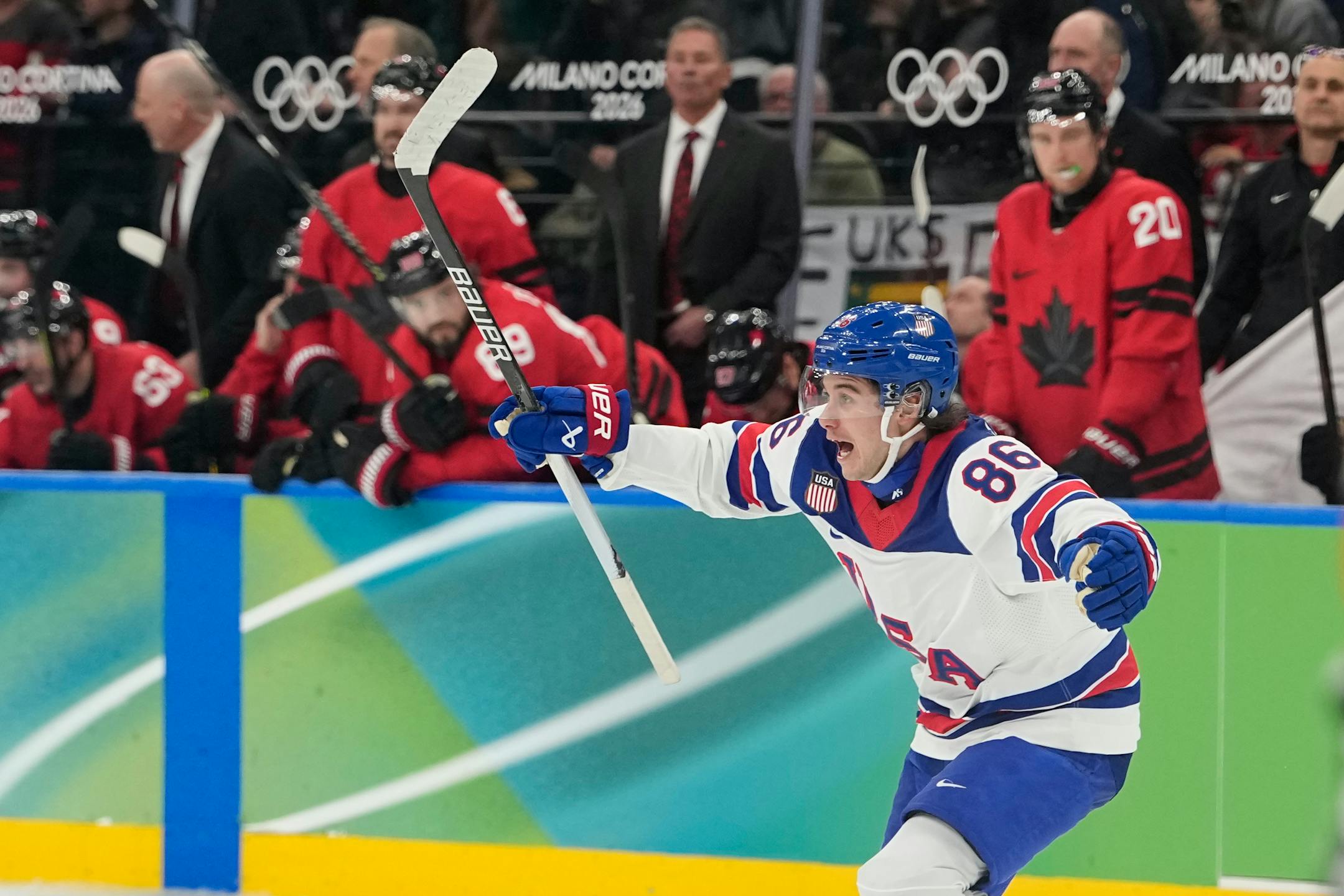
The United States' Jack Hughes (86) rejoices after scoring the winning goal during the gold medal game against Canada on Sunday, Feb. 22. (Hassan Ammar/The Associated Press)

“I can’t even believe this,” Hughes later told NBC during a postgame interview.

While Team USA had to shed the weight of that 46-year drought, this lineup had to prove it could tame Canada in the first Olympics to feature NHL players since 2014.

The Canadians won the last head-to-head meeting, the 4 Nations Face-Off, a year earlier, and their cachet — as a country in international hockey and individually as NHLers — was daunting, from Stanley Cup champions Nathan MacKinnon and Cale Makar to three-time MVP Connor McDavid.

ADVERTISEMENT

U.S. General Manager Bill Guerin, the Wild’s president of hockey operations, didn’t tailor the roster to the Canadian matchup. There was never any guarantee the two countries would cross paths in the Olympics. But Guerin ultimately assembled a group that could contain Canada.

The Americans were ahead 1-0 on a heads-up first-period play by Matt Boldy, the Wild forward attacking Canada’s two best defensemen in Makar and Devon Toews straight on to split the pair and slide a backhander by Binnington, but that lead was in constant peril.

Canada, playing without injured captain Sidney Crosby, dominated the second and third periods, and the chances kept getting more dangerous as the Canadians funneled pucks and people in front of goalie Connor Hellebuyck.

Overlapping penalties by Jake Guentzel and Charlie McAvoy in the second period spelled trouble because arguably the most talented power play in history had 1:33 of a 5-on-3 power play to work with, but the penalty kill — especially Wild defenseman and Maple Grove native Brock Faber — came up clutch.

Not until less than two minutes remained in the second period did the Americans finally crack under the mounting pressure: Makar’s shot sailed by Hellebuyck, and the Canadians had all the momentum going into the third period.

The Americans needed to push back offensively and give their defense a break, but they couldn’t.

Advertisement

Fortunately for them, they had the best blue line and goalie in the tournament.

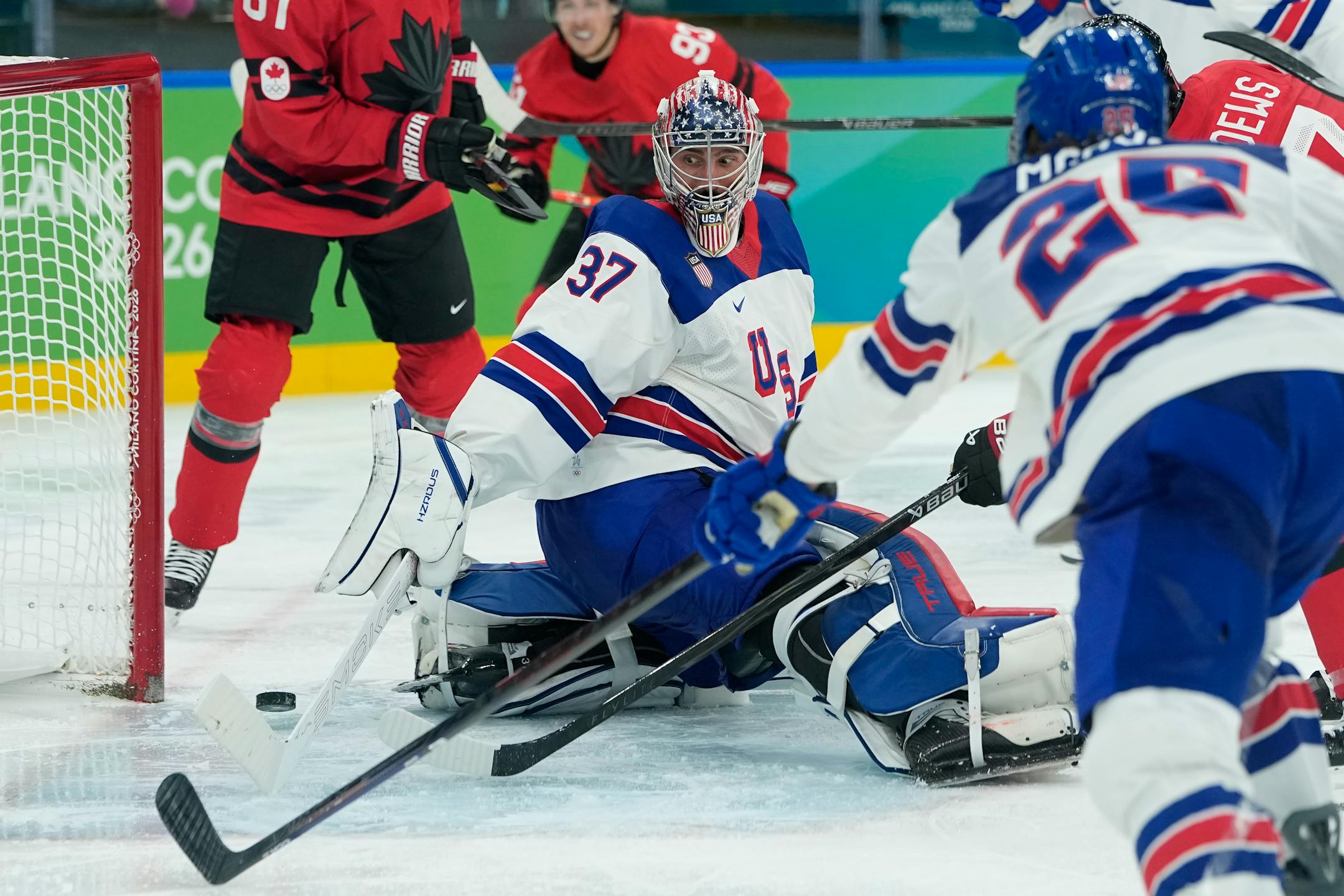
Hellebuyck denied Macklin Celebrini on a breakaway, this after he also kept out a breakaway by McDavid in the second that McDavid didn’t finish cleanly. Hellebuyck, a Winnipeg Jets netminder and last season’s NHL MVP, also made the save of the Olympics, getting the paddle of his stick on enough of a shot by Toews to nudge the puck through the crease.

Team USA goalie Connor Hellebuyck makes a stick save against Canada during the third period Sunday, Feb. 22, in Milan. (Petr David Josek/The Associated Press)

“It’s not my first stick save in my career,” Hellebuyck told reporters in Italy. “It’s probably the biggest moment to make that save. When I’m rolling back and the puck’s not in the net, it’s just an overwhelming feel of, ‘I got this.’”

Team USA was also fortunate — to have MacKinnon send a point-blank shot into the side of the net instead of the open side and to not get whistled for a too-many-men penalty during a dicey line change at the American bench.

But the bend-don’t-break defending and steadiness of Hellebuyck, who seemed to take up the whole net, buoyed the United States. The goalie finished with 41 saves.

The high stick from Canadian Sam Bennett that knocked out Hughes’ teeth finally diverted the action to the other end of the rink late in the third period, the four-minute power play feeling like game over for Canada, but the American power play was too perimeter to take advantage.

Advertisement

A high stick by Jack Hughes actually erased the final 49 seconds of the power play, returning the edge to Canada, but in reality the Americans were back in their wheelhouse — on the penalty kill: They snuffed out a third Canada power play to set up overtime.

New York Rangers forwards Vincent Trocheck and J.T. Miller, who were appointed to the Olympic team over more offensive players like Cole Caufield and Jason Robertson, were key contributors to a penalty-kill unit that was the only one in the tournament to not give up a power-play goal.

Still, the Americans weren’t in the clear, not when Canada rolled out McDavid, MacKinnon and Makar to start 3-on-3 overtime.

But it was Quinn Hughes who had the first close call, Binnington extending his glove to get a piece of Hughes’ shot.

Canada regained possession and even had a near 2-on-0 break before Zach Werenski caught up to a puck that rolled into Canadian territory. He passed it to Jack Hughes for the biggest goal of his life.

The United States' Jack Hughes, right, scores the game-winning goal against Canada goalie Jordan Binnington in overtime Sunday in Milan. (Bruce Bennett/The Associated Press)
Team USA's Jack Hughes (86), sporting a gap in his smile, celebrates the gold medal victory Sunday, Feb. 22. (Carolyn Kaster/The Associated Press)

“That’s exactly how we wanted it to go,” Hughes said. “We wanted to go through Canada, beat them, and it could have went either way tonight. But that’s an unbelievable win for the Americans.”

Advertisement

However Team USA became the Olympic champion again was always going to be impressive.

That the Americans did it by overcoming Canada in a game as fast and physical and tense as this, a truly unprecedented best-on-best for hockey, only intensified one of the best rivalries in all of sports.

The 2030 Winter Games in France can’t come soon enough.

about the writer

about the writer

Sarah McLellan

Minnesota Wild and NHL

Sarah McLellan covers the Wild and NHL. Before joining the Minnesota Star Tribune in November 2017, she spent five years covering the Coyotes for The Arizona Republic.

See Moreicon

More from Olympics

See More
card image
The Associated Press

Those from the “Miracle on Ice” team are big fans of the “Surprise on Ice” team that will bring home the gold from the Milan Cortina Games.

card image
card image
Advertisement