Wild standout Matt Boldy combines the glamour of scoring with the gritty work of penalty killing

In his fifth NHL season, 24-year-old winger Matt Boldy is putting together an all-around game as the Wild climbs up the standings.

The Minnesota Star Tribune
December 10, 2025 at 6:00PM
Matt Boldy's all-around game has moved him among the NHL's elite forwards. (Carlos Gonzalez/The Minnesota Star Tribune)

Matt Boldy pretended he was Sidney Crosby when he played street hockey on his driveway as a kid.

He scored goals and set them up, the Massachusetts native always visualizing “the cooler stuff.”

Never did his imagination place him on the penalty kill.

“It’s the same thing in football,” Boldy said. “No one grows up thinking they’re going to be the center that blocks every play. You’re the quarterback or running back or guy making the big catch.

“That’s just how kids are. You want the big moment.”

Now, as a pro, Boldy has that with the Wild and more.

His bread-and-butter business is booming, with Boldy among the top goal scorers in the league, but the winger also has a successful side hustle as a penalty killer after taking on the responsibility full-time this season.

His addition has helped improve the Wild’s long beleaguered PK. It also showcases Boldy’s evolution into the modern NHL superstar whose specialty is an expertise that applies to the entire game.

ADVERTISEMENT

“When you’re young, you want to score,” he said. “You want to score and make plays and everything. As you get older, you learn that there’s a lot more to it.

“You just want to be on the ice.”

Flipping the script

The NHL used to model Hollywood with its stock characters.

Hero. Villain. Sidekick.

Scorer. Grinder. Fighter.

But the days of typecasting are gone: Not only has the talent in the league escalated to the point where players excel in multiple areas, but teams can’t afford to pay for niche jobs in a salary-cap system; they need goal gurus to backcheck and stay-at-homes who move the puck.

“When I played, you have guys who score and guys who defend,” Utah coach André Tourigny said. “Now, you have guys who are good at everything. That’s what the best players are: They’re a nightmare to play against because they don’t give you anything.”

Still, it’s interesting that while scoring has increased in recent seasons and players are making more money than they ever have (see Kirill Kaprizov’s impending eight-year, $136 million contract) teams are willing to use their stars in situations where they can get hurt.

View post on X

Shot blocking is expected, if not inevitable, on the penalty kill and certainly a reason not to put a team’s best producer in harm’s way.

There’s also the wear-and-tear from taking on extra ice time.

“PK is more exhausting than playing on the power play,” Wild PKer Nico Sturm said. “So, I think if you can, especially as the season goes on, have other guys that can take away these harder minutes from your skilled guys or power play guys, it helps you down the road.”

But teams aren’t skating scared, the Wild included, and they are benefiting from it.

“If you don’t want an accident, don’t [drive] your car,” Tourigny said. “But you want to move a lot. So, at some point it’s the cost of doing business.”

Penalty kill makeover

Wild coach John Hynes tabbed Boldy, 24, for the penalty kill late last season and, after Boldy fit in, Hynes planned to make Boldy a regular.

Before then, Boldy had done a little PKing at Boston College and when he was younger.

After Hynes arrived two years ago, Hynes noticed Boldy’s offensive strengths, his competitiveness and how much he cared about the Wild not getting scored on. But Boldy’s details wavered … until they didn’t.

“He’s very, very consistent whether he’s producing or not producing,” Hynes said, and that commitment to the same game is why the Wild are relying on him more often.

The Wild really had nothing to lose by experimenting with the penalty kill.

They were third-to-last in the NHL (72.4%) last season and two seasons ago (74.5%), and that rut carried over to their early swoon: The Wild were at the bottom of the league after the first month at a grim 60%.

But since November when the Wild rebounded to become a top-five team, their PK has been on a similar ascent, ranking first in the league at 91.5%. The Wild have given up one power-play goal in their last 10 games, going 25-for-26. Overall, they’re a respectable 80.6% (18th).

During the turnaround, the 6-2, 201-pound Boldy has logged the second-most minutes on the PK among Wild forwards, just 20 seconds less than usual partner and linemate Joel Eriksson Ek. He’s been on the ice for just one goal despite an expected goals against of 3.69, according to Natural Stat Trick, and he scored his first career shorthanded goal coming on a breakaway Nov. 19 vs. Carolina.

“The ability to score shorthanded is pretty valuable,” said Calgary veteran forward Blake Coleman, who handles both sides of special teams. “A lot of teams don’t think of it that way, but it changes the game.”

Reaching for the stars

Only Tampa Bay’s Brandon Hagel, the New York Islanders’ Bo Horvat and Washington’s Tom Wilson have more goals than Boldy’s 16 and more minutes on the penalty kill.

Boldy’s workload has eclipsed that of Toronto’s Auston Matthews and Vegas’ Jack Eichel and Mitch Marner, elite scorers who are typically in the Selke Trophy conversation as the NHL’s best defensive forward. The combination of Boldy’s reach, stick skills and competitiveness is why he’s effective.

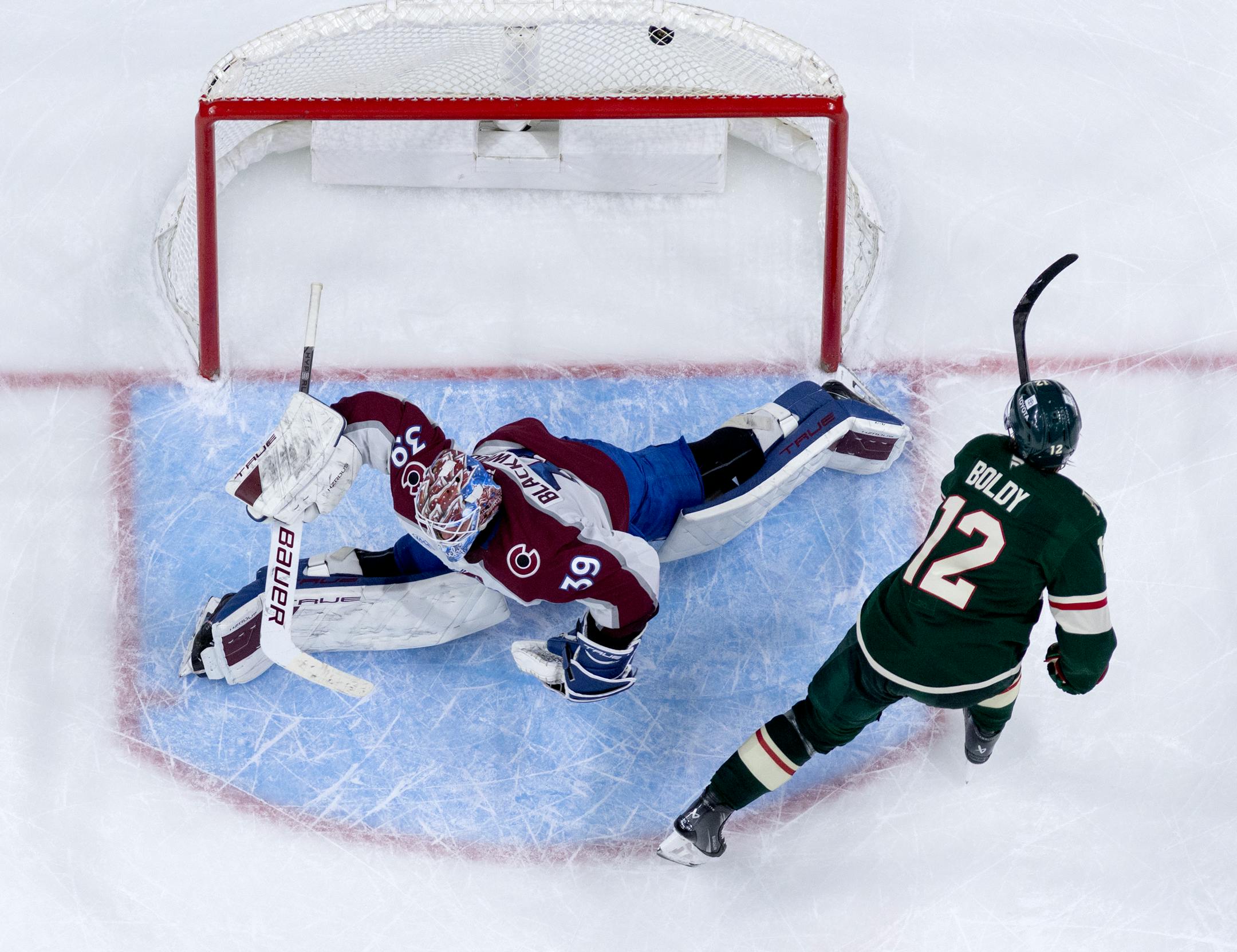
Matt Boldy scores past Colorado goalie Mackenzie Blackwood during a Wild game at Grand Casino Arena last season. (Carlos Gonzalez/The Minnesota Star Tribune)

“His hand-eye coordination for how long he is is so good,” defenseman Brock Faber said, “and he’s physically so strong on pucks. He wins so many battles [and] has a great stick. That’s obviously the definition of a really good PKer.”

Last Saturday vs. Vancouver, Boldy’s second shift on a PK came while the Wild regained full strength, and he one-timed in the puck seconds after Mats Zuccarello left the penalty box.

“They’re one, two, three plays ahead of everybody,” Tourigny said of the stars. “They’re never surprised by anything on the ice. They have a recollection of what’s going on or a feel, a read, which is exceptional. All those qualities you can use on the PK.”

Mind games

Boldy is defending with his offensive instincts, and he’s not alone in that approach.

“You kind of almost get an advantage because you kind of know what other offensive guys are looking for,” said Logan Cooley, the former Gophers center and Utah’s leading goal scorer. “I don’t want to use the word cheat, but you kind of can anticipate a pass or a seam that they might look for.”

Three-time MVP Connor McDavid and 50-goal scorer Leon Draisaitl dabbled on Edmonton’s PK, and coach Kris Knoblauch noticed power plays react differently to the dynamic duo’s presence.

“When you’re careful on the power play,” Knoblauch said, “you’re not as dangerous.”

Hynes believes a high hockey IQ does boost the PK and said he would consider integrating Kaprizov; already Kaprizov is on the ice when the Wild are protecting a late lead and the opposing goalie is pulled for an extra attacker.

Kaprizov didn’t kill penalties in the KHL but occasionally earlier in his career.

“I don’t care,” he said. “If Coach say, I can.”

No one would question the Wild for keeping Kaprizov on the bench to avoid getting injured from a shot block. But as Kaprizov pointed out, the team doesn’t have to defend the whole time: If there’s a chance to create offense, players take it. Also, he thinks it’s the mind that makes the difference.

“You need to be smart,” Kaprizov said. “This is why when top players play PK, they play good on PK.”

Under control

Draisaitl is a former MVP and has led the NHL in points and goals.

Before the season, he made it clear he wanted to be in contention for the Selke. He finished sixth in voting last season, with his lack of PK work likely hurting his cause. He’s already up to 27 shorthanded minutes after finishing with 3:48 in 2024-25.

“The best players in the world, they want to be part of important parts of the game,” Draisaitl said. “You want to play as much as possible and if that’s another way of adding importance to your game or to the group, I think any top player would gladly do that.”

Matt Boldy of the Wild heads up ice during a game against Vegas on Nov. 16 at Grand Casino Arena. (Renée Jones Schneider/The Minnesota Star Tribune)

Boldy covets the control.

“Sitting there and watching is not very fun when you don’t have an impact on what’s going to happen,” he said. “… I’d rather it be my fault if something goes wrong than someone else’s.”

Drafted by the Wild in the first round (12th overall) in 2019, Boldy credits the growth of his defensive game to playing alongside Eriksson Ek.

Their line with Marcus Johansson has thrived as a shutdown unit, giving up only two goals 5-on-5 despite their expected goals against being 6.15. They were scored on only once during their assignment against the Nathan MacKinnon line in the Wild’s 3-2 shootout win over Colorado on Nov. 28, the team’s signature victory of the season.

A whopping 43.7% of Boldy’s ice time through 25 games was against elite competition, which was tops on the Wild and fourth in the league among players with as many games according to PuckIQ.

The perennial 20-goal scorer coming off his first 70-point season is a lock for Team USA at the Olympics.

“As I got older and realized, ‘All right, well, if I don’t figure this out, I’m not going to be out there,’” said Boldy, who’s signed to a seven-year, $49 million contract. “I’m just going to watch it all happen. That’s kind of when I realized that I should probably pull it together and do it all.”

From the first shift to the last and all the power plays, penalty kills and regular reps in between, Boldy is hardwired into the Wild’s motherboard, the coding that makes them function.

The gratification he feels from scoring a goal isn’t the same as what it’s like to prevent one on the PK, but it’s an achievement, nonetheless.

“Our line matched up vs. MacKinnon, and I don’t think we had any points, but we all left that game pretty happy that we played pretty good vs. that line,” Boldy said.

“There’s different things you have to do to win. I think that’s kind of what makes our team so good is everyone is able to kind of accept that role and understand that, that the ugly stuff and the stuff that you might not see on the highlight reels is the reason you win games.

“That’s the biggest thing. That’s where the satisfaction comes from.”

about the writer

about the writer

Sarah McLellan

Minnesota Wild and NHL

Sarah McLellan covers the Wild and NHL. Before joining the Minnesota Star Tribune in November 2017, she spent five years covering the Coyotes for The Arizona Republic.

See Moreicon

More from Wild

See More
card image
Carlos Gonzalez/The Minnesota Star Tribune

In his fifth NHL season, 24-year-old winger Matt Boldy is putting together an all-around game as the Wild climbs up the standings.

card image
card image