Brock Faber heads to second Winter Olympics with a different experience waiting

The Wild’s Brock Faber played in the 2022 Games in Beijing when he was still at the University of Minnesota and NHL players stayed at home. In 2026, he’s back.

The Minnesota Star Tribune
February 11, 2026 at 10:12PM
The Wild's Brock Faber is in Italy, participating in his second Olympic Games for Team USA. (Carlos Gonzalez/The Minnesota Star Tribune)

Brock Faber grimaced as he rubbed his eyes, his face saying more about how he felt than the words leaving his mouth.

He looked crestfallen, bewildered and exasperated, the Wild’s usually upbeat defenseman a shell of himself.

“I’m better than this,” Faber said. “I know I am.”

No one has been more in tune with the Wild this season than Faber.

When the team was down in the dumps the first month, so was he, their woes intertwined like a clump of cords. The Wild had just three victories through 12 games because they were giving up more goals than they could gain, and Faber couldn’t stop the sink; he was getting scored on more than he was used to, like in that Oct. 25 blowout by Utah before he hung his head postgame and made it clear this wasn’t like him.

So, as he proved that, the knot untangled.

The Wild climbed to top-five in the NHL and solidified themselves as a contender with the biggest trade in franchise history.

Meanwhile, Faber is in the midst of his best season in the NHL, a turnaround that’ll send the Maple Grove native to his second Olympics for Team USA at the top of his game.

ADVERTISEMENT

“I feel good,” Faber said. “There’s definitely been ups and downs this year. I’ve had great moments. I’ve had moments where I struggle, and that’s kind of just all part of it and trying to find consistency.

“My body feels good. My mind feels good, and I’m excited to hopefully go over there and help the team as much as I possibly can.”

Talking it out

Even with a history of slow starts, the Wild’s October was terrible.

What made it even more baffling was Faber’s involvement.

He seemed immune from slumps because of how easy he made hockey look. Los Angeles drafted him in the second round in 2020 but traded him to the Wild two years later for Kevin Fiala, and Faber’s transition to the NHL after he was a standout for the Gophers was seamless: He played two games in the regular season and then was in the lineup for the Wild’s playoff series against Dallas in 2023 where he never once was on the ice for a goal against in six games.

Faber was runner-up for the Calder Trophy as the NHL’s best rookie and would have won if he wasn’t going up against Chicago phenom Connor Bedard. He signed an eight-year, $68 million contract and then helped the Wild return to the playoffs last season despite being decimated by injuries.

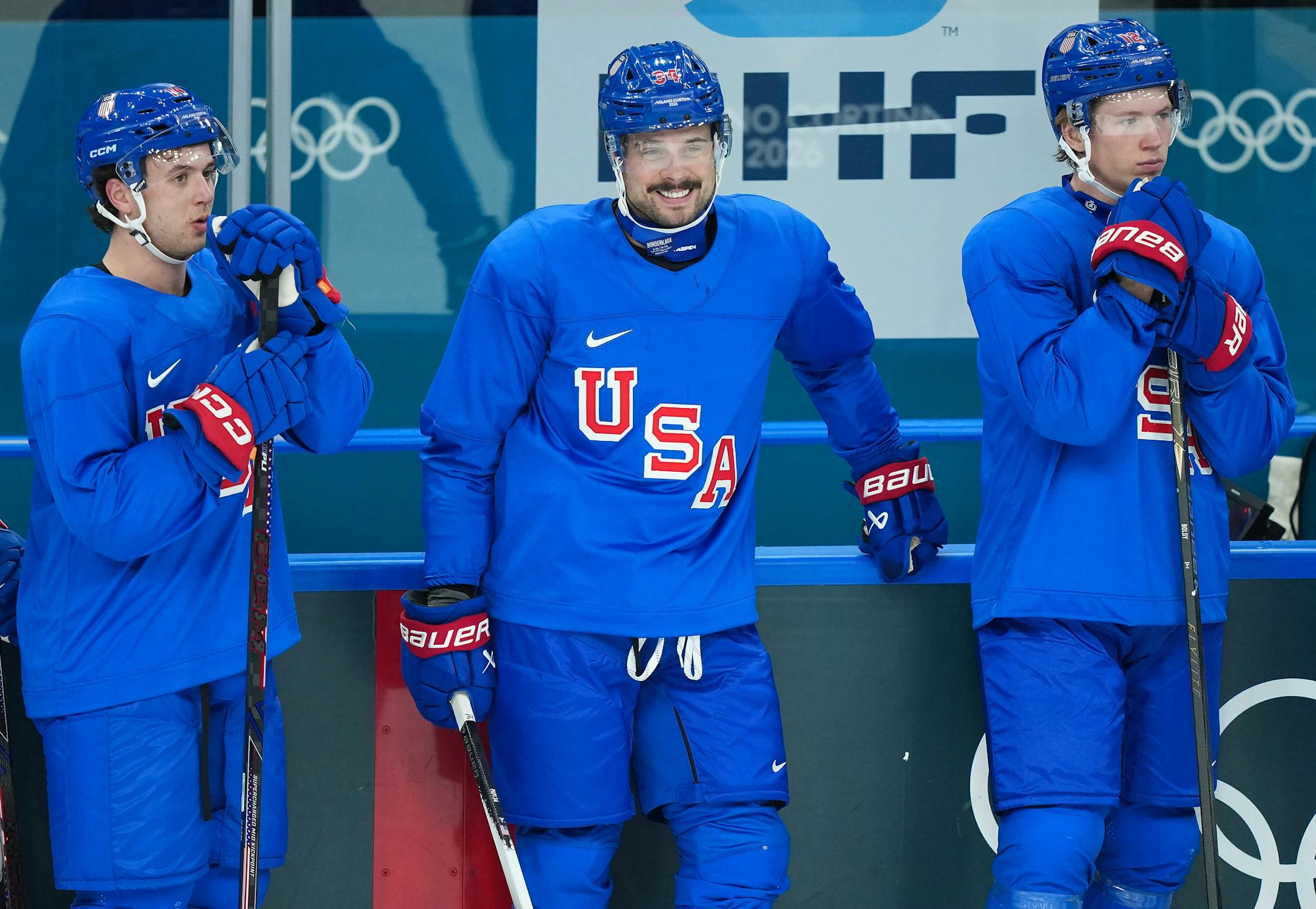
Brock Faber, Auston Matthews and Matt Boldy at a Team USA practice in Milan on Sunday, Feb. 8. (Nathan Denette/The Associated Press)

That’s why at 3-6-3 the Wild and Faber, with a minus-9 goal differential, were confounding.

“Things kind of just weren’t clicking for me and the team,” Faber said, “and it was kind of the first time we were losing consistently, and I was playing bad consistently.”

Faber, 23, tried to remember the big picture: He was playing in the NHL for his hometown Wild for a living, but he was dwelling on his mistakes.

“In those moments, it feels like it’s hard to get out of it,” Faber said.

Finally, after one game he called his first NHL defensive partner, Alex Goligoski, and a rambling Faber vented during their half-hour conversation.

“I’ve been there,” said Goligoski, who has since retired but now works for the Wild as a player development advisor. “When you’re in it, you really start questioning things and you look at stuff and you’re just like, ‘What’s going on here?’”

Goligoski was reassuring, telling Faber to go home and get some rest and “be mad tonight,” but reminded him there was a light at the end of the tunnel and that everything was going to be fine.

And it was.

“It felt like things just stared to click,” Faber said, “and as soon as soon as things started to click, I just got more confident.”

Back to basics

At the beginning of the season, Faber was in a different role than he’d previously played.

He’d been taken off the power play, the Wild cutting back his minutes after he’d been averaging 25½, and with two young players in Zeev Buium and David Jiricek now on the blue line, he concentrated so much on being a shutdown defenseman that he wasn’t creating offense.

“He’s such a motivated, competitive guy,” Wild coach John Hynes said, “I think he was almost like over-trying and I think forcing things, and I think he got in his own head a little bit.”

So, the Wild put him in a situation that would allow him to rediscover his strengths.

He returned to the power play and his ice time increased. Faber got back to being a dual threat while the Wild surged up the standings, losing only one game in regulation in November and going on two seven-game win streaks.

“I definitely see myself as a two-way defenseman, 100 percent,” he said. “That was a reason why I was so frustrated because I wasn’t playing super stellar defensively, and I was getting scored on a lot, which that obviously is never good as someone who prides themselves on being really good defensively.

Brock Faber, left, and Quinn Hughes have been the first defensive pairing for the Wild. (Carlos Gonzalez/The Minnesota Star Tribune)

“Once your game opens up on the other end, it almost helps with the confidence on both ends.”

This transformation was already full steam ahead when the Wild traded for Quinn Hughes on Dec. 12, but the superstar defenseman’s arrival was like a full-page ad for Faber’s improvement.

Faber has been even more dynamic alongside the savvy Hughes, whom the Wild acquired from Vancouver for Buium, Liam Ohgren, Marco Rossi and a first-round draft pick. Their chemistry is clear: Before Hughes, Faber had six goals and nine assists and was a plus-2 through 32 games. In 26 games together, Faber has seven goals and 15 assists and is a plus-17.

The Wild are 31-8-7 since Nov. 1, including 16-5-5 since Hughes joined their lineup, and 34-14-10 overall to tie for the second-most points in the league with 78; only Central Division rival Colorado has more than them (83).

“[Hughes is] obviously a very easy player to play with because he’s so good [and] so good with the puck,” Goligoski said. “But that also makes him hard to play with, like you have to be smart enough to go to the right spots, and he’s a good enough skater that he can play at the speed Quinn’s going to play at.

“[Faber] definitely has all the tools to play at Quinn’s level, which makes them an unbelievable pair,” Goligoski continued. “But I am a little bit surprised at how quick that they gelled.”

Already, Faber’s 13 goals are a career high. The franchise record for a defenseman is 17, set by Brent Burns in 2010-11.

“Playing with a guy like Quinn,” Faber said, “it’s hard not to really grow offensively.”

Hughes believes Faber has the potential to be a 20-goal scorer.

“I knew he was a really good player watching him at the [U.S.] program and World Junior teams with my brothers,” Hughes said. “I knew he had hockey sense, was competitive, could defend, had skill. But just seeing the skating — I knew about the skating — but he’s a pretty explosive skater.”

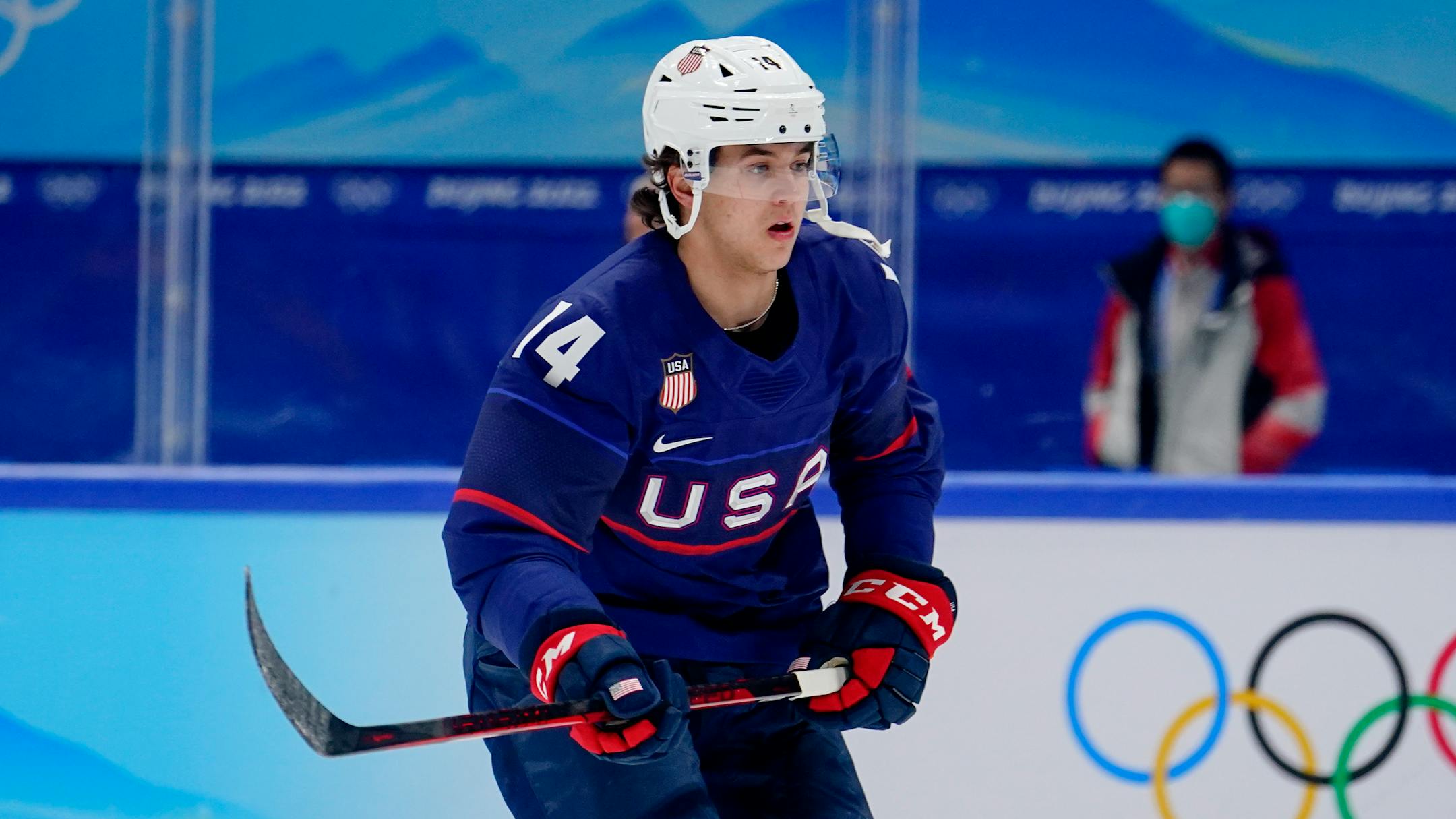
Brock Faber made his Olympic debut in the 2022 Beijing Games, but played in front of no spectators. (Matt Slocum)

Red, white and blue line

But the two sticking together for Team USA in Milan Cortina isn’t a given, not when Faber was a force alongside Carolina’s Jaccob Slavin at the 4 Nations Face-Off.

After the two were put together in the first period of the Americans’ first game, they were tagged for just two goals the rest of the tournament and none in the championship game vs. Canada that the Canadians won 3-2 in overtime.

“We’re both really — and I don’t mean this in a bad way — just simple hockey players who like the simple, smart decisions,” Slavin said, “and so when you have two guys out there like that who aren’t really trying the high-risk, high-reward plays, you’re going to have more opportunity to play offense and not spend as much time in your zone because you’re making the smart plays to not be in the defensive zone.

“And then when we are in the defensive zone, obviously his defensive capabilities and mine go really well together. So, [there’s] not a lot of time and space out there for the opponents.”

Faber was at the last Winter Olympics in Beijing when the United States sent mostly college players and overseas pros after the NHL pulled its participation because of the pandemic.

Unless he was going to a game or practice, Faber couldn’t leave the village where he stayed in a dorm room with three other players. The U.S. placed fifth after losing in the quarterfinals to Slovakia; Faber had an assist in four games.

“It was no fans,” Faber said. “Quarantine. You wouldn’t really get to hang out much.”

The opening ceremony was when it sunk in that, “this is the Olympics. This is crazy,” he said.

Faber’s parents, Jay and Karri, and his sisters Payton and Paige are among the family members making the trip to Italy as well as his girlfriend, Morgan. Once the men’s hockey tournament starts Feb. 11, the Americans will begin vying for their first gold medal since the “Miracle on Ice” in 1980 at Lake Placid.

Not only has Faber seen the “Miracle” movie “100 times at least” — it was what the family played on the TV screen in the back of its minivan — but Faber remembers when Warroad’s T.J. Oshie went 4-for-6 in the shootout to help the United States defeat Russia at the 2014 Sochi Olympics.

“That shootout was one of the coolest things I’ve definitely ever watched,” Faber said, “and obviously him being from Minnesota, it was really cool.”

Two dreams

Going to the Olympics is what Faber wanted but getting there isn’t the goal: Being the best is, just like it is with the Wild.

These two objectives are separate but also symbiotic.

Team USA is getting Faber at his greatest, and the Olympics could return him even better prepared to help lead the Wild to a championship.

In that sense, both Faber’s ambitions go hand-in-hand, and this is his chance to make them a reality.

“The end-all be-all is winning a gold medal and a Stanley Cup,” Faber said. “Hopefully more than one, but we gotta start with one first.

“Yeah, that’s definitely the dream. That’s always been the dream. That’s still the dream.”

about the writer

about the writer

Sarah McLellan

Minnesota Wild and NHL

Sarah McLellan covers the Wild and NHL. Before joining the Minnesota Star Tribune in November 2017, she spent five years covering the Coyotes for The Arizona Republic.

See Moreicon

More from Wild

See More
card image
Carlos Gonzalez/The Minnesota Star Tribune

The Wild’s Brock Faber played in the 2022 Games in Beijing when he was still at the University of Minnesota and NHL players stayed at home. In 2026, he’s back.

card image
card image