With 92-loss season complete, Twins remain at a loss to diagnose what went wrong in 2025

The pitching went bad and the hitting never really was there before Twins management decided to pull the plug and trade away more than a third of the roster.

The Minnesota Star Tribune
September 29, 2025 at 3:22AM
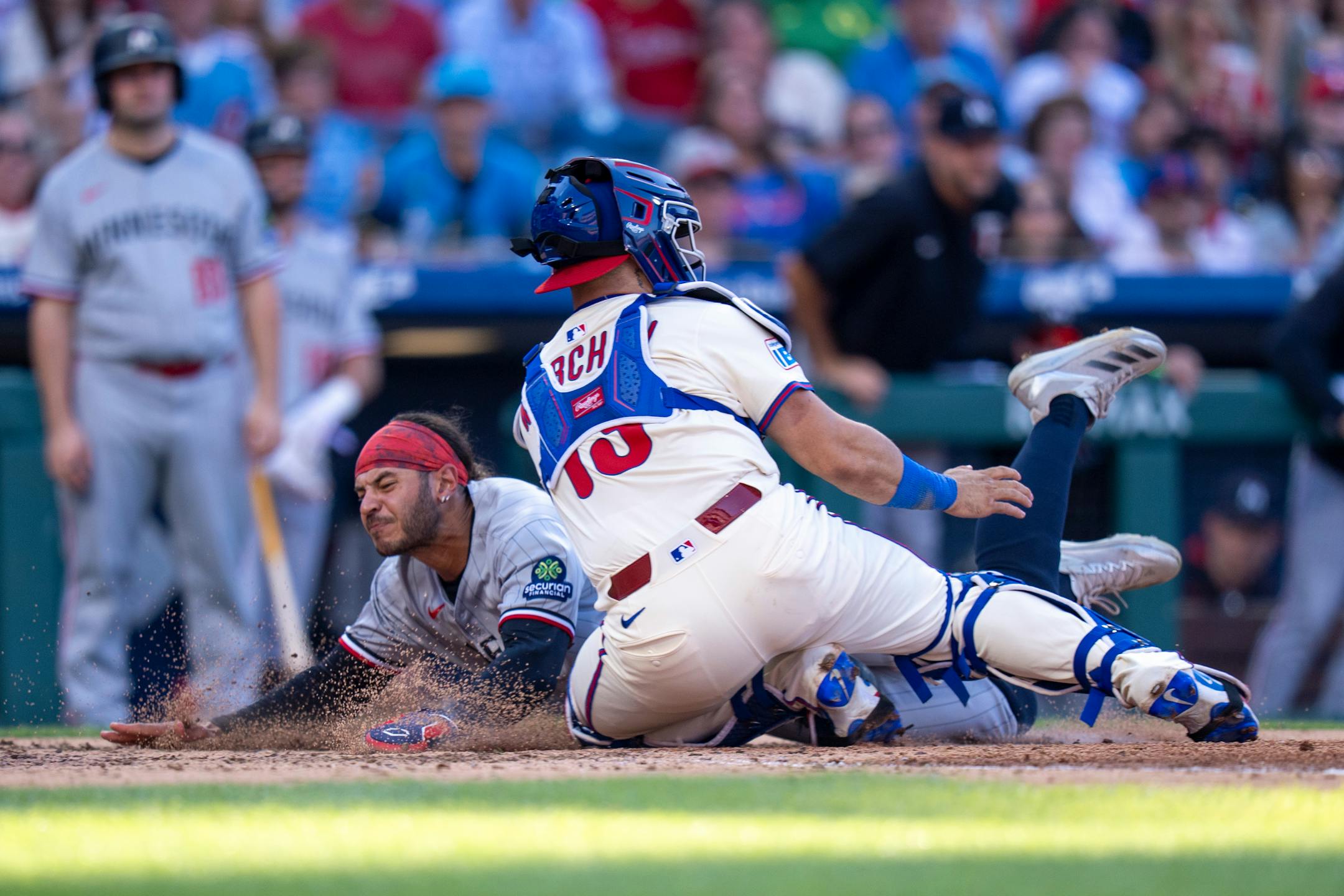
Minnesota Twins' Austin Martin, left, slides safely into home before Philadelphia Phillies catcher Rafael Marchan, right, can apply a tag during the sixth inning of a baseball game, Sunday, Sept. 28, 2025, in Philadelphia. (AP Photo/Chris Szagola) (Chris Szagola)

PHILADELPHIA – When people look back at the 2025 Twins season, everyone will notice their 70-92 record, which was the second-worst mark in the American League. What might not be as obvious is how much the season shook all levels of the organization.

A season that started with lofty goals and the highest payroll in the AL Central nearly crumbled with a slow start in April, was resuscitated through a 13-game winning streak in May and then collapsed in June. After poor play out of the All-Star break, the front office conducted the largest trade deadline fire sale in modern baseball history, shipping off 10 players from their major league roster.

“It was a weird deadline,” All-Star pitcher Joe Ryan said. “I felt like I was in shock for a couple of weeks after that.”

Manager Rocco Baldelli, who completed his seventh season leading the club, described it as two different seasons. There was two months after the trade deadline, and the first four months of the season when the Twins failed to find consistency.

Sure, there were some key injuries. Royce Lewis strained his hamstring in spring training, and Matt Wallner went down with his own hamstring injury in April, leaving the lineup devoid of true power hitters. Some players wonder if rookie Luke Keaschall, who was out for three months after a pitch broke his arm, could have provided some type of missing spark if he was healthy.

The pitching staff had a league-worst 6.07 ERA in June, more than a full run higher than the next-worst team, after Pablo López injured a muscle in his shoulder.

“Just because it didn’t work out doesn’t mean that there weren’t a lot of good guys in there, there weren’t a lot of guys that were trying hard,” said Philadelphia outfielder Harrison Bader, one of the players the Twins traded at the deadline. “We had the pieces there. We just didn’t have the ability to piece it all together and unfortunately that’s what happens sometimes.”

The second season, as Baldelli described it, started when the Twins started trading away players. The number of trades — parting with more than a third of the roster — was stunning. Nobody inside the clubhouse braced for that many players to leave.

ADVERTISEMENT

“It’s almost one of those things where you feel like you should have time to regroup a little but there’s no time to regroup,” Baldelli said. “It’s hard to put into words. That’s probably exactly my point. It probably tested me as much as anything I’ve ever experienced in the game.”

Byron Buxton and Christian Vázquez organized a team dinner at a steakhouse in Cleveland afterward because they wanted to give everyone a chance to meet each other.

“It felt like all of us got traded, too, just because we had a completely new team, learning new faces and new expectations,” pitcher Bailey Ober said. “It was a lot to handle in that short little time.”

On the final days of the season, Twins players still have a difficult time diagnosing exactly what went wrong. There was enough talent that contending teams at the trade deadline picked apart their roster. Their 13-game winning streak was the second-longest in team history, and that wasn’t enough to stabilize their season.

The Twins offense, after firing their big-league hitting staff last year, went from 10th in the majors in runs scored (742) in 2024 to 23rd (678) in 2025. Buxton was healthy and delivered All-Star production, but many of their young hitters didn’t take meaningful steps forward. Carlos Correa and Lewis never caught fire.

“We didn’t hit this year at all,” Vázquez said. It takes time for new hitting coaches to mesh with players, and a rough start to the season exasperated their ability to solve issues.

“They need to learn how we work as a hitter. I think that comes with communication with them. They need to be open to talking with us and be open to hearing us when we are frustrated. That’s a hard job, a hitting coach. You have 13 guys with different minds. It’s a tough job to do. It’s fun when everybody is hitting. You sleep well. But when half of the team is struggling, you don’t sleep at all.”

The Twins reached their high-water mark on June 4 with a 34-27 record. They were comfortable with their starting pitching depth when López and Zebby Matthews hit the injured list during the same week, but that proved wrong.

Their record dropped below .500 for good on June 20.

“June was a terrible month for this team,” Ober said. “I was probably the worst pitcher in baseball that month of June. That month just sunk us, I think. Maybe that was the turning point for the front office and ownership to think that we weren’t going to be able to put it all together.”

There are many players inside the Twins clubhouse who wonder what would have happened if the front office stood pat at the trade deadline. After all, they had a better record than the division champion Guardians at the All-Star break.

“I think if we had a little bit more of a runway to do it, I think we would’ve had a different outcome,” Bader said, “but that’s just not the nature of the game or the nature of our season at that point.”

After closing the season with a 2-1, 10-inning loss to the NL East champion Phillies on Sunday — the Twins gave up only three hits, but they had only five themselves while striking out 16 times — players will head in different directions to begin their offseasons. None are quite sure what to expect this winter after everything they experienced over the last six months.

“That’s a life experience,” Baldelli said. “That is something in your career that you’ll never forget. Not just me, but probably anyone would say the same thing. You’ll never forget it.”

about the writer

about the writer

Bobby Nightengale

Minnesota Twins reporter

Bobby Nightengale joined the Minnesota Star Tribune in May, 2023, after covering the Reds for the Cincinnati Enquirer for five years. He's a graduate of Bradley University.

See Moreicon

More from Twins

See More
card image
Mike Janes

Winokur, a 6-foot-6 shortstop and center fielder, hit .226 with 17 homers, 68 RBI and 26 stolen bases in high Class A this year.

card image
card image