
Rash: Winter Olympics arrive as a respite from a volatile new year

Thirty-seven athletes with Minnesota ties will compete at the Milano Cortina 2026 Games.

Columnist Icon
The Minnesota Star Tribune
February 4, 2026 at 11:00AM
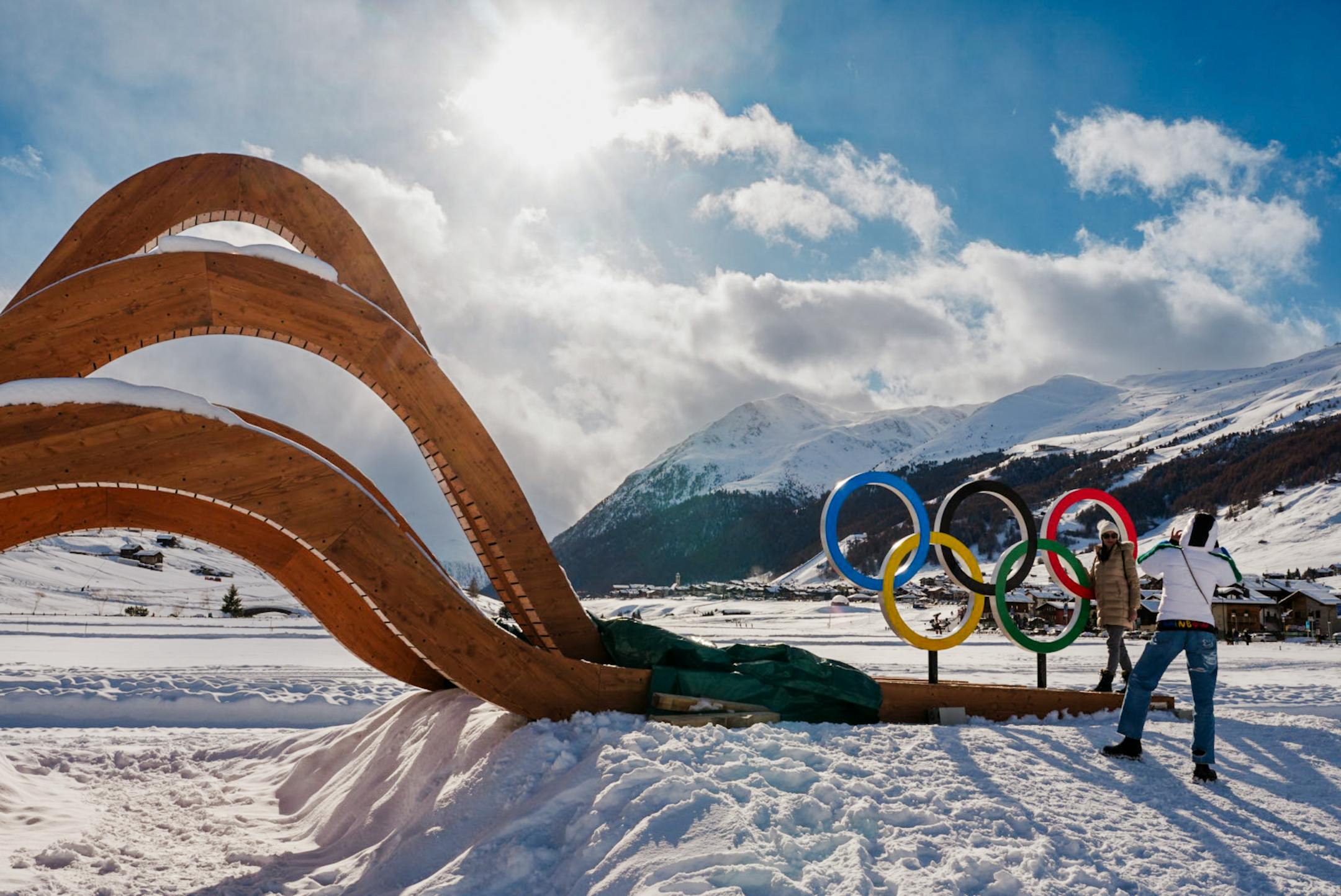
Visitors take a photo with the Olympic rings at the Livigno Snow Park, in Livigno, Italy, ahead of the 2026 Milan Cortina Games. (GABRIELA BHASKAR/The New York Times)

Opinion editor’s note: Strib Voices publishes a mix of commentary online and in print each day. To contribute, click here.

•••

Every four years for a few brief weeks the Winter Olympics offer a respite from a restive world. They’re an idealized international event that, however imperfect, improves, or at least alleviates, the global tensions of the time.

But this year the geopolitical juxtaposition is especially stark as athletes gather in Italy for the 2026 Milan Cortina Games. In part because of what happened a month ago in another snowy European enclave, Davos, Switzerland. There, at the annual World Economic Forum, President Donald Trump ratcheted his rhetoric on Greenland, Denmark and NATO nations — the whole Western alliance and, by extension, the rules-based international order that the U.S. mostly designed and benefited from. While Trump eventually de-escalated, the threats led Canadian Prime Minister Mark Carney to give a seminal speech including a now-famous phrase: “We are in the midst of a rupture, not a transition.”

That’s the context that awaits 232 American Olympians — including 37 with Minnesota ties — as they march in the opening ceremony on Friday, Feb. 6, culminating in the gold-medal men’s hockey game (featuring NHL players for the first time in 12 years) on Sunday, Feb. 22.

The International Olympic Committee “has relied on, in good times, for the Winter Games to be a joyous celebration without the same kind of politics and turmoil” of the Summer Games, said Douglas Hartmann, a University of Minnesota sociology professor whose scholarship on sports includes a close focus on the Olympics. But now, Hartmann said, a key question about the Olympic movement is if there is “opposition to a country that has been seen both as the leader in sport and as the leader in some kind of democratic, cosmopolitan commitment. That’s where it feels so transformative, like it’s a reset; it’s a radical change, a disruption of the status quo.”

This “rupture, not a transition,” perception isn’t only international but domestic, especially with the Immigration and Customs Enforcement’s Operation Metro Surge in the Twin Cities. In searing images seen worldwide, Minnesota is on global newscasts and covers of newspapers and magazines, including this week’s Economist, which features a photo of a traumatized woman being manhandled by four federal agents. Accompanying the visceral visual is this headline: “The ICE test: America’s paramilitary peril.” Accordingly, Hartmann thinks it’s likely that Minnesota Olympians will be asked by international journalists as much about ICE as they are about the ice or snow they compete on.

It’s unclear how much Minnesota athletes may comment. It’s uncommon, after all, for Olympians to offer perspectives on divisive issues, especially given strict IOC and U.S. Olympic & Paralympic Committee rules on making political statements. And understandably, most are focused on “Citius, Altius, Fortius” (“Faster, Higher, Stronger”), the Olympic motto and ideal.

But in 2021, in response to COVID as well as the wake of the murder of George Floyd in Minneapolis, the motto was amended to be “Faster, Higher, Stronger — Together.” Thomas Bach, then the president of the IOC, said at the time, “Solidarity fuels our mission to make the world a better place through sport. We can only go faster, we can only aim higher, we can only become stronger by standing together — in solidarity.”

So some reporters may want to ask Minnesota Olympians to talk not just about speed, altitude and strength but to what degree they feel solidarity with what’s happening back home.

If so, Hartmann believes that it could put them in “such a complicated position, navigating between our people, our principles, our ideals and also representing a government that seems completely willing to jettison both its principles and its people.”

If they do want to keep the conversation on sport, there’s plenty for the Olympians, let alone Olympic fans back home, to talk about.

Including the story about Burnsville native Lindsey Vonn, the three-time medal winner whose extraordinary comeback at 41 may not be just a story but the story of these Games. But the story took a twist when her knee unfortunately did the same in a World Cup race last week. Vonn is “confident,” she said on Feb. 3, that despite a torn ACL, she can compete. “I’m gonna do it; end of story,” said the daring downhiller.

The slopes will also be where snowboarder Iris Pflum of Minneapolis will compete. And on less steep terrain, cross-country skiing will showcase another Minnesota Olympic legend, Jessie Diggins, who will go for gold again in what she has announced will be her last Winter Games. (The Afton native also has silver and bronze medals along with three overall World Cup titles.)

Bloomington’s Zak Ketterson will also compete in cross-country, and Golden Valley’s Luci Anderson, Apple Valley’s Margie Freed and Paul Schommer, who attended the College of St. Scholastica in Duluth, will compete in biathlon.

From snow to ice, speedskating will feature three with Minnesota ties: White Bear Lakes’ Giorgia Birkeland, Lino Lakes’ Greta Myers and Conor McDermott-Mostowy, who studied neuroscience at Macalester College.

And fan-friendly (if not fan-frenzied here at home) curling, which begins on Wednesday, Feb. 4, has 11 competitors with state ties trying to medal.

The mettle of seven men’s hockey players with links to Minnesota (through their hometowns, college teams and the Minnesota Wild, or all three for Brock Faber) will skate for Team USA while the women’s team will have eight who played here in high school, college, and the pros with the Minnesota Frost (or in the case of Taylor Heise, Kelly Pannek, Lee Stecklein and Grace Zumwinkle, all three). Several men’s and women’s international rosters are stocked with players who play for the Wild or Frost or college teams as well, which will make the hockey competition compelling on many levels. Including, potentially, a geopolitical one in potential matches between the U.S. and Canadian teams, as seen at last year’s fierce 4-Nations Face-Off tournament.

With world turmoil upending geopolitics, the streets of Minneapolis and points beyond and between, the Olympics may seem irrelevant or indulgent. They’re neither. Indeed, they’re an example of how the world can come together. “Part of the power of the Games is it’s a genuinely international cultural exchange, and there’s nothing like it,” said Hartmann.

Especially with so many Minnesotans reflecting the same grit many of their fellow citizens are showing at home.

about the writer

about the writer

John Rash

Editorial Columnist

John Rash is a columnist.

See Moreicon

More from Columnists

See More
card image
GABRIELA BHASKAR/The New York Times

Thirty-seven athletes with Minnesota ties will compete at the Milano Cortina 2026 Games.

Meredith Two Crow pauses and listens to the Ojibwe drum circle during the Jan. 20 pregame ceremony.
card image