
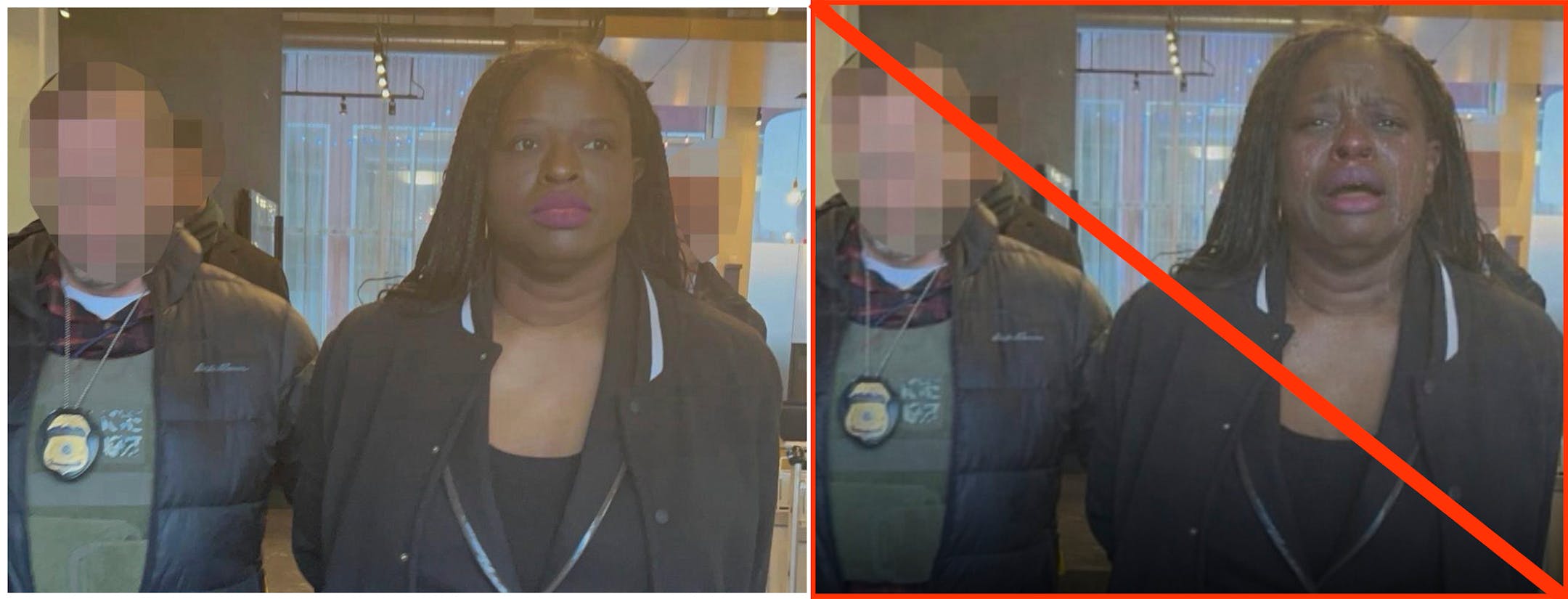
White House posted altered photo depicting activist Nekima Levy Armstrong crying during arrest

The longtime activist’s attorney said Levy Armstrong was “calm and composed.” A White House spokesperson posted on social media that “The memes will continue.”

The Minnesota Star Tribune
January 23, 2026 at 10:16PM
At left, the image posted on social media by the Department of Homeland Security. On the right, the altered image posted by the White House on X. The Star Tribune added the red box and line to indicate which photo had been altered by the White House. (Photos via @Sec_Noem and @WhiteHouse on X)

The White House posted a digitally altered photo of Minneapolis civil rights activist Nekima Levy Armstrong that depicts her crying as she’s arrested by federal agents in connection with the demonstration at a church service on Jan. 18.

In a previous version of the image posted by Department of Homeland Security Secretary Kristi Noem, Levy Armstrong is composed, with a calm face as she’s led away by a law enforcement officer.

Asked about the altered photo, the White House directed the Minnesota Star Tribune to a post on X from Kaelan Dorr, deputy communications director. “Enforcement of the law will continue. The memes will continue. Thank you for your attention to this matter,” the post says.

The New York Times independently analyzed the photo through an AI detection system, which concluded that the first photo posted by Noem is real and the version posted by the White House appears to have been manipulated.

The Justice Department on Jan. 22 announced the arrests of Levy Armstrong and fellow demonstrators Chauntyll Allen, a St. Paul school board member, and William Kelly, accusing the trio of interrupting a Sunday service at Cities Church in St. Paul after they determined one of the pastors led the local U.S. Immigration and Customs Enforcement field office.

Jordan Kushner, Levy Armstrong’s attorney, on the day of his client’s arrest called the White House’s manipulated image “outrageous defamation.”

“I was present at her arrest. She was completely calm and composed and rational,” Kushner said. “It just shows the racism and fascism in this administration, that they’re willing to literally invent reality.”

Federal magistrate judges ordered the release of Levy Armstrong, Allen and Kelly from custody tied to the Justice Department’s allegations that the trio violated the federal FACE Act, which protects places of worship, among other spaces.

Who is Nekima Levy Armstrong?

Levy Armstrong has long been at the forefront of discussions on race, poverty and social justice issues in Minnesota.

The civil rights attorney has led several groups supporting racial equality, including a stint as president of the local NAACP and adviser to Black Lives Matter.

After the killing of George Floyd, her organization was recognized by Oprah Winfrey.

During interviews with the Star Tribune on the fifth anniversary of Floyd’s death, Levy Armstrong recalled telling former Minneapolis Police Chief Medaria Arradondo at the time that the community’s account of what happened to Floyd stood in stark contrast to officers’ accounts.

“It was probably the middle of the night by this point. We organized it over the phone, put up a Facebook post, I got a couple hours of sleep, and I went to City Hall,” she recalled.

Levy Armstrong in 2015 told the Star Tribune that she dreamed of becoming a lawyer to “change things” after growing up surrounded by poverty in south central Los Angeles.

After moving to Minnesota in 2003, she worked at the University of St. Thomas School of Law. There, she served as the founding director of the Community Justice Project, a civil rights legal clinic.

About the FACE Act

According to the Justice Department, the Freedom of Access to Clinic Entrances Act, or FACE Act, “prohibits the use or threat of force and physical obstruction that injures, intimidates, or interferes with a person seeking to obtain or provide reproductive health services or to exercise the First Amendment right of religious freedom at a place of religious worship.”

The law was passed in 1994 when abortion clinic protests and blockades were increasing.

Penalties for violators range from fines to imprisonment.

about the writer

about the writer

Sarah Nelson

Reporter

Sarah Nelson is a reporter for the Minnesota Star Tribune.

See Moreicon

More from News & Politics

See More
card image
Renée Jones Schneider/The Minnesota Star Tribune

The women say they guided agents through the emergency, later raising concerns about medical protocols, weapons safety and accountability.

card image
card image