
What the U.S. Supreme Court decision on racial profiling in immigration means for Minnesota

Immigration lawyers call the LA decision “disturbing,” say it opens door to racial profiling in Minnesota.

The Minnesota Star Tribune
September 11, 2025 at 11:00AM
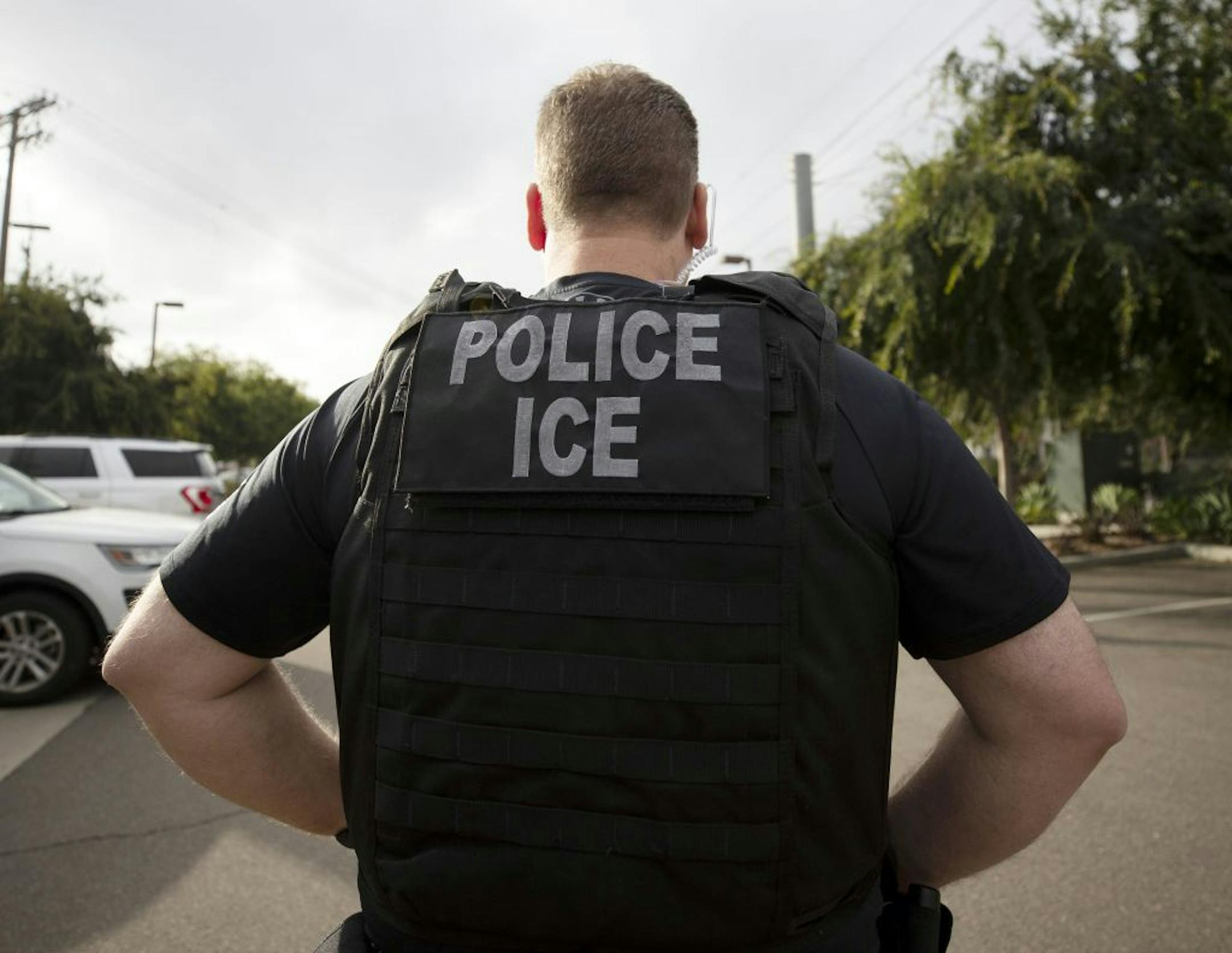
FILE - In this July 8, 2019, file photo, a U.S. Immigration and Customs Enforcement (ICE) officer looks on during an operation in Escondido, Calif. International students will be forced to leave the U.S. or transfer to another college if their schools offer classes entirely online this fall, under new guidelines issued Monday by federal immigration authorities. The guidelines, issued by U.S. Immigration and Customs Enforcement, provide additional pressure for campuses to reopen even amid growing
The U.S. Supreme Court said on Monday that immigration agents in Los Angeles could continue to use what opponents call racial and ethnic profiling to decide who to question about their citizenship. (The Associated Press)

The U.S. Supreme Court ruled Monday that immigration agents in Los Angeles could continue to use what opponents call racial and ethnic profiling to decide who to question about their citizenship.

It’s a temporary decision in a California legal challenge working its way through the lower courts. But local immigration attorneys fear it will embolden Immigration and Customs Enforcement agents to detain people based on their skin color, the language they speak or the type of job they work — factors at issue in the legal dispute.

ICE detentions have doubled in Minnesota since President Donald Trump took office, and deportations are happening roughly twice as fast as they did under former President Joe Biden.

The case originated during the federal immigration raids the Trump administration conducted in Los Angeles in June that led to protests and Trump deploying the National Guard. Both citizens and unauthorized immigrants were detained, in some cases because they were Latino or spoke with an accent, leading to legal complaints that ICE agents were disregarding constitutional protections.

The six conservative justices on the high court said Monday that those tactics could continue while the case proceeds; the three liberal justices dissented. The Trump administration praised the ruling.

“This is a win for the safety of Californians and the rule of law,” said U.S. Department of Homeland Security Assistant Secretary Tricia McLaughlin, adding that “law enforcement will not be slowed down.”

Local immigration attorneys and civil liberties advocates say the ruling undermines longstanding constitutional protections under the Fourth Amendment safeguarding people against unreasonable search and seizure.

Can Minnesotans be stopped based on what they look like?

Teresa Nelson, legal director of the ACLU of Minnesota, said she doesn’t think the decision gives ICE agents across the country a green light to racially or ethnically profile because it is technically confined to ICE’s tactics in Los Angeles.

Yet, she called it a “disturbing development” that the Supreme Court would allow those tactics in Southern California.

“I’m not throwing my arms up and saying everyone in Minnesota is in immediate danger,” Nelson said. “It does embolden folks, and we are hearing stories about similar things happening in Minnesota. I don’t want to dismiss the alarm and fear. But I don’t want to heighten it.”

Has this happened here yet?

Immigration attorneys and advocates say the decision sends a message that these types of tactics could be coming here.

“Communities of color have always been aware we live in a world of certain biases,” said Julia Decker, policy director of the Immigrant Law Center of Minnesota. “This has now been put out in the world in a much different way — in black and white from the Supreme Court.”

Immigration attorneys said there have been anecdotal stories of ICE using questionable tactics to detain people in Minnesota suspected of being in the country illegally. But there doesn’t appear to be a legal challenge yet from a Minnesotan claiming to have been detained because of race, ethnicity or related factors.

What about ‘sanctuary’ communities?

Immigration is governed by federal, not state laws.

But Trump has targeted places with so-called “sanctuary” policies that discourage local law enforcement from helping enforce federal immigration laws. There is no legal definition of a sanctuary jurisdiction.

ICE’s immigration crackdowns have already spread from Los Angeles to Boston and Chicago and may soon be headed to other communities.

What does the law say?

Fifty years ago, the Supreme Court ruled that border patrol agents could not detain people strictly based on the belief they were of Mexican descent. Agents needed more “reasonable suspicion” that someone had violated U.S. immigration laws.

Justice Brett Kavanaugh’s concurring opinion in the California case appears to go beyond that precedent. He argues that while ethnicity alone isn’t a reason to detain someone, it could be relevant when combined with things like language spoken, someone’s accent or if the person is a day laborer.

Kavanaugh’s opinion was criticized for relying, in part, on a disputed claim from the Trump administration that 10% of the Los Angeles population is in the U.S. illegally.

In her dissent, Justice Sonia Sotomayor said Kavanaugh and the administration were basically saying being Latino and having a low-wage job means someone could be detained at any time and forced to prove citizenship.

“This is something that every one of us should care about,” said Luke Grundman, litigation director for Mid-Minnesota Legal Aid. “It is not just about immigration enforcement. It is about basic freedoms being eroded.”

What comes next?

The California decision came from the so-called shadow docket where justices make time-sensitive decisions about lower court cases that are likely to end up before the U.S. Supreme Court. It hasn’t changed any laws or legal precedent.

But some Minnesota lawyers said they were troubled that the Supreme Court would allow a constitutionally questionable practice to continue before it has come before the full court for all the facts to be vetted.

They fear that people across the nation, including in Minnesota, could be permanently harmed by the temporary decision and have little recourse.

“Once a person is picked up and found not to have proper documentation, they could be detained, and they won’t just be let out because an officer didn’t show a constitutional basis for the stop,” Grundman said.

about the writer

about the writer

Christopher Magan

Reporter

Christopher Magan covers Hennepin County.

See Moreicon

More from Politics

See More
card image
Mark Schiefelbein/The Associated Press

A Navy admiral commanding the U.S. military strikes on an alleged drug boat in the Caribbean told lawmakers Thursday that there was no ''kill them all'' order from Defense Secretary Pete Hegseth, but a stark video of the attack left grave questions as Congress scrutinizes the campaign that killed two survivors.

card image