
Advertisement

Minnesotans hoping Supreme Court ruling brings swift relief for companies, farmers

Court sends 6-3 blow to economic regime, which had upended global commerce and hurt Minnesota farmers and businesses.

The Minnesota Star Tribune
February 20, 2026 at 4:03PM
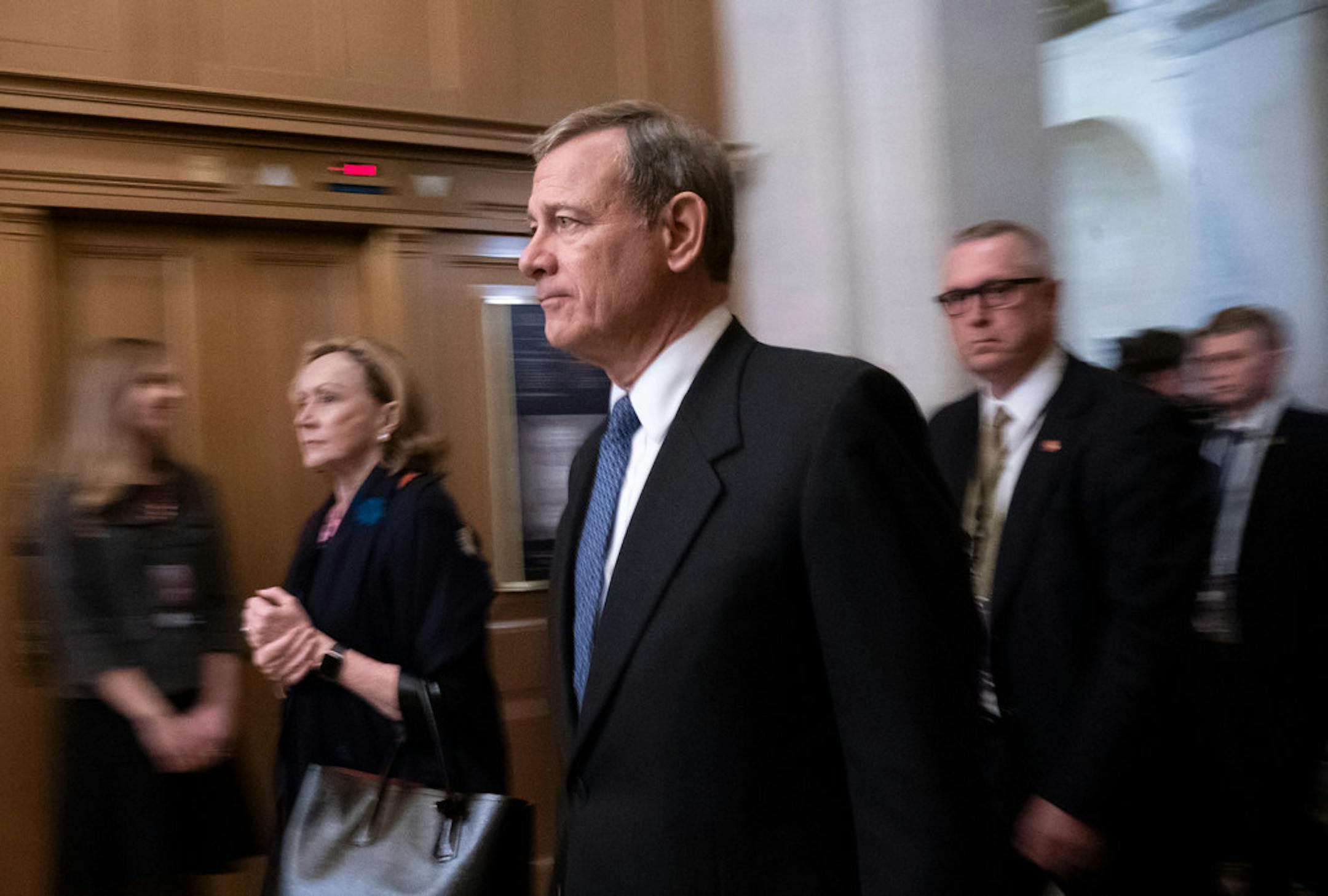
Chief Justice John Roberts left the Senate on Saturday after opening arguments by President Donald Trump's defense team. His team made only a two-hour presentation, reserving the heart of its case for Monday.
Chief Justice John Roberts wrote the opinion that struck down President Donald Trump's justification for his wide-ranging tariffs. (Vince Tuss — Associated Press/The Minnesota Star Tribune)
Advertisement

WASHINGTON, D.C. — The U.S. Supreme Court struck down President Donald Trump’s global tariffs, which have caused mass disruption for Minnesota businesses, farmers and consumers.

The state’s top Democrats were quick to praise the 6-3 ruling, written by Chief Justice John Roberts, which reprimanded the president for overstepping his executive power.

“Today, the Supreme Court finally affirmed what I have been saying for a year: President Trump’s reckless tariffs — which are costing families, farmers, and small businesses — are illegal,” said Amy Klobuchar, the Democratic senator from Minnesota and a candidate for governor.

The ruling is a setback for Trump’s signature economy levers in his first year back in the White House, but could signal relief amongst American businesses — including Minnesota farmers and manufacturers — who’d been bearing the brunt of what ultimately culminated into a trade war through retaliatory dues.

Trump asserted the International Emergency Economic Powers Act (IEEPA) gave him authority to institute the tariffs.

But Chief Justice John Roberts in the ruling said the justification does not hold up.

“The President asserts the independent power to impose tariffs on imports from any court, of any product, at any rate, for any amount of time,” Roberts wrote in the opinion. “Those words cannot bear such weight.”

Rep. Angie Craig, a Democrat who represents both suburban and rural areas across southern Minnesota and is the ranking member on the House Agriculture committee, said Trump’s tariffs were “illegal” and the decision would bring relief for farmers, small businesses and consumers.

Advertisement

“Turns out there are limits on his power,” Craig said, in a post to the social media network X.

Klobuchar, who attended the oral argument in the case, said in a statement: “With today’s decision, it is clear that Congress — not the president — has the power to impose tariffs. We must reassert this authority and stand up for American workers, businesses, and consumers.”

Rep. Kelly Morrison, a Democrat who sits on the small business committee in Washington, called the decision a “big win” for the American people.

Tariffs have cost Minnesota companies millions, in some cases hundreds of millions of dollars, and have contributed to the need for restructuring operations and supply chains and higher prices for customers.

Beth Benike became one the faces on the price of tariffs for small businesses across the nation. She said her reaction on the Supreme Court’s ruling was “instant tears of happiness.”

Owner of infant mat maker Busy Baby, a small business in Oronoco, Minn., stood outside the Supreme Court in early November for the tariff case’s oral arguments. She estimated she’s paid about $50,000 on tariffs that the court has now struck down.

Advertisement

“I feel like it’s a thousand-pound weight come off my chest,” Benike said.

Tariffs have cost the Medina-based powersports company Polaris $200 million. The duties have figured into the company’s cost-cutting and restructuring, and CEO Mike Speetzen said it has absorbed all but $40 million.

Speetzen said the tariffs represented “the most significant challenge we have seen since the pandemic.”

While tariffs weren’t the only reason for cost-cutting, the restructuring has come at a cost. The company’s full-time employment is at 14,500 now, down from 18,500 at the end of 2024, according to a federal regulatory filing.

Speetzen said in the company’s earnings call earlier this month if the Supreme Court ruled against Trump, “obviously, the team’s got a plan of action, because there’s a lot of complexity.”

The New York Federal Reserve earlier this month said 90% of the tariff burden fell on U.S. companies and consumers, not entities in the exporting country. The average tariff rate increased from 2.6% to 13%.

Advertisement

“The vast majority of economists agree that tariffs reduce economic welfare. Therefore, the impact of terminating these tariffs would not be ‘catastrophic’ and ‘ruinous,’ as the government alleges, but instead would improve our country’s economic well-being and prosperity,” the U.S. Chamber of Commerce said in an amicus brief.

For nearly a year, since so-called “Liberation Day” last April, when Trump imposed sweeping tariffs on trading partners around the globe, Benike has been paying an additional 20% on the tariffs the president tried to authorize under the International Emergency Economic Powers Act.

Trump said the tariffs were needed because of a widening trade deficit and the need to build manufacturing in the U.S.

In January, Treasury Secretary Scott Bessent visited Minnesota and hypothesized that if the nation’s high court struck down the president’s strategy of invoking the IEEPA to justify tariffs that the president would be hamstrung to deal with fentanyl overdoses.

“What is in doubt, and it’s a real shame for the American people, was the president loses flexibility to use tariffs both for national security, for negotiating leverage,” Bessent said, in conversation with journalist Michelle Caruso-Cabrera.

Dave Townsend, a partner in Dorsey & Whitney’s International Trade Group, noted in a statement that the U.S. has collected between $130 billion and $150 billion in tariffs that have now been declared illegal.

Advertisement

“It is hard to overstate the vast scale of these IEEPA tariffs as they touch virtually every industry in one way or another,” Townsend said.

Last April, chief executives from top retailers, including Minneapolis-based Target, met with Trump to discuss the tariffs’ impacts. Then-CEO Brian Cornell conceded last spring that tariffs led to higher prices, as roughly 30% of the retail giant’s private-label items are sourced from China. Richfield-based Best Buy similarly imports about 30% of its products from China.

Farmers, particularly for Minnesota’s $9 billion soybean economy, are particularly dependent on trade with China. Roughly 1 out of ever 3 or 4 rows of soybeans —– until this past year — had ended up being sent on trains to the west coast and then shipped overseas to China.

On Friday, Benike said her husband – who is a corn and soybean farmer in southeastern Minnesota – had just attended an oats workshop and was contracting for peas and possible sweet corn to begin to find new crops for his fields.

“We’ve been taking it at both ends,” Benike said.

Benike said she is sober about the challenges ahead.

The tariff policies resulted in layoffs at her company. Now, she needs to “dig” herself out of debt accumulated when she had to abandon container ships of products in China — which she manufactures entirely in the Asian country due to logistical constraints in the U.S.

“There’s still a battle here,” Benike said. “But it’s renewed my faith in the checks and balances of our government.”

Minnesota Star Tribune reporters Emma Nelson, Patrick Kennedy, Joe Carlson and Catherine Roberts contributed to this report.

about the writer

about the writer

Christopher Vondracek

Washington Correspondent

Christopher Vondracek covers Washington D.C. for the Minnesota Star Tribune.

See Moreicon

More from Business

See More
Chief Justice John Roberts left the Senate on Saturday after opening arguments by President Donald Trump's defense team. His team made only a two-hour presentation, reserving the heart of its case for Monday.
Vince Tuss — Associated Press/The Minnesota Star Tribune

Court sends 6-3 blow to economic regime, which had upended global commerce and hurt Minnesota farmers and businesses.

card image
card image
Advertisement