
‘James Madison’s nightmare’: How Trump is leaning on arcane laws to advance immigration agenda

Before threatening the Insurrection Act, Trump officials privately strategized about using the Alien Enemies Act to detain people in Chicago, according to Signal messages reviewed by the Star Tribune.

The Minnesota Star Tribune
January 17, 2026 at 12:00PM
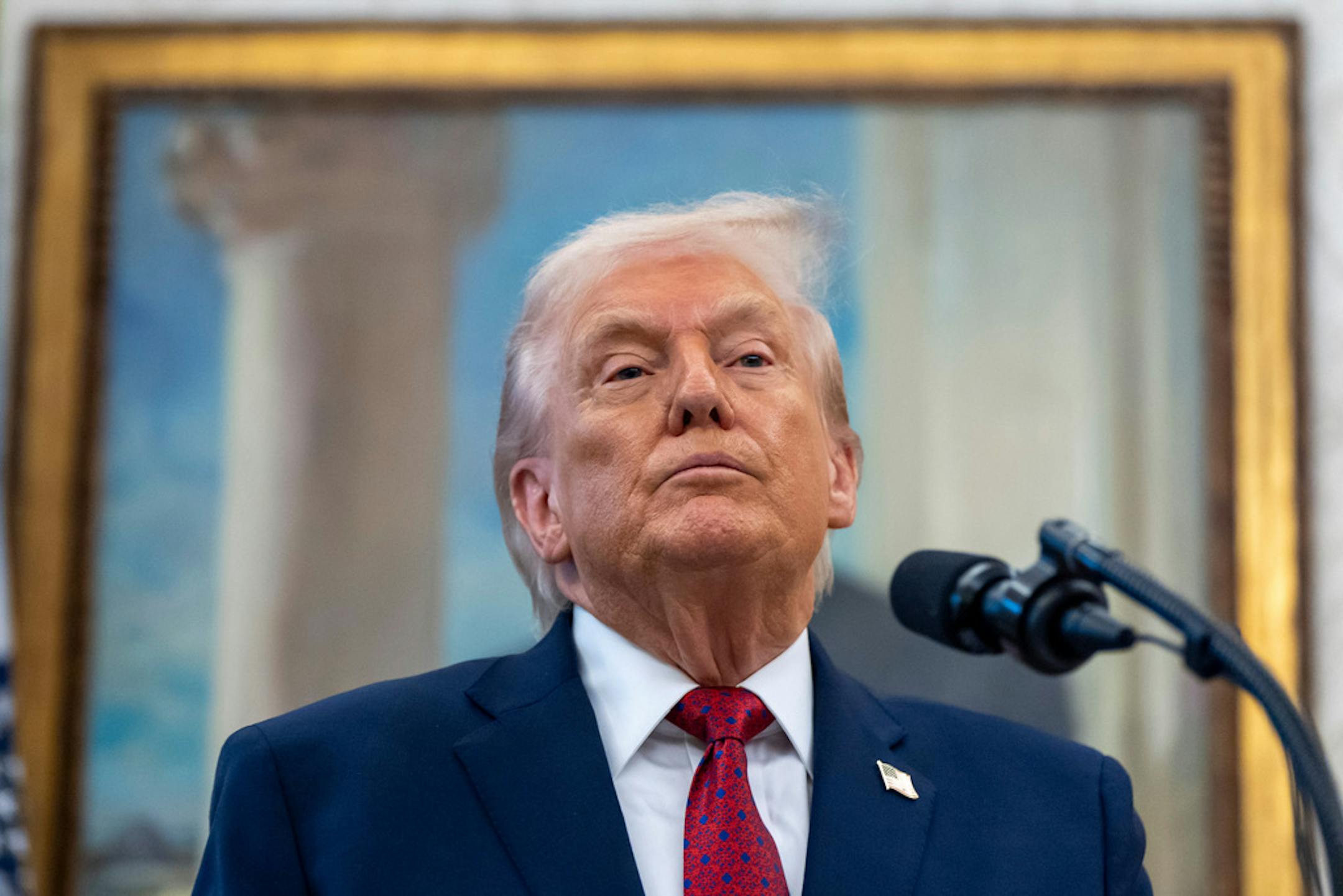
President Donald Trump threatened on social media to invoke the Insurrection Act, but seemed to soften his language about it the next day. (Alex Brandon/The Associated Press)

To silence unrest in Minnesota, Donald Trump is threatening to reach all the way back to the early 19th century.

On social media this week, Trump proposed invoking the Insurrection Act of 1807 to deploy military troops into the Twin Cities to protect federal immigration agents from protesters.

If the President were to make good on his threat, it would mark a stunning flex of federal power with little precedent in modern history, legal experts say. The law hasn’t been used in 34 years, since George H.W. Bush sent troops to help state and local police quell riots in Los Angeles. The last time it was used against the wishes of a state’s governor, as it would be today, was in 1965, when Lyndon B. Johnson federalized the National Guard to protect civil rights marchers traveling from Selma to Montgomery, Ala.

Invoking the Insurrection Act in Minnesota now would be an extraordinary escalation of tensions, said Joseph Nunn, a lawyer who specializes in domestic military matters for the non-partisan Brennan Center for Justice. In this case, Nunn said, the president would be sending troops to suppress a conflict triggered by federal agents’ presence and tactics.

“We are living in James Madison’s nightmare,” he said. “All of the founders would have been horrified to see the national government resorting to this level of force — not as a last resort, but as basically a first resort.”

Trump’s threat against Minnesota this week is the latest example of how his administration has considered using arcane laws and legal arguments to enact his agenda.

In addition to the Insurrection Act, Trump officials have talked publicly about suspending due process, a foundational constitutional principle. Trump invoked the Alien Enemies Act last year to speed up deportations of alleged Venezuelan gang members. White House officials considered using it a second time to justify detaining people in Chicago, according to previously unreported Signal messages obtained by the Star Tribune.

The 1798 wartime law, designed to combat an invasion or predatory incursion, has only been used three times prior to this administration. The last time was during World War II.

Opponents have aggressively fought the administration in court over these maneuvers. This week, both Minnesota and Illinois filed lawsuits challenging the legality of Trump’s immigration enforcement. The Illinois Attorney General’s Office alleged federal agents acted as “occupiers” instead of law enforcement during operations in the state last fall.

In separate cases, federal judges issued temporary restraining orders in both Portland and Illinois, stopping the administration from sending National Guard troops into those cities. A judge ordered troops out of California in December, saying it violated the law. And another judge has limited the use of the Alien Enemies Act to deport people.

In an interview with the New York Times, Trump suggested the Insurrection Act could provide a work-around to legal rulings.

“Look, I’ve been stopped on some things,” he told the newspaper last week. “Now, I will say, if I feel it’s important to invoke the Insurrection Act, which I have the right to do, that’s a different thing, because then I have the right to do pretty much what I want to do. But I haven’t done that.”

A spokesperson for the White House did not comment beyond directing reporters to earlier statements made by Trump and a White House official.

From Whiskey Rebellion to Minneapolis

On Friday, one day after threatening to invoke it, Trump appeared to walk back his threat to send troops to Minnesota.

“I don’t think there’s any reason right now to use it,” he told reporters. “But if I needed it, I’d use it.”

If Trump does use the Insurrection Act, he will break the longest streak in American history it has not been invoked.

The Act has been used 30 times throughout history, beginning with George Washington, who relied on an early version of the law during a revolt over liquor tax known as the Whiskey Rebellion. President Abraham Lincoln invoked the act during the Civil War. Grover Cleveland also wielded the law three times to put down riots and strikes during the late 1800s.

Since the Civil Rights Era, presidents have only invoked it three times: once by Ronald Reagan and twice by George H.W. Bush.

In a briefing this week, White House Press Secretary Karoline Leavitt said only Trump knows what the tipping point could be for him. She pointed the finger at Democrats, who Leavitt said were “using their platforms to encourage violence against federal law enforcement officers.”

Stephen Vladeck, a law professor at Georgetown University Law Center, said he does not believe that what is unfolding in Minnesota appears to meet the high bar compared to past uses of the law. The Twin Cities has seen clusters of intensified protests since Jan. 7, when Renee Good, a 37-year-old woman, was killed by an ICE agent during a confrontation on a Minneapolis street. Some have led to violent clashes with federal officers, but the city has not seen widespread rioting or unrest.

“The fact that a small handful of protesters have resorted to violence is not an invitation to treat the entire protest as an unlawful insurrection,” Vladeck said.

Nunn said the nation’s framers were suspicious of a standing army and took precautions to keep the federal government from easily deploying troops into states. The Insurrection Act provides a temporary loophole to deploy troops domestically in extreme situations.

In addition to Democrats, Minnesota’s Libertarian Party leaders have also condemned the presence of federal agents.

“Minnesota needs to solve Minnesota’s problems,” said Chair Rebecca Whiting in a statement. “Having the federal government send thousands of agents into our state is not the answer. In fact, 250 years ago we had a revolution over this sort of thing.”

Alien Enemies Act

One conversation between high-level Trump officials, which has not been previously reported, shows how the administration strategized about using Alien Enemies Act to justify detaining immigrants in Chicago.

Last fall, Anthony Salisbury, a top White House aide, told his superior over the messaging app Signal about a Border Patrol plan to send federal agents into an apartment building. According to Salisbury, federal agents believed the building was home to 100-plus members of Venezuelan gang Tren de Aragua.

“Use AEA [Alien Enemies Act] to drag them out of their homes,” his superior replied on Signal, according to private messages reviewed by the Star Tribune. “Then fly them to Texas.”

The sender of this message is anonymous on the Signal chats, but at the time Salisbury reported directly to Senior White House Policy Adviser Stephen Miller, and other messages refer to the person as “Stephen” and “SM.”

Salisbury then sent a message to a contact in U.S. Customs and Border Enforcement asking if they planned on “exercising AEA to drag them out of their homes and put them in Texas,” the messages show. They also discuss a conversation taking place between “SM” and Customs and Border Patrol Cmdr. Greg Bovino, who has been leading immigration operations in Minnesota, Chicago and other parts of the country.

A few days later, in a midnight raid, federal agents laid siege on a five-story apartment complex in South Shore with a Black Hawk helicopter and detained 37 people.

Agents did drag people from their homes, according to news reports.

A lawsuit filed in Illinois condemned the military tactics, alleging agents arrested and detained dozens of people, including children and United States citizens, without warrants. House Democrats launched an investigation into the arrests, asking for evidence tying the tenants to gang activity.

Miller called the raid “one of the most successful law enforcement operations that we’ve seen in this country.”

A president ‘willing to adopt the most extreme measures’

Trump’s latest threat has left some worried about the limits of the president’s expansive view of federal power.

In calling for peace this week, Minnesota Gov. Tim Walz warned protesters not to give the Trump administration an excuse to “declare martial law.”

The Insurrection Act, however, is not martial law. It allows military service members to act as local police and enforce civilian law; martial law suspends civilian law entirely, leaving the military in charge, Vladeck said.

Trump has not threatened to use martial law in Minnesota.

U.S. Sen. Richard Blumenthal, D-Conn., who introduced a bill over the summer to limit a president’s use of the Insurrection Act, also noted that Trump talked about suspending habeas corpus last May. Habeas corpus is a foundational provision in the U.S. Constitution that prohibits authorities from detaining or jailing anyone in the U.S. without due process.

The last time a U.S. president suspended habeas corpus was in 1941 after Japan bombed Pearl Harbor.

“What we’ve seen from this president is threats of unchecked power to abuse the military for political purposes,” Blumenthal told the Star Tribune. “Some of the President’s comments … certainly indicate that he is willing to adopt the most extreme measures.”

Blumenthal’s bill would modify the Insurrection Act to clarify the law cannot be used to suspend habeas corpus, impose martial law or deputize private militias to act as soldiers.

“We need to make sure that it is invoked only in the most extreme circumstances, and never against peaceful, free expression and protest,” he said.

about the writers

about the writers

Andy Mannix

Investigations

Andy Mannix is an investigative reporter for the Minnesota Star Tribune.

See Moreicon

Kristoffer Tigue

Reporter

Kristoffer Tigue is a reporter for the Minnesota Star Tribune.

See Moreicon

More from News & Politics

See More
card image
Alex Brandon/The Associated Press

Before threatening the Insurrection Act, Trump officials privately strategized about using the Alien Enemies Act to detain people in Chicago, according to Signal messages reviewed by the Star Tribune.

card image