

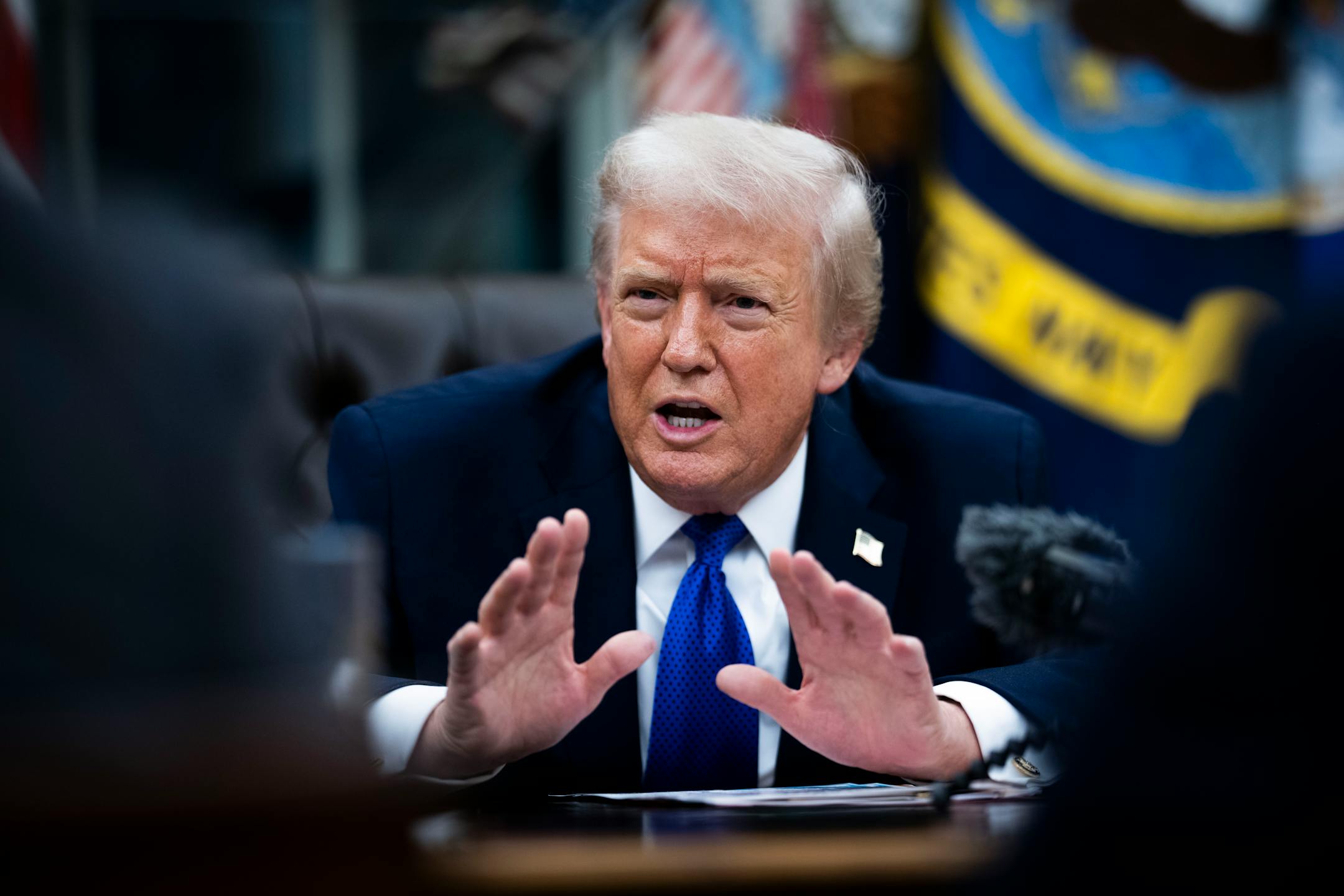
President Donald Trump is threatening to use the Insurrection Act in Minnesota to tamp down unrest and the pushback against ICE agents working in the state.
Trump gave the warning early Thursday, Jan. 15, in a post on Truth Social, his social media platform, after a federal agent shot a man in the leg Wednesday night in north Minneapolis and hundreds of protesters descended on the scene. The Department of Homeland Security said the officer fired defensive shots after being attacked with a snow shovel and broom.
Videos showed officers wearing masks and helmets firing tear gas and flash grenades in the direction of protesters as a standoff lasted for several hours. Some protesters vandalized vehicles at the end of the night.
Roughly 3,000 federal agents have been sent to Minneapolis in recent weeks as part of the Trump administration’s crackdown on illegal immigration. Tensions between federal agents and Minneapolis residents have been rising since an ICE agent shot and killed Renee Good on Jan. 7 at 34th Street and Portland Avenue S.
“If the corrupt politicians of Minnesota don’t obey the law and stop the professional agitators and insurrectionists from attacking the Patriots of I.C.E., who are only trying to do their job, I will institute the INSURRECTION ACT, which many Presidents have done before me, and quickly put an end to the travesty that is taking place in that once great State,” Trump said.
What is the Insurrection Act of 1807?
The Insurrection Act of 1807 allows the president to send military forces, including active-duty troops and federalized National Guard units, to cities to suppress civil disorder and to enforce federal laws. The act has been invoked in response to 30 crises, most recently in 1992 to respond to the Los Angeles riots following the police beating of Rodney King, according to according to New York University’s Brennan Center for Justice.
In 1957, President Dwight Eisenhower invoked the Insurrection Act to send federal troops to enforce the integration of schools in Little Rock, Ark. Trump threatened similar action amid the riots after the police killing of George Floyd in 2020.
The Supreme Court has ruled that the president alone can determine whether the act’s conditions have been met.


